One Mark Could Shape Alabama's 2026 Election
Nearly 7 in 10 Alabama voters may vote a straight-party ticket Tuesday, giving party loyalty enormous power down the ballot
TL;DR: Alabama leads the nation in straight-ticket voting, with 67.7% of voters using the option in 2024. The practice gives Republicans a huge Statewide edge but can work just as strongly for Democrats in Jefferson, Montgomery and parts of the Black Belt. With a close Governor's race and several key down-ballot contests Tuesday, one oval at the top of the ballot could decide far more than one race.
Alabama voters will choose a Governor, U.S. Senator, members of Congress, State lawmakers and scores of local officials Tuesday.
But if recent history is any guide, most voters will not select those candidates one at a time.
They will choose a party, and vote for their tribe.
Nearly 68% of Alabama voters cast a straight-party ballot in 2024, according to Alabama Secretary of State data. That means roughly two out of every three voters made one mark that automatically cast votes for their chosen party's candidates throughout the partisan ballot.
The rate was 66.6% in the 2022 midterm election. In 2020, 1.56 million of Alabama's 2.33 million ballots — about 67% — were straight Democratic or Republican tickets.
That trend has been building for years.
An AL.com analysis found Alabama's straight-ticket rate has risen from 52.3% in 2012 to about 65% in 2018 and 67.7% in 2024.
Alabama Democratic Party Chairman Bobby Singleton told AL.com he thinks it could reach 70% Tuesday.
If so, Alabama would further cement its unusual place in American politics.
Only six States — Alabama, Indiana, Kentucky, Michigan, Oklahoma and South Carolina — still offer straight-party voting, according to the National Conference of State Legislatures.
Fourteen States have abolished the practice since 1994, according to the MIT Election Data and Science Lab.
Alabama's system is simple.
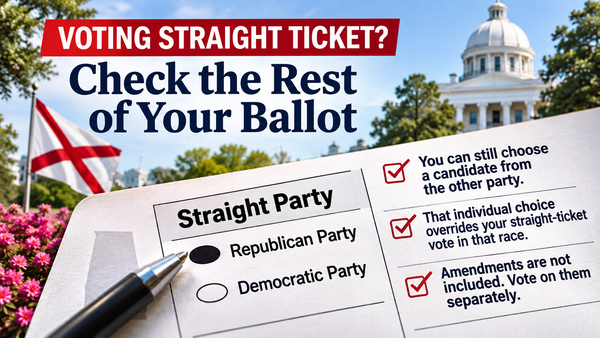
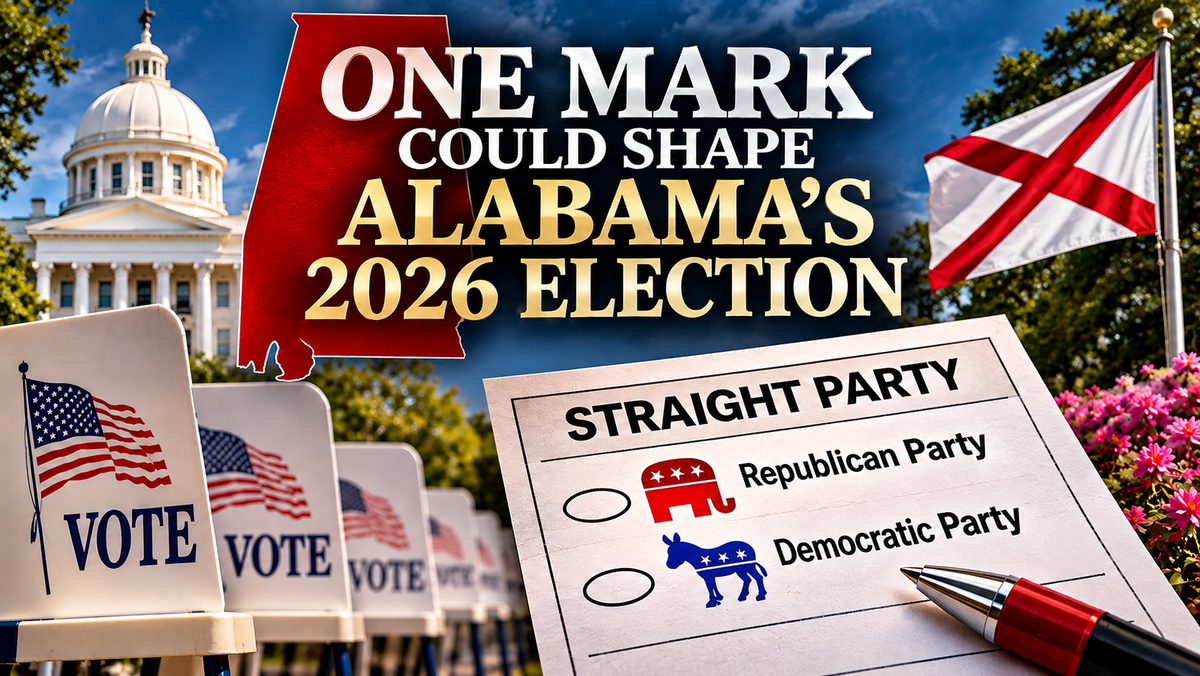
A voter can fill in the oval for the Alabama Republican Party or Alabama Democratic Party. That automatically casts a vote for that party's candidate in each partisan race on the ballot.
However — and this is not well known — voters can still cross party lines.
As an example: a voter can mark the Democratic straight-party oval and then vote for a Republican in the Sheriff's race. The individual vote overrides the straight-party choice in that race.
Straight-party voting also does not cast votes on constitutional amendments or other nonpartisan questions. Those must be marked on their own.
But for partisan races, the effect can be enormous.
A voter who goes to the polls mainly to vote for Tommy Tuberville or Doug Jones for Governor can, with one additional choice, cast votes for dozens of candidates he or she may know (or care) little or nothing about.
That’s why straight-ticket voting could become a major factor in Tuesday's election.
At the State level, straight-ticket voting has become a powerful Republican tool for maintaining Republican dominance
Official election data show 648,953 straight-Republican ballots were cast in 2022, compared with 298,434 straight-Democratic ballots. In other words, 45.6% of all ballots cast in Alabama were straight Republican before individual candidate selections were even considered.
The gap remained huge in 2024.
More than 1.5 million Alabama voters used the straight-ticket option. More than 1 million voted straight Republican and roughly 540,000 voted straight Democratic, according to Secretary of State data cited by the Alabama Reflector.
That makes straight-ticket voting a built-in advantage for Republican candidates in Statewide races.
It is particularly valuable farther down the ballot.
State Sen. Arthur Orr (R-Decatur) made that point himself last month.
“That's how the Republicans have been so strong since 2010, but really 2014,” Orr said during an appearance on WVNN's “The Dale Jackson Show.” “Straight ticket voting has helped all the down ballot races and helped those in lesser offices that the public may not be as familiar with the candidates, but they just vote straight ticket, and all those candidates below get the benefit of that.”
Orr said the effect can decide close races.
“What we see, if we don't have that straight ticket voting, the candidates below won't pick up that support and help, and many times that's put them over the top. If they can't rely on that, that it gets a little bit more interesting in the down-ballot races.”
That being said, the Statewide numbers tell only half the story.
In Democratic urban counties and much of the Black Belt, the same system that helps Republicans Statewide can become a powerful Democratic device.
Jefferson County is perhaps the best example of this.
In 2024, 299,855 ballots were cast in Jefferson County. Of those, 213,291 were straight-party ballots.
Democrats accounted for 119,012, or 55.8%, of the straight-party votes. Republicans accounted for 94,279, or 44.2%, according to official Jefferson County election results.
Overall, 71% of all Jefferson County ballots were straight-party votes.
Two years earlier, during the 2022 midterm, Jefferson County voters cast 75,334 straight-Democratic ballots and 53,463 straight-Republican ballots.
And in the high-turnout 2020 presidential election, the County cast 133,369 straight-Democratic ballots and 100,760 straight-Republican ballots, according to the Alabama Secretary of State's official report.
That makes Jefferson County an important exception to Alabama's Statewide Republican straight-ticket advantage.
It could matter Tuesday in races such as the contest between Democratic Sheriff Mark Pettway and Republican challenger Jacob “J.J.” Reach, as well as contested County Commission and legislative races.
The geographic split becomes even clearer when the State's largest Counties are looked at.
In the 2024 election, Baldwin County cast 69,308 straight-Republican ballots and only 14,334 straight-Democratic ballots. More than 82% of the County's straight-party votes went Republican.
Madison County recorded 69,239 straight-Republican votes and 49,835 straight-Democratic votes. Mobile County recorded 73,686 Republican and 52,771 Democratic straight-party votes.
Jefferson went the other direction, with 119,012 Democratic versus 94,279 Republican straight-party ballots.
The pattern was also clear in the State's official 2020 data:
|
County |
Straight Democrat |
Straight Republican |
|
Jefferson |
133,369 |
100,760 |
|
Madison |
51,367 |
66,488 |
|
Mobile |
58,365 |
72,616 |
|
Montgomery |
48,259 |
20,789 |
|
Shelby |
18,677 |
54,400 |
|
Baldwin |
13,483 |
57,259 |
|
Tuscaloosa |
26,784 |
35,274 |
The Secretary of State's 2020 County report shows just how sharply Alabama can divide itself.
Montgomery County's straight-ticket voters favored Democrats by more than two-to-one. Shelby County's favored Republicans by almost three-to-one.
In other words, straight-ticket voting does not inherently favor one party — it favors the party that already dominates a particular electorate.
Statewide, that is the Republican Party. In Jefferson and Montgomery counties, it is generally the Democratic Party.
To further complicate the issue, there is a related statistic that is easy to confuse with straight-ticket voting.
Federal voting-rights litigation has repeatedly documented extraordinarily high levels of racial polarization in Alabama elections.
In litigation over Alabama's congressional map, experts estimated that Black Alabama voters supported Democratic candidates at rates ranging from roughly 92% to 99%, depending on the expert and election studied.
A separate federal case examining Jefferson County elections found that Black voters gave Black candidates more than 90% support in every race studied. Support was never below 92% and exceeded 95% in all but three elections.
Older federal litigation produced similarly stark estimates. One analysis found average Black support of 94% for Black Democrats and 92% for white Democrats.
Election returns do not identify the race of an individual voter who uses the straight-party oval.
What the evidence does show is two overlapping trends: Alabama has extremely high straight-party voting, and Black voters have historically shown very high support for Democratic candidates.
Those two factors help explain the huge Democratic straight-ticket totals in Jefferson, Montgomery and Black Belt counties.
There have been repeated efforts to end the practice of straight ticket voting in Alabama, with the latest coming earlier this year.
Rep. Mary Moore (D-Birmingham) introduced HB575, which would have removed the straight-party option from Alabama ballots.
The bill was not symbolic in its wording. The legislation would have repealed several sections of Alabama law dealing with straight-party voting and prohibited ballots from including the mechanism beginning in 2027.
Moore was joined by Democratic Reps. Kelvin Datcher, Tashina Morris, Patrick Sellers, Laura Hall, Jeremy Gray, Curtis Travis, Marilyn Lands, Barbara Drummond, Pebblin Warren and Rolanda Hollis.
The bill never made it out of committee.
And opposition did not come only from Republicans.
Joe Reed, longtime Vice Chair for Minority affairs in the Alabama Democratic Party, strongly opposed the bill.
“This letter comes to inform you that there are some political shenanigans going on that threaten the future of the Democratic Party in general and Black voters in particular,” Reed wrote, according to the Alabama Reflector. “To eliminate straight voting will be the death nail of what is left of the Democratic Party.”
Doug Jones has taken the opposite position.
Jones called Alabama's straight-ticket system “rigged” during his campaign for Governor and pledged to seek its elimination.
Democratic Secretary of State candidate Wayne Rogers also supports ending it, arguing that the system “perpetuates the party that's in power.”
Republican leaders openly urge voters to use it. The Alabama Republican Party has promoted “Vote Straight Republican,” and Orr has described straight-ticket voting as an important reason Republicans have been able to carry down-ballot offices.
That is not hard to understand, because the system currently benefits the GOP Statewide.
There is a significant amount of historical irony in that, for those of us who are old enough to remember when Alabama was a one-party Democrat State.
Straight-ticket voting dates to an Alabama political system once dominated by Democrats. As political control shifted, the same tool increasingly began helping Republicans.
Former Secretary of State John Merrill noted after the 2018 election that nearly two-thirds of Alabama voters had voted straight party — then a record.
“This is a very high, high number,” Merrill said. “It tells me that people are becoming more polarized.”
Tuesday’s election may provide one of the best test yet of what straight-ticket voting actually does.
The Governor's race between Tuberville and Jones has become competitive — something that hasn’t happened in years. The 2nd Congressional District race between Democrat Shomari Figures and Republican Rhett Marques is also being closely watched.
Then there are legislative, courthouse and County races where candidates have far less name recognition.
That makes the number of voters who mark the party oval particularly important.
A strong Tuberville turnout accompanied by heavy straight-Republican voting could give GOP candidates well down the ballot a large boost.
A stronger-than-normal Democratic turnout for Jones could do the same for Democrats — particularly if those Jones voters mark the straight-Democratic oval rather than voting only for him.
That possibility is one reason Singleton believes straight-ticket use could approach 70%.
It also explains why the parties care so much about a tiny oval near the top of an Alabama ballot.
Candidates spend months raising money, knocking on doors, running television ads and telling voters why they deserve an individual vote.
But for perhaps seven out of every ten Alabamians who walk into a polling place Tuesday, the most powerful decision may come before they reach any of those candidates.
Republican.
Or Democrat.
One mark — and much of the ballot is already decided.