
FORTRESS: Anniston, Redstone in Pentagon Preparedness Plan
Pentagon plans for bases that can withstand attacks and grid failures closely match major projects already underway in Alabama
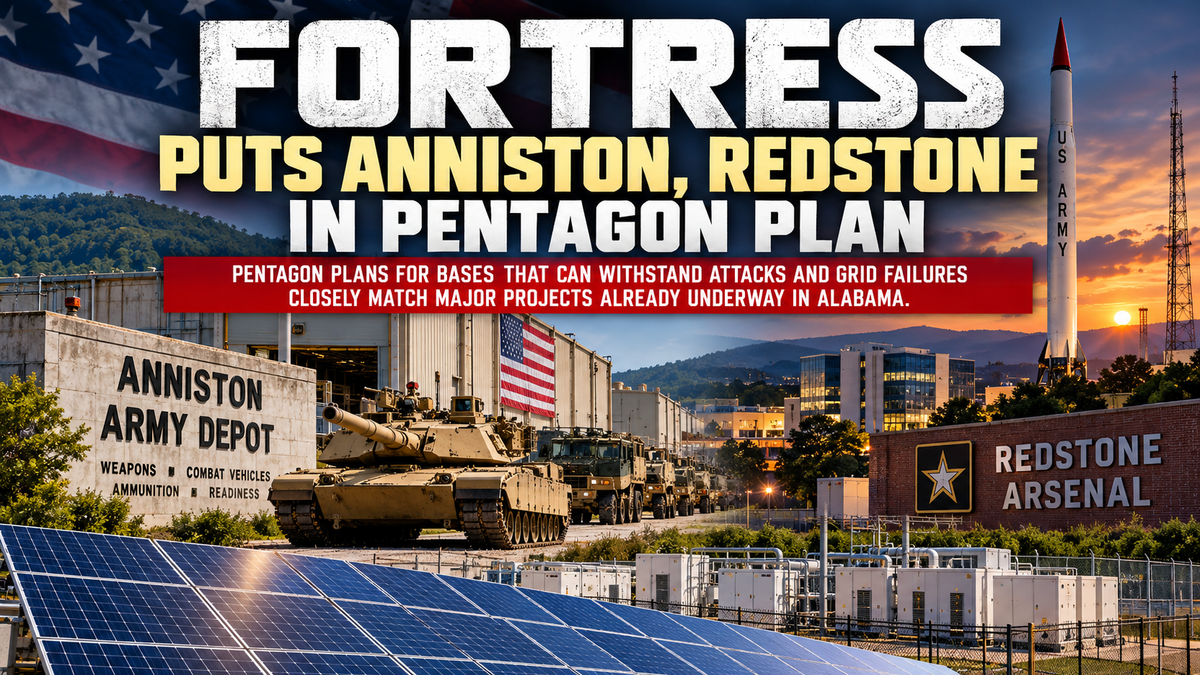
TL;DR: The Pentagon's new FORTRESS America plan calls for military bases that can keep operating through power failures, attacks and broken supply chains for up to 90 days. Anniston Army Depot already has a major microgrid project, nearly $1 billion in planned upgrades and a proposed graphite plant. Redstone Arsenal is also pursuing new power sources as its defense and space missions grow.
The Pentagon wants American military bases prepared to keep fighting even if the lights go out across the communities around them.
In Alabama, much of the groundwork for that level of preparedness may already be underway.
Secretary of War Pete Hegseth announced FORTRESS America on Sept. 30, a broad Pentagon plan to make major U.S. military bases less dependent on the civilian power grid and foreign supply chains.
FORTRESS stands for Federal Operations for Resilience, Troop Resources, Energy, Supply, and Survivability.
Under the plan, the Pentagon wants bases capable of producing their own power. It also calls for larger stockpiles of fuel, ammunition and spare parts, stronger domestic supply chains and military installations hardened against cyberattacks, sabotage and drones.
“Every major military installation in America is going to generate its own power, independent of the civilian grid,” Hegseth said while announcing the plan.
The Pentagon calls FORTRESS a “national insurance policy for the American homeland.” Its five main areas are energy, domestic supply chains, strategic reserves, hardened bases and secure space and communications systems.
Recent Pentagon comments have put some numbers behind the plan.
Assistant Secretary of Defense Dale Marks said the goal is to find ways for bases to operate for “30, 60, or even 90 days without a single watt of outside power.”
Marks also said FORTRESS calls for a 90-day stockpile of key parts, fuel, propellants and ammunition at installations, along with the ability to make some needed parts on site. The Pentagon has not set one deadline requiring every base to reach that standard at the same time.
For Alabama, two installations stand out when considering preparedness: Anniston Army Depot and Redstone Arsenal.
Anniston Army Depot is best known for repairing and rebuilding tanks, combat vehicles, artillery and small arms.
But the northeast Alabama depot is also developing the kind of independent power system envisioned by FORTRESS.
Pentagon budget records describe a $56.45 million power generation and microgrid project designed to keep critical operations running for at least 14 days during an outside power failure.
The system combines new and existing natural gas generation with solar power and controls that can separate — or “island” — the depot from Alabama Power's outside grid.
The project includes 10 megawatts of new Army-owned natural gas generation, another 7.5 megawatts of existing Army-owned generation and about 7.4 megawatts of existing solar generation.
A 2026 Army solicitation shows that Anniston is also preparing to maintain its microgrid around the clock, including emergency repairs, generator testing and “black start” exercises used to test whether the system can restart after a major outage.
The current 14-day goal falls short of the Pentagon's possible 30-, 60- or 90-day FORTRESS targets. But it gives Anniston a major head start if the department decides to push the depot toward longer periods of independent operation.
Power is only part of what is changing at Anniston.
The Army launched its FORGE modernization program at the depot in September. The agreement is valued at $986.97 million, with an initial obligation of $658.17 million.
FORGE — Facilities, Operations, Readiness, Growth and Experience — combines four major military construction projects with 19 repair and maintenance projects.
“This is a historic moment for Anniston Army Depot,” Depot commander Col. Charles Moore said at the kickoff.
The five-year effort is meant to turn aging Army industrial facilities into a faster and more modern production network capable of meeting the demands of a major conflict.
That comes on top of another $233 million energy and infrastructure project at Anniston. The Army Corps of Engineers says that work is being financed through future energy savings and is aimed at improving reliability, safety and the depot's ability to respond quickly.
Anniston also fits another major part of FORTRESS: bringing key defense supply chains back to the United States.
In June, the Army conditionally selected Anniston as one of the sites for private critical-mineral processing on military land.
Empire State Mines, a Titan Mining subsidiary, was selected to develop graphite processing at Anniston.
Graphite has military uses ranging from batteries to weapons and other defense systems. Army officials said domestic mineral processing is needed for missiles, munitions, sensors and military platforms.
The Anniston project is especially notable because the Army said these awards mark the first time it has placed commercial mineral-processing facilities on U.S. military installations.
That puts power generation, heavy repair work, manufacturing and part of the critical-mineral supply chain at the same Alabama installation.
The timing also follows a high-profile visit from Acting Secretary of the Army Adam Telle.
As ALPolitics.com reported, Telle visited Anniston on Oct. 23 with U.S. Rep. Mike Rogers (R-AL-03), Chairman of the House Armed Services Committee.
“Anniston Army Depot represents a cornerstone of our national defense and a vital part of our Army organic industrial base,” Telle said.
The Depot is the Army's designated Center of Industrial and Technical Excellence for a long list of equipment. Its work includes the M1 Abrams tank, M88 recovery vehicle, Stryker, artillery, small arms and other systems.
The Depot also handles conventional ammunition and missiles, while the Department of Defense's only missile recycling center is located there.
Telle's visit focused on the same issue now at the heart of FORTRESS: keeping America's military industrial base capable of producing and repairing what troops need when a crisis hits.
Meanwhile, in North Alabama, Redstone Arsenal faces its own version of the problem.
The Huntsville installation is home to major missile, space, intelligence and federal operations. Those missions require enormous amounts of reliable electricity.
Redstone currently uses about 57 megawatts on an average day, with summer demand reaching roughly 76 megawatts. Army officials say future missions could eventually double the Arsenal's power demand.
“Resilient power is no longer viewed simply as a utility requirement,” Redstone Garrison Commander Col. Erin Eike said. “It is now considered a national security imperative.”
Redstone was one of nine installations initially considered for the Army's Janus nuclear microreactor program, which seeks to put small nuclear reactors at military bases to provide secure power independent of the civilian grid.
Redstone, however, did not make the first group of five installations selected in August. Those reactors are slated for Fort Bragg, Fort Campbell, Fort Hood, Fort Benning and Fort Drum.
Nuclear power is not Redstone's only option.
The Army and Tennessee Valley Authority signed an agreement this summer to study new power resources on military property, with Redstone and Fort Campbell as key sites.
At Redstone, officials have discussed a far larger 300- to 500-megawatt generating facility on about 50 to 60 acres. The Arsenal would receive priority access to its power, while extra electricity could support the surrounding region. No final project has been approved.
Neither Anniston nor Redstone has been publicly designated as a special “FORTRESS America base,” and the Pentagon has not announced that Anniston must expand its current 14-day power plan to 90 days.
Nonetheless, the overlap in readiness and increased resilience is clear.
FORTRESS calls for independent power. Anniston is building an islandable microgrid, while Redstone is studying major new on-site generation.
FORTRESS calls for domestic supply chains. Anniston has been picked for domestic graphite processing.
FORTRESS calls for strategic reserves and an industrial base able to keep operating during a crisis. Anniston stores ammunition and missiles while rebuilding some of the Army's most important ground combat systems.
And FORTRESS calls for installations capable of staying in the fight even when the infrastructure outside their gates is under attack.
Much of that work was underway before Hegseth announced FORTRESS.
The new Pentagon plan could now pull those separate projects into a much larger strategy — one in which Anniston serves as a hardened industrial and repair hub while Redstone protects the power needed for some of the nation's most sensitive missile, space and defense missions — that would eventually involve all of Alabama’s bases, and keep Alabama at the forefront of our nation’s defense.