Stephen Miller: The Right Man for the Fight Ahead
Guest Opinion by Perry Hooper Jr.
Guest Opinion by Perry Hooper Jr.
Washington is about to become a political battlefield, and President Donald Trump has made one thing unmistakably clear: he has no intention of surrendering the agenda that brought him to the White House. With Democrats preparing to take control of Congress, congressional investigations looming, and the political establishment already demanding that Trump retreat from his America First priorities, this is no time for hesitation, appeasement, or business as usual. It is a time for discipline, determination, and an unwavering sense of purpose. By naming Stephen Miller his new White House Chief of Staff, President Trump has sent a powerful message to Washington. The mission has not changed, the President is not backing down, and the remaining two years of his administration will not be spent managing a retreat.
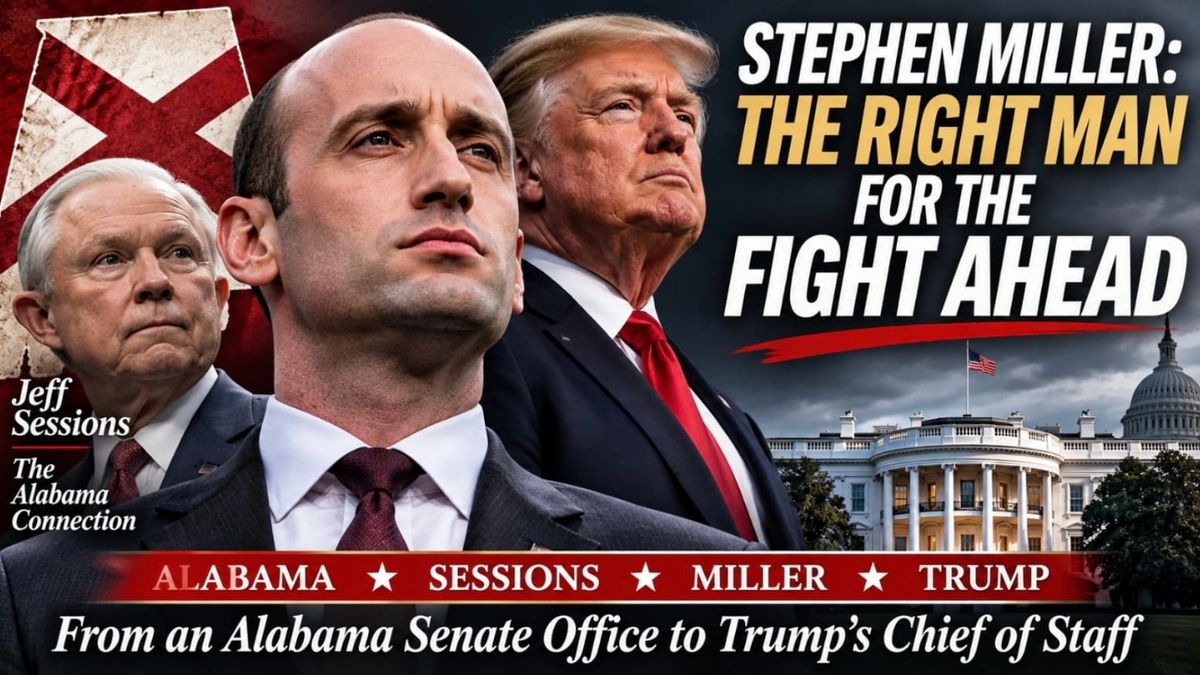
There is something particularly satisfying about this appointment for those of us in Alabama who remember where Stephen Miller's political education began. Before he became one of President Trump's closest and most influential advisers, Miller spent seven years working for Alabama Senator Jeff Sessions. Those were not years spent learning how to please the Washington establishment. They were years spent challenging it. While Republican and Democratic leaders were negotiating the 2013 Gang of Eight immigration legislation, Sessions and Miller were asking questions that Washington's comfortable political class did not want to answer. What would these policies mean for American workers? Who would enforce our immigration laws? What responsibility did our government have to the citizens whose interests it was elected to protect? Sessions was willing to stand against powerful members of both parties, and Miller helped supply the research, arguments, and communication strategy that made that opposition impossible to ignore.
Think about that for a moment. One of the most consequential figures in President Trump's administration developed much of his political philosophy working for a United States senator from Alabama. The principles that Sessions fought for in the Senate became central themes of Trump's 2016 presidential campaign. Miller joined that campaign in January 2016, and Sessions became the first sitting United States senator to endorse Trump the following month. What began as a fight over immigration policy grew into a national political movement that challenged decades of conventional thinking in Washington. Alabama was there at the beginning, and today an alumnus of Jeff Sessions' Senate office occupies one of the most powerful positions in the executive branch.
Stephen Miller has never been mistaken for someone who came to Washington to make friends with the political establishment. He came to advance a set of principles, and he has spent more than a decade doing precisely that. He understands that executive orders are worthless if federal agencies refuse to carry them out, that campaign promises mean nothing without implementation, and that bureaucratic resistance can undermine presidential decisions just as effectively as congressional opposition. Miller knows the difference between announcing a policy and making it operational. As Deputy Chief of Staff for Policy, he was deeply involved in shaping the administration's approach to immigration enforcement and other major domestic priorities. As Chief of Staff, he now has the responsibility to make sure the President's entire team operates with that same focus.
Let us be clear about what the next two years will bring. Democrats have won control of both chambers of Congress, and their leaders have already signaled an aggressive approach to oversight of the administration. They can launch investigations, issue subpoenas, challenge spending decisions, and use their legislative power to confront Trump at almost every turn. The Republican agenda will face congressional roadblocks that did not exist during the first two years of this term. The political noise will be deafening. Every controversy will threaten to consume the news cycle, every disagreement will become a national spectacle, and every agency decision will be examined for opportunities to challenge the President. That is precisely why the choice of Chief of Staff matters so much. The White House cannot allow political warfare to become an excuse for abandoning the daily business of governing.
Trump does not need a Chief of Staff who spends his mornings worrying about whether Washington's editorial boards approve of yesterday's decisions. He needs someone who can identify the President's priorities, hold senior officials accountable, coordinate government operations, and keep the administration moving despite relentless distractions. That does not mean ignoring Congress, disregarding the courts, or treating constitutional limits as inconveniences. It means understanding those limits, defending lawful presidential authority, and refusing to let opposition become paralysis. Miller will be judged by his ability to deliver that kind of disciplined leadership, not simply by his reputation as a formidable political combatant.
Susie Wiles deserves enormous credit for her service to President Trump. She helped engineer his extraordinary political comeback and brought organization and stability to a White House that faced enormous expectations. Her leadership helped establish the foundation upon which the second administration has operated. But the political circumstances have changed dramatically, and the demands of the next two years will be different. Trump has selected a successor whose career has been built around confronting resistance to the policies he believes in. Whatever one's opinion of Miller's political positions, there can be little question that his appointment signals a deliberate decision to maintain the administration's direction rather than abandon it following the midterm elections.
I also believe Jeff Sessions deserves recognition for the role he played in this story. History has a way of overlooking the people who challenged the prevailing political wisdom before doing so became fashionable. Sessions understood that immigration, national sovereignty, and the economic interests of American citizens were not peripheral issues. They were fundamental questions about the responsibilities of the federal government. Stephen Miller learned to argue those questions in Sessions' office, took those arguments into Donald Trump's campaign, and helped carry them into the White House. The political journey from Alabama to the West Wing is a remarkable testament to the influence one senator and his staff can have on the direction of national policy.
President Trump once described Miller with three simple words: "He gets it." That may be the most important qualification of all for the position he now holds. Miller understands the President's priorities because he helped develop many of them. He understands the obstacles because he has been confronting them for years. He understands Washington because he has spent his career watching how quickly the federal bureaucracy and political establishment can frustrate even the most determined administration. Now he must translate that experience into effective leadership across the entire White House.
The next two years will test the Trump administration as severely as any period of this presidency. The stakes for the administration's border policies, economic agenda, energy priorities, and efforts to reform the federal government are substantial. Success will require more than fiery speeches and political confrontation. It will require focus, execution, and the determination to accomplish what remains possible under the Constitution.
In Washington, it is easy to find people who know how to explain why something cannot be done. President Trump has chosen a Chief of Staff whose entire career has been devoted to finding ways to advance the policies he believes should be done. From Jeff Sessions' Alabama Senate office to the center of presidential power, Stephen Miller has never been one to shrink from a fight. Now comes the far greater test: turning that fighting spirit into two years of focused, effective government.
Perry O. Hooper Jr. is a longtime Alabama Republican figure, former Alabama Legislator and Montgomery businessman. He served as Co-Chair of “Alabama Trump Victory” in 2016, and served as an at-large delegate to the Republican National Convention. He is a noted civic leader in Montgomery with deep family roots in Alabama’s legal and political history.
Opinions do not reflect the views and opinions of ALPolitics.com. ALPolitics.com makes no claims nor assumes any responsibility for the information and opinions expressed above.