
Taco Bell Eyed in Growing Cyclospora Outbreak
Federal investigators are examining a possible Taco Bell link as Cyclospora illnesses climb, with lettuce emerging as a leading suspect
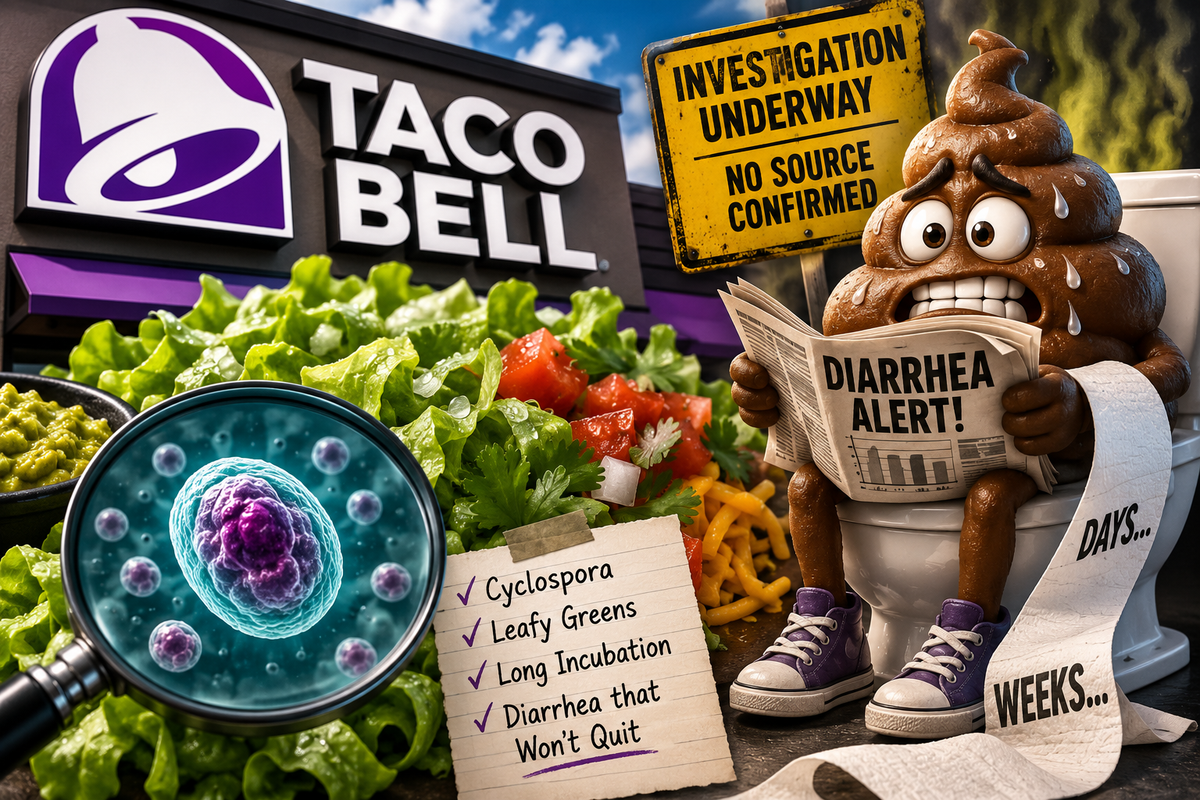
Federal and State health officials are investigating whether ingredients served at some Taco Bell restaurants are connected to a growing multistate outbreak of cyclosporiasis, a parasitic illness that causes severe, often prolonged diarrhea. While investigators have not identified a definitive source, lettuce and other leafy greens have emerged as the leading suspects.
The investigation is being led by the Centers for Disease Control and Prevention (CDC), the U.S. Food and Drug Administration (FDA), and several State health agencies, including the Michigan Department of Health and Human Services (MDHHS). Officials stress that no single restaurant, supplier, or food product has been confirmed as the source of the outbreak.
According to the CDC, 1,645 confirmed cases of cyclosporiasis had been reported in 34 States as of July 13, with another 5,100 cases “requiring further investigation.” This is in stark contrast to the 249 cases reported nationally by this time last year.
Most cyclosporiasis infections occur during the spring and summer months, when fresh produce consumption is highest. Patients can experience watery diarrhea, loss of appetite, weight loss, stomach cramps, bloating, nausea and fatigue. Without treatment, symptoms can linger for weeks or even months.
Michigan has become the focal point of the investigation after State officials identified thousands of cases this year. Investigators reviewing patient interviews found that many ill individuals reported eating lettuce or salad greens before becoming sick. Several also reported dining at Taco Bell locations, prompting a broader review by federal and State investigators. However, health officials caution that eating at the same restaurant does not prove it was the source of the illness.
The Alabama Department of Public Health confirmed Wednesday, July 15, that 11 cases of cyclosporiasis have been reported in the State since May 1. Most were identified in North Alabama, though two were associated with international travel and one was tied to a separate foodborne outbreak involving a local Mexican-style restaurant chain. State health officials have not linked any Alabama cases to the ongoing federal investigation involving Taco Bell, and no hospitalizations or deaths have been reported in the State.
As a precautionary measure, Taco Bell has removed several fresh ingredients from select restaurants while the investigation continues.
In a statement, the company said, "Out of an abundance of caution, we proactively removed select ingredients from certain restaurants while we continue to work closely with health officials."
According to multiple reports, ingredients temporarily removed from some locations include lettuce, cilantro, onions, pico de gallo and guacamole. No nationwide recall has been announced, and federal officials have not ordered restaurants to stop serving lettuce.
Cyclospora is a microscopic parasite spread through food or water contaminated with human feces. Unlike many foodborne bacteria, the parasite cannot be passed directly from one person to another because it must first mature in the environment before becoming infectious. The illness has frequently been linked to imported fresh produce, including leafy greens, basil, cilantro and berries. Washing produce may reduce contamination but does not always eliminate the parasite.
Investigators say tracing the source has been complicated by the lengthy incubation period, which can range from two days to two weeks after exposure, and by the complex distribution network for fresh produce. By the time patients become ill, they often have difficulty recalling exactly what they ate or where individual ingredients originated.
Health officials advise anyone experiencing persistent watery diarrhea lasting more than a few days — particularly after eating fresh produce or restaurant salads — to seek medical attention. Cyclosporiasis can be treated with prescription antibiotics, but it often is not detected by routine stool testing unless physicians specifically request testing for the parasite.
For now, investigators continue working to determine whether the outbreak can be traced to a common supplier, a specific produce distributor, or another point in the food supply chain. Until then, federal agencies emphasize that the investigation remains ongoing and that no final conclusions have been reached regarding Taco Bell or any other restaurant chain.