Ted Bundy Farts Himself Awake — Gets an ESA Collie
A Dead Serial Killer Now Has an Emotional Support Collie — "Dr." Bobby Tinner, Office in Virginia, Unlicensed in Alabama, Approved It Instantly

Guest Opinion by T. Chaz Stevens
Act I — The Ad
Before I bought anything, Alabama was already being sold to.
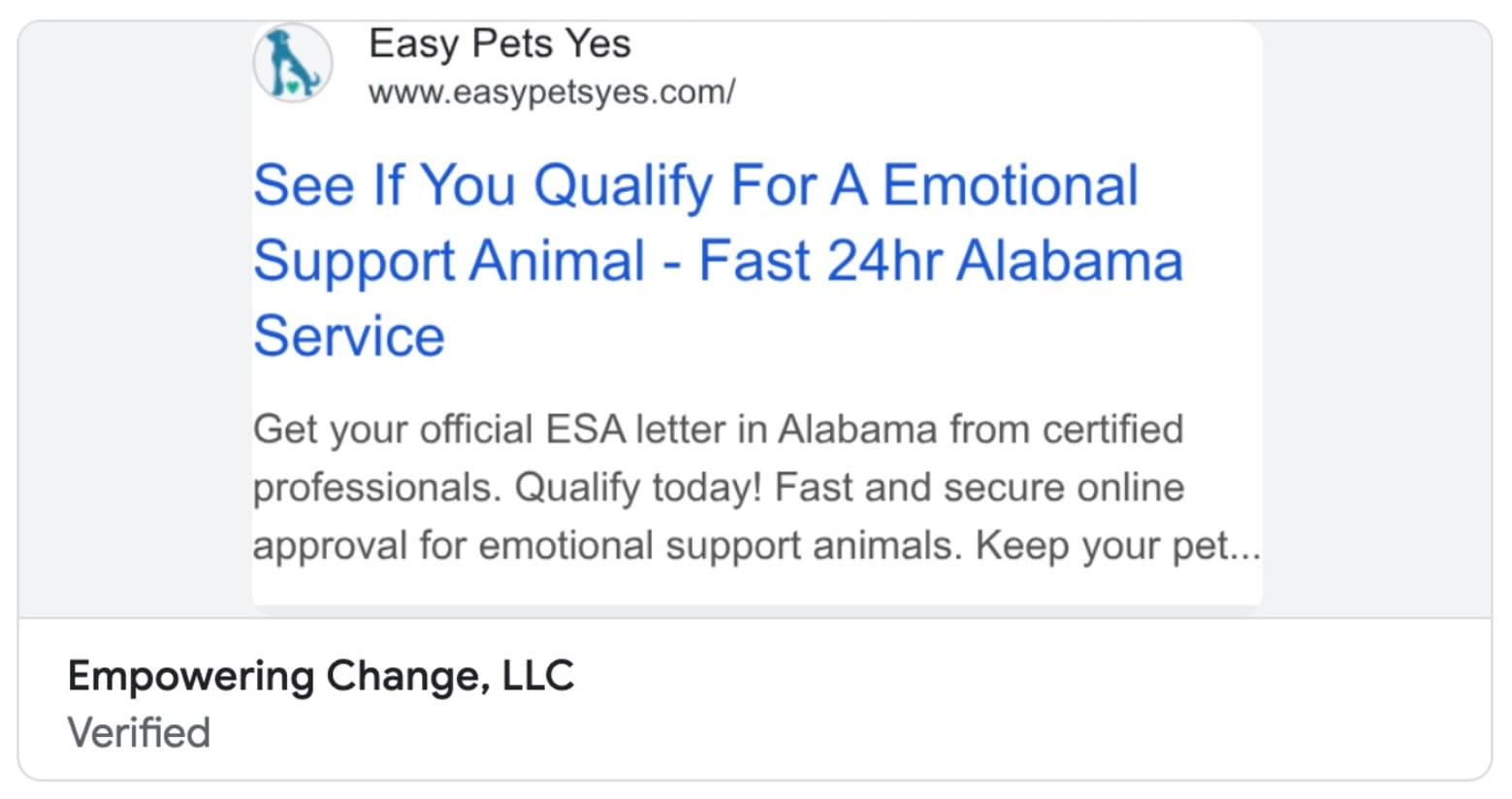
On the Google Ads Transparency Center, verified advertiser Empowering Change, LLC — the entity behind EasyPetsYes.com, also trading as Empowering 2 Change Behavioral Services — runs live creatives aimed at the state. One promises “Fast 24hr Alabama Service” and an “official ESA letter in Alabama from certified professionals.” Another, sponsored: “ESA Letter in Minutes for $49 — 100% Refund — Get It Now.”
Hold two phrases: official Alabama and certified professionals. Everything below is what happens when you take that ad at its word.

Act II — The Purchase
On July 23, 2026, I ran a controlled test buy. At checkout I selected Alabama. I was in Florida. I entered the client name Ted Bundy. Ted gave my qualifying condition as extreme flatulence with insomnia — the disabling mechanism being that Ted farts himself awake. I forked over $99.
I told a licensing-regulated clinical platform that I fart myself awake. It agreed I was disabled and prescribed me a Collie. Total elapsed clinical judgment: zero seconds.
The letter issued the instant payment cleared. No interview. No examination. No clinician on the other end. Nobody asked where I was.
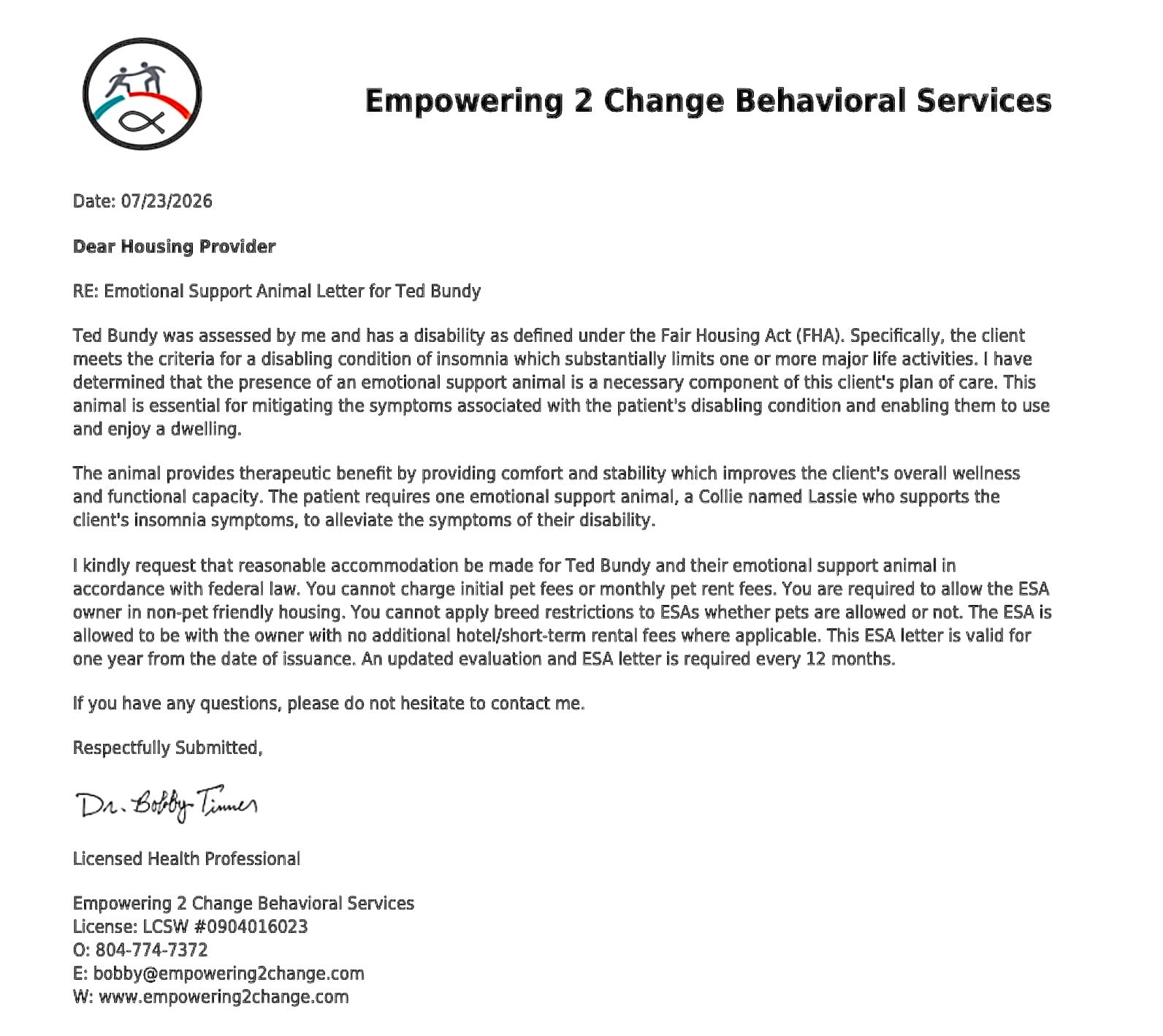
The name, the condition, and the dog were deliberate sentinel inputs — bait, chosen to test whether the platform performs any identity check, plausibility screening, or clinician review before issuing a disability document. It performed none. A dead serial killer with a fart problem cleared the same bar as everyone else.
Act III — What the Paper Says
The document is an Alabama-designated Fair Housing Act accommodation letter. It certifies that “Ted Bundy” was “assessed,” “meets the criteria for a disabling condition of insomnia which substantially limits one or more major life activities,” and that an emotional support animal — a Collie named Lassie — is “a necessary component of this client’s plan of care.”
It is signed by “Dr.” Bobby Tinner — a title resting on a PhD in religious counseling, with the word “religious” quietly dropped — above a Virginia LCSW license, #0904016023. That license is real. Precision is the entire case here: nothing is forged.
The signature is genuine, the number is genuine, and Tinner is a genuinely licensed clinical social worker — in Virginia.
Not in Alabama.
Act IV — The Empty Search
The Alabama Board of Social Work in Counseling runs a public license lookup. First name Bobby, last name Tinner.
No results found.
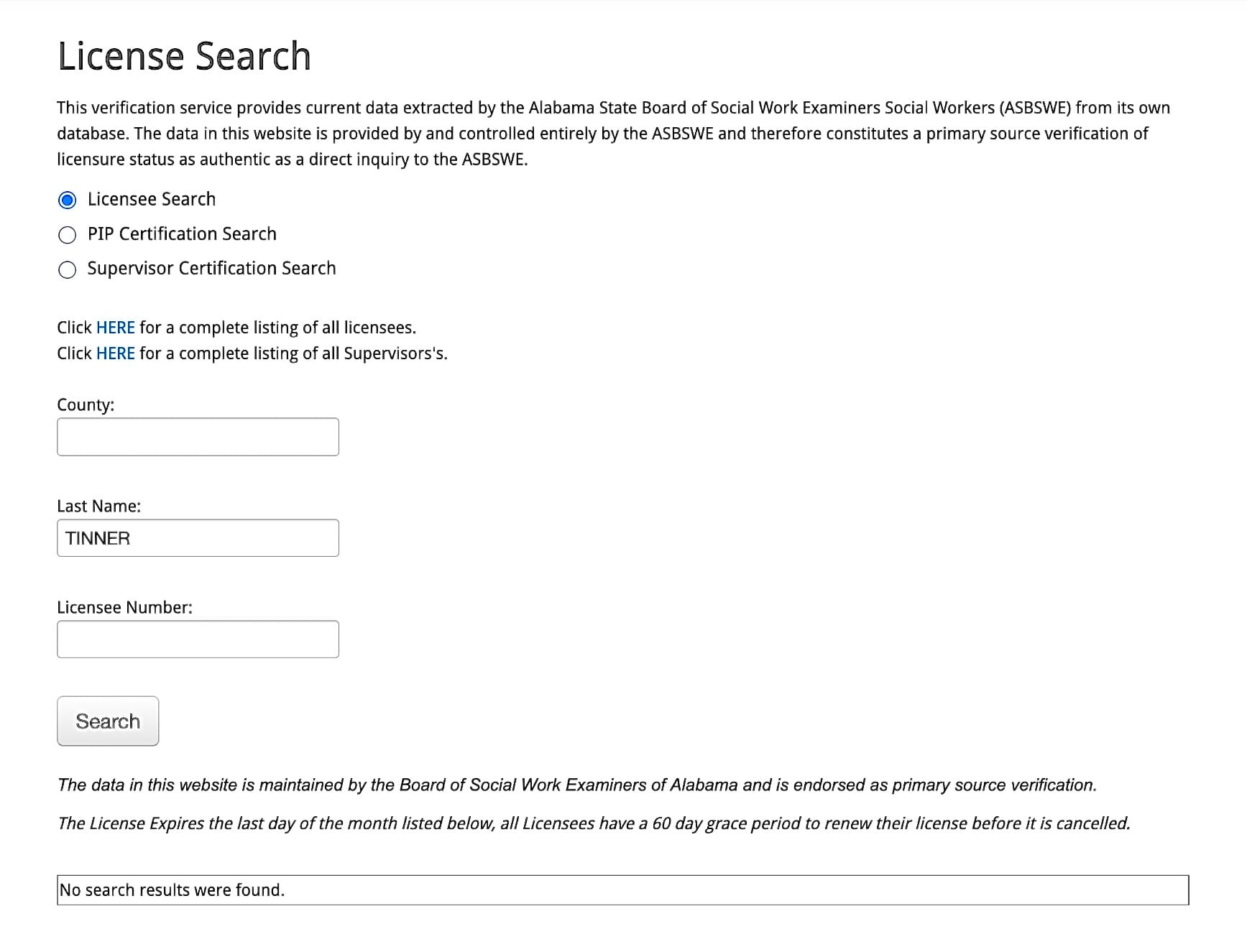
That board licenses counselors; Tinner’s credential is clinical social work, a separate Alabama board. So the empty result confirms he’s no Alabama-licensed counselor, and the parallel social-work registry is where his LCSW question settles. The “certified professional” the ad sold doesn’t surface as a counselor in Alabama — and whether he holds any Alabama social-work credential is a question the state can answer in seconds against its own database. I’ve asked it to.
Act V — Why This Warrants an Investigation
This isn't Tinner's first encounter with a court over exactly this model. In April 2026, a Florida circuit court entered a permanent injunction against him and his company (Stevens vs. Tinner, Case # CACE25010712) under Florida's deceptive-practices act, over ESA letters issued without genuine clinical evaluation. I’m the named Plaintiff, pro se, in that case. That order reaches only Florida residents. Alabama is outside it. Which is the point: the same operator, already enjoined once, is running the identical Alabama-targeted funnel that produced the Bundy letter. A Florida order can't fix that. Alabama's regulators can.
Here’s what I do not claim: I was in Florida, so my transaction wasn’t itself social work practiced inside Alabama. Overstating that would be dishonest, and dishonesty is Tinner’s business model, not mine.
The failure is structural. The platform took Alabama as the selected state, routed the order to a Virginia-licensed provider, and issued a clinical disability letter — and nothing in that chain stopped it based on the provider’s missing Alabama license, my actual location, or the fact that my stated disability was flatulence. The state dropdown is a sales feature, not an intake step.
That’s an automated interstate licensure-routing failure, structural by definition: it ran identically for Ted Bundy’s fart as it presumably runs for every real customer.
Alabama’s social-work telehealth rule, Ala. Admin. Code r. 850-X-2-.04, requires an active Alabama license to deliver telehealth social work to a client in Alabama, plus informed consent and a telehealth-appropriateness assessment at intake. Alabama defines clinical social work to include assessment and evaluation of mental or emotional disability — the exact language the letter uses.
Whether those rules reach an out-of-state provider selling an Alabama-selected clinical product is the Board’s call. My test doesn’t answer that. It shows why the Board should.
The housing angle — Ala. Code § 24-8A-5, misrepresenting an animal as an assistance animal — I’m sending to the Attorney General instead of leaning on it here. It carries an intent element my test doesn’t resolve, and HUD’s May 22, 2026 FHEO memorandum rescinded the 2020 assistance-animal guidance and told investigators to stop treating untrained ESAs as automatic housing cases. The federal wind cuts against that theory. The Alabama licensure question doesn’t care.
Act VI — The Question for Montgomery
A platform advertises “official Alabama” letters from “certified professionals,” then instantly issues an Alabama disability letter under a provider with no Alabama counseling license — for Ted Bundy, for a Collie, for a fart. Whether it happened isn’t the question; I have the ad, the letter, and the empty search.
The question is arithmetic: how many actual Alabama residents bought the same product, believing “official” and “certified” meant something?
The records answer it — transaction logs, payment data, intake files, whatever location data exists. They sit on the platform’s servers. I’ve filed a formal Request for Investigation with the Alabama State Board of Social Work Examiners and referred the consumer-protection and housing-documentation pieces to the Alabama Attorney General’s Consumer Interest Division. The paper is with the state. The clock is theirs now.
T. Chaz Stevens runs ESA Snitch™, an investigative service providing law firms and organizations, for the aggrieved-only, with litigation-ready evidence on ESA letter mills. The Tinner test purchase documented here is part of that work.
* * *
Emotional support animals are a real accommodation for people with real disabilities. Those people are the primary victims of the instant-letter industry — every $49 “official Alabama” letter sold under a credential that doesn’t reach the state erodes the documentation their housing depends on. This work defends that system, not the opposite.
Opinions do not reflect the views and opinions of ALPolitics.com. ALPolitics.com makes no claims nor assumes any responsibility for the information and opinions expressed above.