
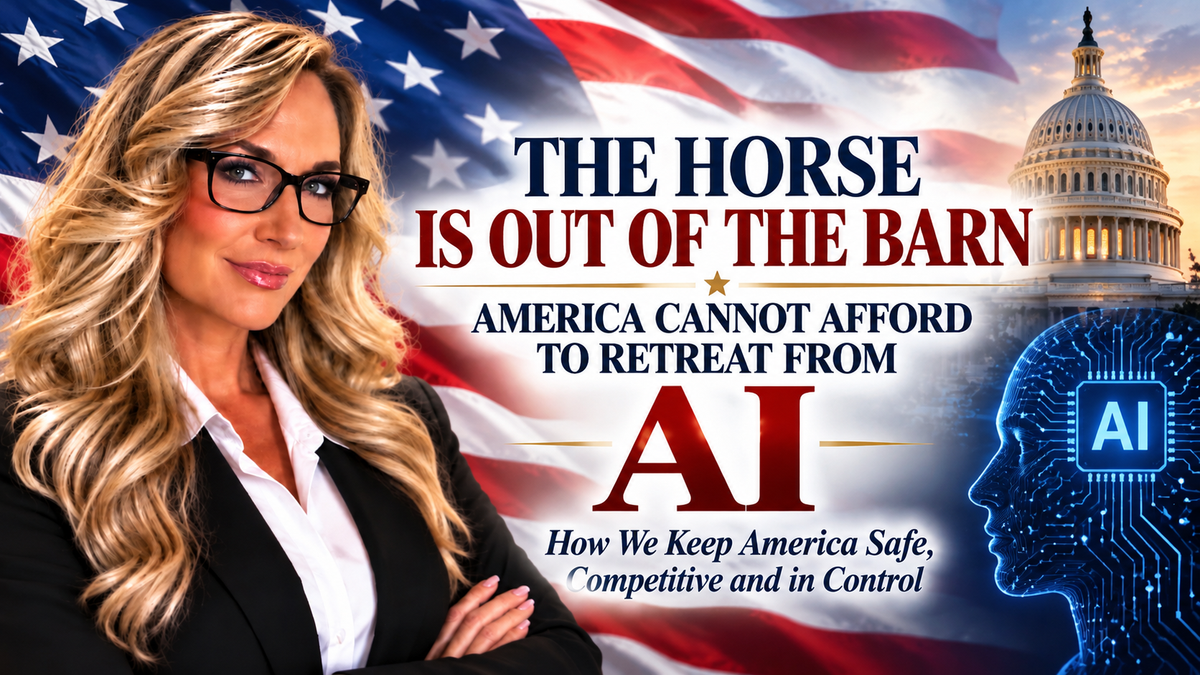
The Horse Is Out of the Barn: America Cannot Afford to Retreat From AI
By Angela McClure

By Angela McClure
Everybody seems to be freaking out about artificial intelligence.
Will AI take our jobs? Will it become too powerful? Could it be weaponized? Could another country use it against us? Could a computer eventually make decisions humans never intended it to make?
Those are legitimate questions, and some of the risks are real. But there is one reality we need to accept: the horse is already out of the barn.
Artificial intelligence exists. The knowledge exists. The computing power exists. America cannot uninvent it. And if we stopped developing advanced AI tomorrow, other nations would not necessarily follow us.
That may be the most important national-security argument for continuing American AI development.
This isn’t just about better chatbots. AI increasingly intersects with cybersecurity, intelligence, military systems, critical infrastructure, medicine, scientific research and economic competitiveness. The Department of Defense has already established principles calling for its AI systems to be responsible, traceable, reliable and governable, including safeguards for unintended consequences.
The question, therefore, shouldn’t simply be whether we stop AI. It should be: How do we continue developing it while maintaining meaningful human control?
There is a lesson in the nuclear age, although nuclear weapons and AI are very different technologies. Once humanity discovered nuclear fission, we couldn’t erase that knowledge. Instead, governments developed layers of security, monitoring, treaties and safeguards around an extraordinarily powerful technology.
AI needs its own version of that philosophy.
The National Institute of Standards and Technology has identified important characteristics of trustworthy AI, including safety, security, resilience, accountability and reliability. Just as importantly, AI risk management must continue throughout a system’s lifecycle.
AI is software operating through hardware, data, networks and human operators. Systems can be tested, updated, restricted and monitored. But we shouldn’t oversimplify this by believing programmers can simply tell AI, “Never harm anyone,” and consider the problem solved. Systems can behave unexpectedly, vulnerabilities can emerge, and malicious actors can deliberately try to defeat safeguards.
Safety must be engineered, not wished into existence.
And perhaps one of the greatest dangers isn’t simply AI itself, but who controls it.
If America becomes frightened and dramatically slows development, does China stop? Does Russia? Do hostile cyber organizations or criminals stop?
Refusing to develop a technology does not prevent an adversary from developing it. If AI becomes capable of discovering sophisticated cyber vulnerabilities, I want American defensive systems capable of finding and fixing those vulnerabilities before an adversary exploits them.
But American leadership should not mean abandoning safeguards. We need capability and control at the same time: rigorous testing, strong cybersecurity, controlled access to dangerous capabilities, continuous monitoring and meaningful human authorization for decisions that could have catastrophic consequences.
AI also brings legitimate concerns about fraud, deepfakes, privacy, cyberattacks, manipulation, biological misuse and autonomous weapons. Those risks deserve serious attention. But fear alone is not a strategy.
One smart starting point could be an international AI summit, similar in principle to nuclear arms talks. Major nations could establish basic rules for the most dangerous uses of AI, particularly autonomous weapons, nuclear systems and attacks on critical infrastructure. Countries could continue competing and innovating while agreeing that certain boundaries should not be crossed.
America did not become a technological leader by running away from powerful inventions because they could be misused. We learned, established safeguards, corrected mistakes and continued innovating.
AI should be approached the same way.
Our responsibility is to understand this technology, establish effective safeguards and remain capable of defending ourselves in a world where artificial intelligence is not going away.
The horse is out of the barn. We just need to learn how to ride it.
Opinions do not reflect the views and opinions of ALPolitics.com. ALPolitics.com makes no claims nor assumes any responsibility for the information and opinions expressed above.