The Origins of Impeachment
Guest Opinion by Justice Will Sellers
Guest Opinion by Justice Will Sellers
This year marks the 650th anniversary of one of the most consequential constitutional innovations in Western history: legislative impeachment.
Born in the Good Parliament of 1376, this mechanism fundamentally altered the relationship between executive power and legislative accountability. What began as a pragmatic solution to medieval corruption has endured as a central safeguard of constitutional governance, ultimately shaping the structure of the United States Constitution.
The Good Parliament convened under extraordinary circumstances. King Edward III was elderly and disengaged from governance, England was mired in the costly and faltering Hundred Years’ War, and the royal treasury had been depleted by mismanagement and corruption. At the center of public outrage were the King’s closest advisors; they were widely accused of exploiting royal authority for personal gain.
At the time, English law presented a profound constitutional dilemma. The reigning legal maxim held that “the King can do no wrong,” and as the source of all justice, the monarch was immune from prosecution in his own courts.
Yet this immunity created a dangerous vacuum.
When corruption or abuse emanated from the King’s government, there was no direct legal mechanism to hold anyone accountable. Charging the King would amount to treason and risk civil war. Meanwhile, the ordinary courts, staffed by judges dependent on the Crown, lacked both the authority and independence to prosecute powerful ministers.
Faced with this institutional impasse, the House of Commons devised an ingenious solution. Rather than confront the monarch directly, they drew a critical distinction between the King and those who exercised his authority.
Ministers, they argued, could not shield themselves behind sovereign immunity. If they had engaged in corruption or abused the public trust they should be accountable. Parliament effectively separated the person of the monarch from the actions of the government; a progressively novel concept for that age.
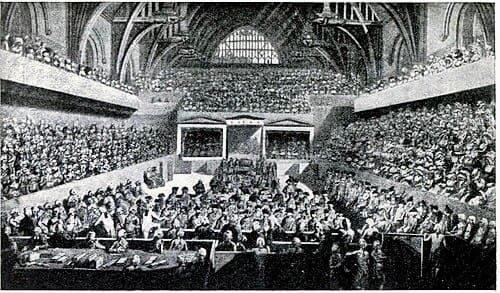
To enforce this principle, Parliament developed an innovative, quasi-judicial process that came to be known as impeachment. The House of Commons assumed the role of prosecutor, acting as the “grand inquest of the nation,” while the House of Lords functioned as the tribunal, hearing evidence and rendering judgment. This bifurcated structure mirrored a criminal proceeding but remained entirely within the legislative sphere.
The results were immediate and dramatic. 650 years ago this month, the King’s Ministers were formally accused of serious offenses, including embezzlement, bribery, and abuse of power. Parliament removed them from office, imposed heavy fines, and ordered their imprisonment. For the first time, the machinery of government had been used to hold the King’s agents accountable without overthrowing the monarchy itself.
Impeachment thus emerged as a constitutional “escape valve”; a peaceful mechanism for addressing systemic abuses of power when ordinary legal remedies failed. It allowed Parliament to confront corruption, restore public confidence, and reassert the rule of law without resorting to rebellion.
When the framers of the United States Constitution gathered in Philadelphia in 1787, they were deeply influenced by this English constitutional history and understood both the utility and the risks of impeachment as a political-legal instrument.
Their challenge was to adapt this centuries-old mechanism to a republican government with a powerful, independent executive. Unlike the English monarch, the American President would not be cloaked in absolute immunity, and though he would wield significant authority, he remained subject to constitutional constraints.
The Framers debated extensively how impeachment should function in this new context. One proposal suggested that the Supreme Court should try impeachments, but this idea was rejected. The Court was considered too small and too susceptible to political pressure in matters of such magnitude.
Instead, the framers adopted the English model of a divided process that awarded the House of Representatives sole power to impeach, and tasked the Senate with conducting the trial.
Equally significant was the debate over the standard for impeachment.
George Mason argued that limiting impeachment to “treason and bribery” would be insufficient to address the full range of potential abuses by a President, so he proposed adding the term “maladministration.”
James Madison objected forcefully, warning that such a vague standard would allow Congress to remove a President for mere policy disagreements, effectively transforming the system into a parliamentary government.
Mason ultimately withdrew his proposal and substituted the phrase “other high Crimes and Misdemeanors,” which was language drawn directly from English parliamentary practice and carried a specific historical meaning.
Rather than referring to ordinary criminal offenses, it encompassed serious abuses of public power, violations of constitutional duty, and breaches of public trust. In adopting this formulation, the framers struck a careful balance that allowed impeachment to remain available as a check on executive misconduct but prevented it from becoming a cudgel for routine political disputes.
The Constitution further refined the process by imposing structural safeguards. Conviction in the Senate would require a two-thirds majority, ensuring that removal from office could occur only with broad political consensus, and the penalties were limited to removal and potential disqualification from future office, leaving criminal prosecution to the ordinary courts. These constraints underscored the exceptional nature of impeachment.
Six-and-a-half centuries after its creation, impeachment remains one of the most enduring features of constitutional governance, and it stands as a testament to a fundamental principle first articulated in 1376; that those who exercise the power of the state are accountable under the law.
Impeachment was never intended to be a routine instrument of political struggle. It is, rather, an extraordinary mechanism reserved for extraordinary circumstances; a constitutional safeguard designed to protect the integrity of government while preserving the separation of powers.
As Chief Justice William Rehnquist later observed in his study of impeachment, it is a high-stakes process rooted in history, tradition, and the enduring tension between authority and accountability.
From the halls of Westminster to the chambers of Congress, the legacy of the Good Parliament endures. In every impeachment proceeding, the echoes of 1376 can still be heard; a reminder that even in the most powerful offices, no one stands entirely above the judgment of the people’s representatives.
Will Sellers is a graduate of Hillsdale College and is an Associate Justice on the Supreme Court of Alabama. He is best reached at jws@willsellers.com.
Opinions do not reflect the views and opinions of ALPolitics.com. ALPolitics.com makes no claims nor assumes any responsibility for the information and opinions expressed above.