Trillions Lost While Americans Struggle: Tanner Medley Talks Fraud, Data Centers and Flock Cameras
By Angela McClure

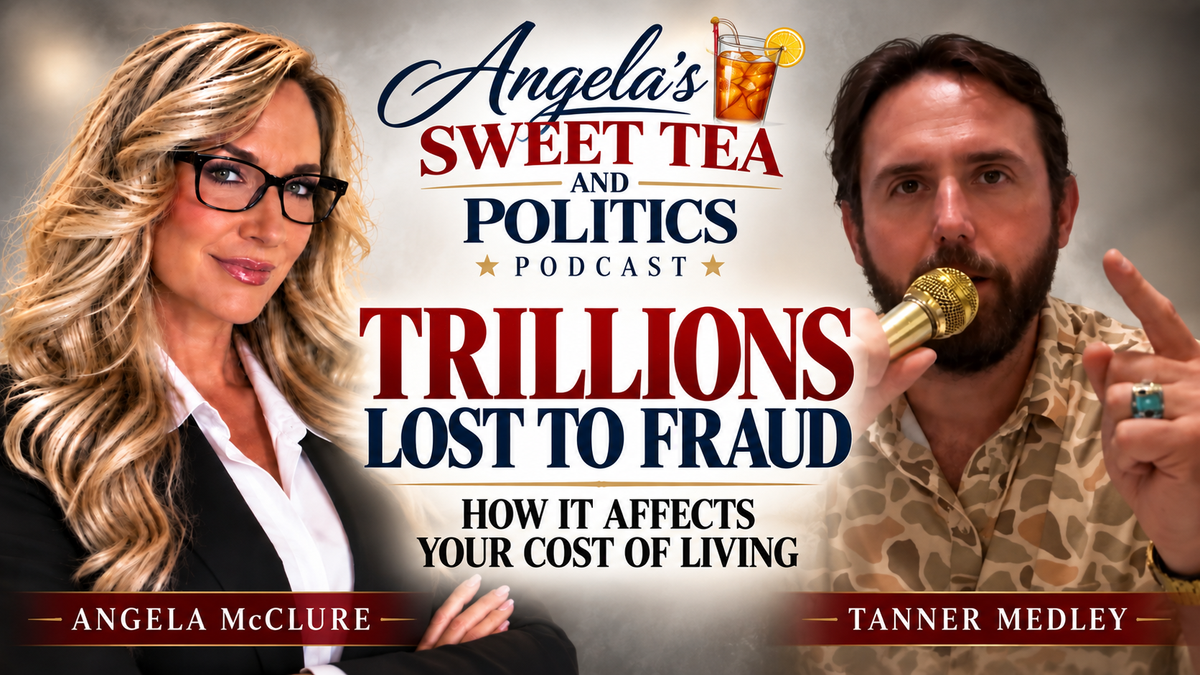
On this week’s episode of Angela’s Sweet Tea and Politics, I sat down with South Alabama political social-media influencer Tanner Medley for a conversation that quickly moved beyond ordinary political talking points and into an issue every taxpayer should be asking about: Where is all of our money going?
Medley, whose South Alabama social-media communities reach more than 140,000 followers, has built an audience by talking about the issues people in his communities are actually discussing. During our conversation, three subjects stood out: the staggering amount of fraud involving federal dollars, the rapid expansion of data centers, and growing concerns about Flock license-plate-reader cameras.
But the conversation began with something hitting virtually every American household—the cost of living.
When I asked what could actually be done to bring financial relief to families, Medley proposed what he called a large-scale “war on fraud,” arguing that fraud has become so enormous that Washington has been reluctant to seriously tackle it.
The numbers put the issue into perspective.
The Government Accountability Office estimates that the federal government loses between $233 billion and $521 billion every year to fraud, based on data from fiscal years 2018 through 2022. At those annual rates, a decade of losses would amount to roughly $2.3 trillion to $5.2 trillion. Separately, federal agencies reported approximately $186 billion in improper payments in fiscal year 2025 alone, and cumulative reported improper payments since fiscal year 2003 have reached about $3 trillion. Fraud and improper payments are related but are not the same thing; not every improper payment is fraudulent.
Think about those numbers while families are standing in grocery-store aisles calculating what they can afford, struggling with utility bills, housing costs and other everyday expenses.
Stopping fraud would not automatically make a gallon of milk or a carton of eggs cheaper tomorrow. Inflation is affected by monetary policy, energy costs, supply and demand, wages, productivity and numerous other forces. But hundreds of billions of dollars lost annually to fraud represents money that taxpayers must ultimately finance. Reducing those losses could improve the federal government’s fiscal position and give policymakers more room to reduce borrowing, protect legitimate programs or pursue tax and spending policies aimed at household affordability.
That makes fighting fraud more than an accounting exercise. It is a cost-of-government issue.
GAO itself says there is no single solution. Among the approaches it has identified are better fraud analytics, stronger data sharing, greater transparency, improved oversight and implementation of recommendations designed to close known vulnerabilities.
Data Centers: Who Should Pay?
Medley also identified data centers as one of the biggest issues he is hearing about from people in his South Alabama communities.
He acknowledged why communities are concerned—water usage and pollution fears, noise, massive construction projects and, increasingly, electricity costs. He also argued that Americans need to understand the other side of the equation: artificial intelligence requires enormous physical infrastructure, and the United States is competing globally in AI development.
His position was not simply “stop building data centers.”
Instead, Medley argued that elected officials need to change how these projects are handled. He criticized situations in which local officials sign nondisclosure agreements with developers, leaving residents wondering what is happening in their own communities. Most importantly, he argued that technology companies developing massive data centers should be responsible for infrastructure costs associated with serving those facilities rather than allowing those costs to be spread across ordinary utility customers.
That is a conversation communities across America are increasingly going to have to confront: We may need the technology, but who pays for the infrastructure required to support it?
Flock Cameras: Security Versus Privacy
Then there are Flock cameras.
Medley said a poll he conducted in his home community found 93 percent of respondents opposed the cameras. That is his local poll—not a statewide or national scientific survey—but it illustrates the intensity of concern among the people participating in his community.
Medley acknowledged the law-enforcement argument: automated license-plate readers can potentially accelerate investigations and help authorities locate suspects or vehicles. But he believes those benefits must be weighed against privacy, data-retention and potential-abuse concerns.
That distinction matters. Technology capable of helping solve a crime can simultaneously raise legitimate questions about how much information should be collected on law-abiding citizens, how long it should be retained, who can access it and what safeguards exist against misuse.
My position during our conversation was similar: technology that helps locate criminals and protect communities has obvious value, but the current system raises serious privacy concerns and needs stronger safeguards.
Ultimately, this episode came back to one common theme: accountability.
Accountability for taxpayer dollars. Accountability for the infrastructure costs associated with emerging technology. Accountability for how government and private companies collect and use information about American citizens.
Medley summed up what he hears from ordinary people succinctly near the end of our conversation: Flock cameras, data centers, artificial intelligence, grocery prices and the price of practically everything are weighing on people’s minds.
Washington often debates policy in trillions of dollars. Families don’t.
They experience government and the economy through a grocery receipt, an electric bill, a mortgage payment and the taxes coming out of every paycheck.
If the federal government is potentially losing hundreds of billions of dollars every year to fraud, Americans have every right to demand that Washington attack that problem with the same urgency politicians bring to raising taxes, increasing spending or creating another government program.
Opinions do not reflect the views and opinions of ALPolitics.com. ALPolitics.com makes no claims nor assumes any responsibility for the information and opinions expressed above.