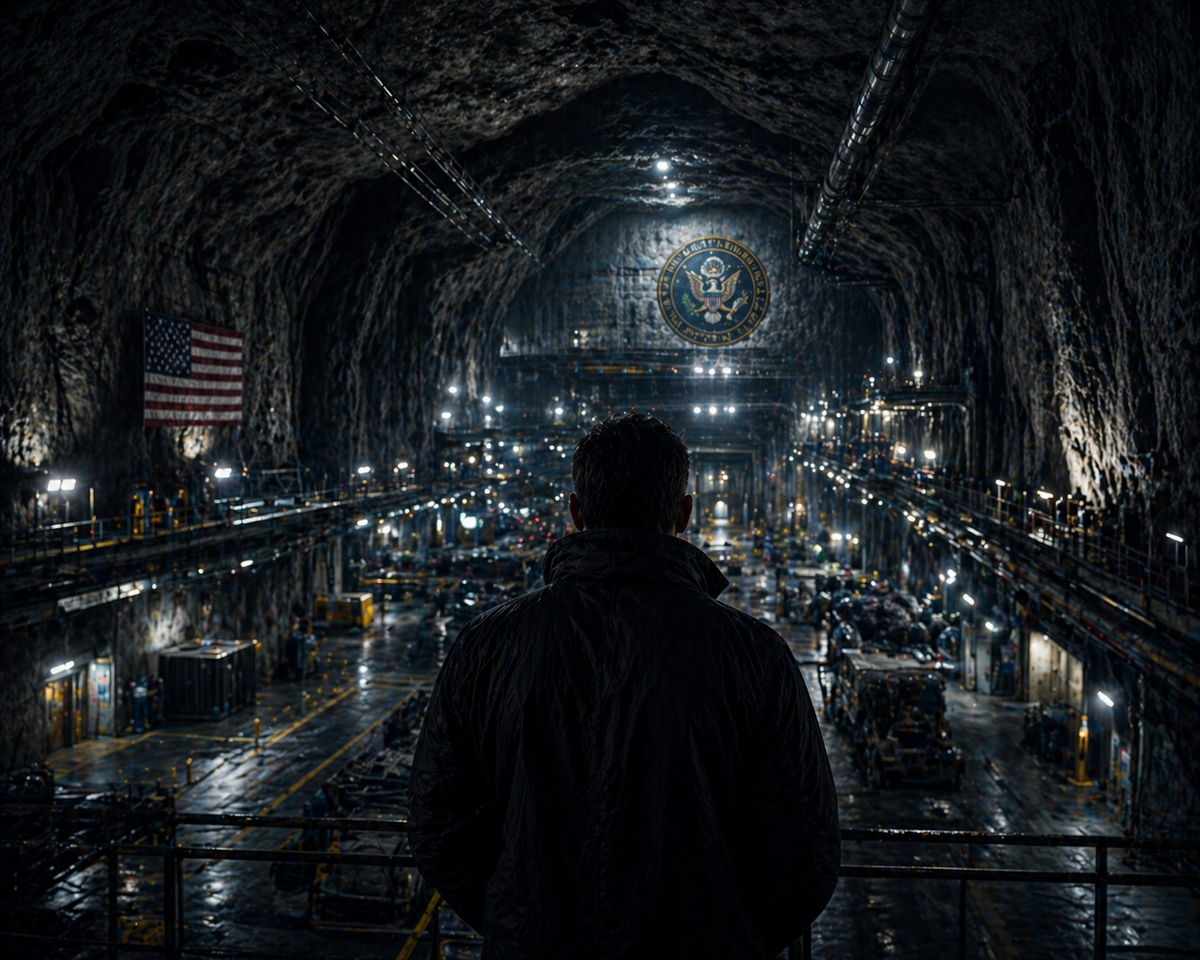
What Lies Beneath
The Pattern, Part 4–Guest Opinion by Alicia Haggermaker
Guest Opinion by Alicia Haggermaker
There is something about Huntsville that doesn't make it into the Chamber of Commerce materials.
The city sits on limestone. North Alabama's geology is karst terrain — one of the most cave-rich regions in the United States. Rainwater dissolves limestone over millennia and creates extensive underground networks of chambers, passages, and caverns. Alabama has over 4,200 documented caves. The National Speleological Society recognized this and relocated its headquarters to Huntsville in 1971.
This is not trivia. It is infrastructure context.
Limestone is among the most engineering-friendly mediums for underground construction. It is soft enough to tunnel through with relative ease compared to harder rock formations — yet structurally stable enough once carved to support significant overhead weight without extensive reinforcement. It maintains consistent cool temperatures year-round. It provides natural electromagnetic shielding. It drains through its own karst network. When the government needs underground space that is easy to build, stable to occupy, thermally consistent, and naturally shielded — it goes to limestone.
The United States government has been doing exactly this, publicly, for decades. SubTropolis in Kansas City is the world's largest underground business complex — carved entirely into limestone, housing government records, federal storage, and private operations across 55 million square feet of subsurface space. It is not classified. It is not secret. It is simply what limestone makes possible when you decide to use it.
Redstone Arsenal sits on 38,300 acres of it.

The Arsenal has been in continuous federal military possession since 1941. The EPA has designated it a Superfund site — noting, in its own documentation, the facility's complex hydrogeology. That is the agency's term for the behavior of water moving through fractured limestone beneath 38,300 acres of classified military installation. The Arsenal's own environmental division has publicly acknowledged caves of significant size on the installation, including Matthew's Cave, and monitors the underground chambers for groundwater quality.
They know what is down there. They are monitoring it. The public record of what those chambers contain — beyond groundwater — has never been released.
This matters because of what has been operating above that limestone since 1945.
Wernher von Braun arrived in Huntsville through Operation Paperclip with 118 German scientists whose records had been falsified by American intelligence. What they brought with them was not limited to conventional rocketry. Advanced electromagnetic research, propulsion concepts operating outside published physics, and classified weapons programs that Nazi Germany had been developing in the final years of the war — all of it was absorbed into American black budget programs that have operated without full public accounting ever since.
Seventy-five years of development. On 38,300 acres of limestone. With a power infrastructure delivered by the Tennessee Valley Authority whose full consumption figures have never been cross-referenced against the stated surface operational footprint.
That cross-reference is where the questions start.
The NSA's Utah Data Center — a single publicly acknowledged data storage facility — continuously consumes 65 megawatts of electricity. Enough to power 33,000 homes. Forty million dollars a year in power costs alone. That is one known facility of modest classification compared to what advanced propulsion research, directed energy programs, and deep aerospace development require operating continuously underground.
A facility of that nature needs independent power generation — not grid power, which is vulnerable and monitorable. It needs cooling infrastructure for both the underground environment and the data systems within it. That cooling requires water, measurable in utility records. It generates heat, detectable above ground through thermal differential mapping. It needs hardened communications infrastructure. It needs shift workers who have to get there and leave. It needs supply chains. Each of these requirements leaves a record somewhere in a public database that no single analyst has been tasked with assembling.
The TVA delivers power to Redstone Arsenal. TVA is a public utility with public records. Power consumption by facility is documented. If the stated surface operations of 38,300 acres don't account for the power being delivered — that gap in the public record is the underground infrastructure expressing itself.
That FOIA request has not been filed publicly. Or if it has, the results have not been published.
Huntsville is not alone in this pattern. The USGS documents that approximately 20 percent of the continental United States sits on karst terrain. A disproportionate number of the most sensitive American military installations sit within that footprint. Fort Knox sits above the same limestone geology that produced Mammoth Cave, the world's longest known cave system. Fort Meade — home to the NSA and U.S. Cyber Command — sits within the Valley and Ridge karst system that runs continuously from Alabama through Virginia and Maryland into New England. Wright-Patterson Air Force Base in Ohio — the facility most associated in congressional testimony with recovered UAP materials — sits above Ohio's documented limestone substrate.
The same facility that retired Air Force Maj. Gen. William McCasland commanded before he walked out of his Albuquerque home on February 27, 2026, leaving his phone, his prescription glasses, his wearable devices, and everything that could locate him — and has not been found since.
This is not coincidence. Limestone karst terrain was almost certainly a deliberate selection criterion for facilities requiring subsurface infrastructure. The geology does what no engineered structure can replicate as cheaply or as invisibly — it provides pre-existing natural voids, structural stability, thermal consistency, electromagnetic shielding, and drainage networks that make underground construction faster, cheaper, and harder to detect from the surface.
The institutions of American power didn't just build on limestone. They built with it. Thirty-five of the fifty state capitol buildings are constructed of Indiana limestone. So is the Pentagon. The National Cathedral. The Empire State Building. The Salem Limestone formation in south-central Indiana became the primary building material of American institutional power across the twentieth century. The surface structures and the subsurface infrastructure share the same geological origin. The visible and the invisible are literally made of the same thing.
What is under Huntsville is not a conspiracy theory. It is an unanswered question that the residents living above it — who hear things and feel things that never make the evening news — have never been permitted to formally ask.
The researchers who were best positioned to answer it are on a federal investigation list.
The FOIA requests that would surface the power consumption gap haven't been filed publicly.
The thermal satellite data that would detect subsurface heat signatures is available to anyone with access to the right databases.
The limestone doesn't lie. The power grid doesn't lie. The water utility doesn't lie. The thermal satellite doesn't lie.
The institution does.
Part 5 will bring this pattern to the most immediate level — the fight over the meter on your house, what it actually measures, and what the people who want that data are actually trying to see.
Part 1 of this series may be found HERE, Part 2 HERE, and Part 3 HERE.
Sources:
https://drive.google.com/file/d/1QtAkMesBYVIDvfokSF3v0JINzdCZhgSR/view?usp=drive_link
Full Substack piece:
Alicia Boothe Haggermaker is a lifelong resident of Huntsville, Alabama, and a dedicated advocate for health freedom. For more than a decade, she has worked to educate the public and policymakers on issues of medical choice and public transparency. In January 2020, she organized a delegation of physicians and health freedom advocates to Montgomery, contributing to the initial draft of legislation that became SB267.
Opinions do not reflect the views and opinions of ALPolitics.com. ALPolitics.com makes no claims nor assumes any responsibility for the information and opinions expressed above