AGs Push to Protect Women’s Sports
Fifteen State Attorneys General want Congress to ensure its college sports bill does not undercut State laws protecting women’s teams
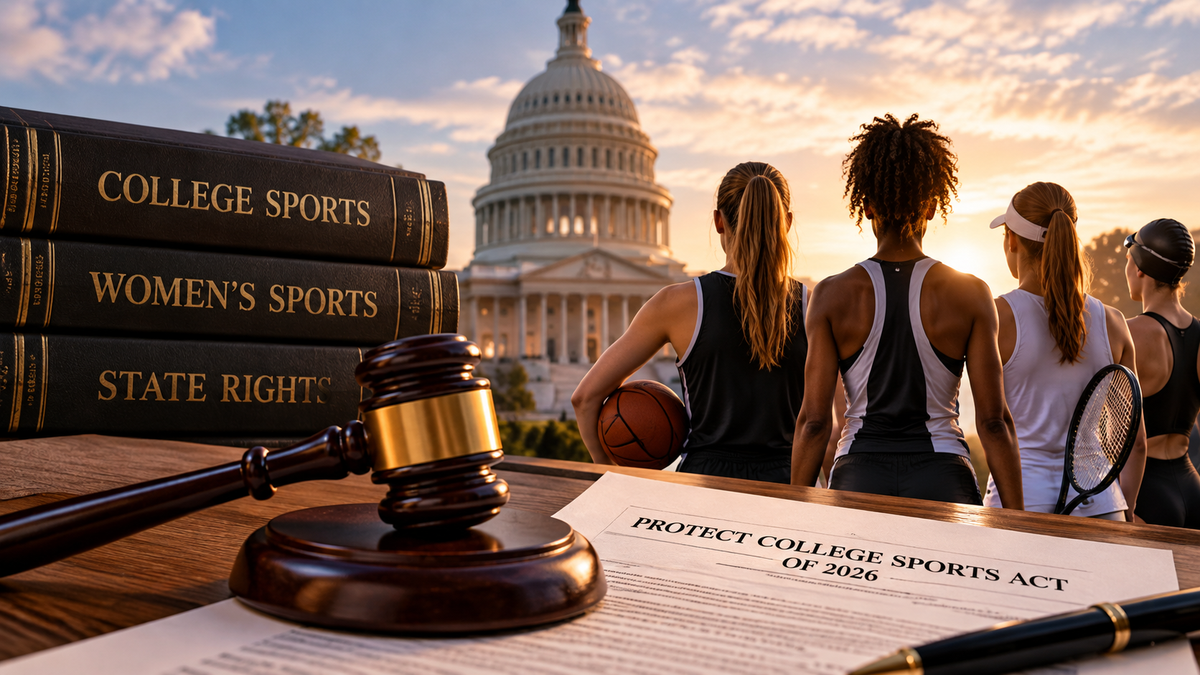
TL;DR: A 15-State coalition, led by Mississippi Attorney General Lynn Fitch and joined by Alabama Attorney General Steve Marshall, is urging Congress to preserve language in the Protect College Sports Act that protects States’ authority to restrict women’s college sports based on sex. The Attorneys General say an earlier version could have created a loophole that threatened State laws and enforcement powers. The revised language, they argue, makes clear that States can continue enforcing their own women’s sports laws.
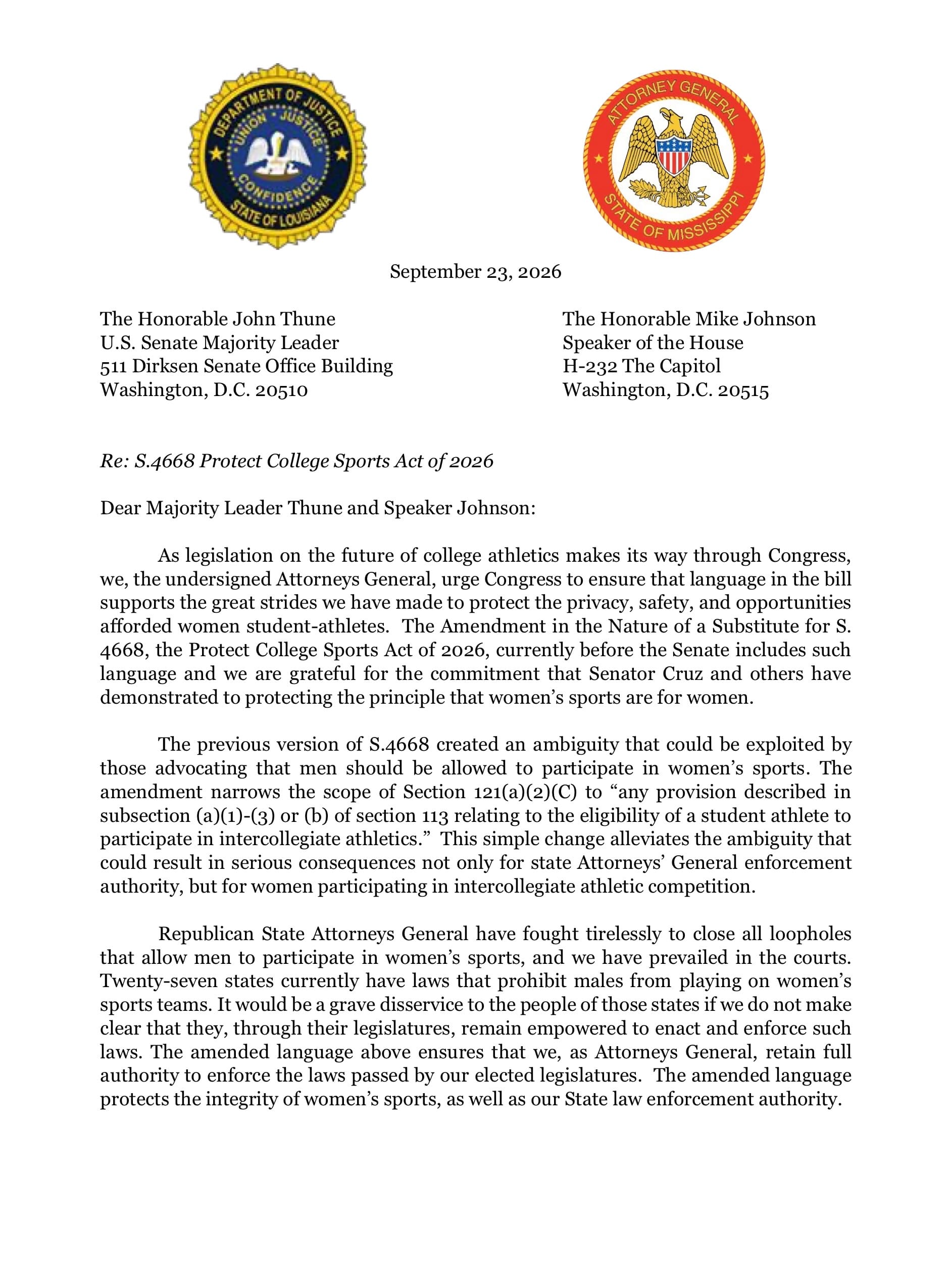
Mississippi Attorney General Lynn Fitch is leading a multi-State push urging Congress to make sure a sweeping college sports bill protects State laws governing women’s athletics.
Fitch, along with Louisiana Attorney General Liz Murrill and Alabama Attorney General Steve Marshall, led a coalition of 15 State Attorneys General asking congressional leaders to preserve language in the Protect College Sports Act of 2026 that addresses women’s sports.
The Sept. 23 letter was sent to Senate Majority Leader John Thune and House Speaker Mike Johnson, with a copy to Senate Commerce Committee Chairman Ted Cruz.
At issue is S. 4668, the Protect College Sports Act of 2026. The broad bill would reshape federal rules for college athletics, including name, image and likeness, or NIL, agreements. It also deals with revenue sharing, media rights and protections for women’s and Olympic sports. The Senate Commerce Committee advanced the bill in June on a bipartisan 19-9 vote.
However, Fitch and the other Attorneys General warned that an earlier version of the bill contained language they believed could interfere with State laws limiting women’s sports to female athletes.
“As legislation on the future of college athletics makes its way through Congress, we, the undersigned Attorneys General, urge Congress to ensure that language in the bill supports the great strides we have made to protect the privacy, safety, and opportunities afforded women student-athletes,” the coalition wrote.
The Attorneys General specifically backed revised language in an amendment to the bill. According to their letter, the change narrows a provision dealing with State laws and college athlete eligibility.
“The previous version of S.4668 created an ambiguity that could be exploited by those advocating that men should be allowed to participate in women’s sports,” they wrote. The revised language, they said, “alleviates the ambiguity that could result in serious consequences not only for State Attorneys’ General enforcement authority, but for women participating in intercollegiate athletic competition.”
The coalition argues that the distinction matters because 27 States have enacted laws restricting participation on women’s sports teams based on sex.
“Republican State Attorneys General have fought tirelessly to close all loopholes that allow men to participate in women’s sports, and we have prevailed in the courts. Twenty-seven States currently have laws that prohibit males from playing on women’s sports teams. It would be a grave disservice to the people of those States if we do not make clear that they, through their legislatures, remain empowered to enact and enforce such laws,” the letter states.
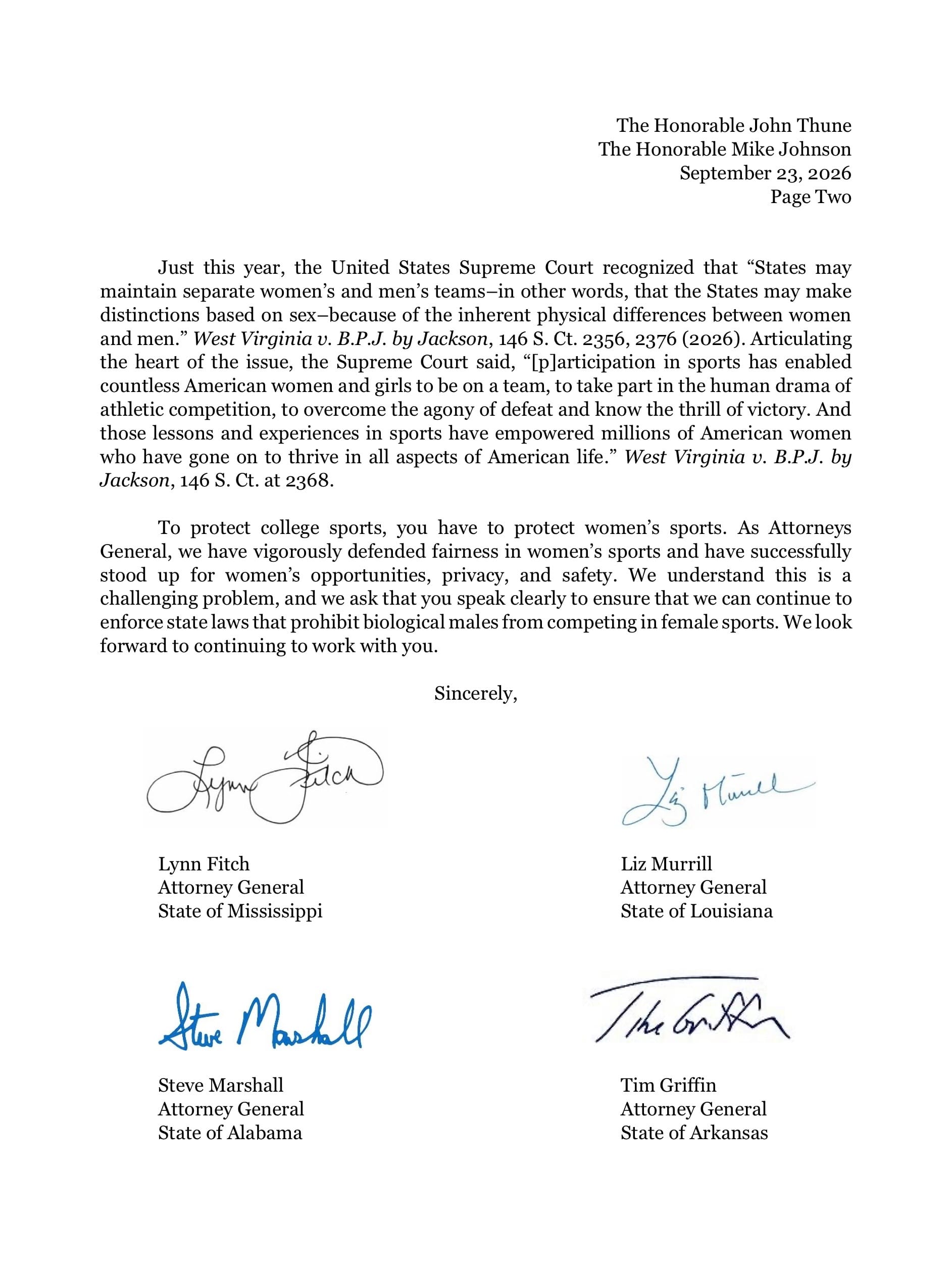
The Attorneys General also pointed to the U.S. Supreme Court’s 2026 decision in West Virginia v. B.P.J., in which the Court upheld State authority in this area. The coalition quoted the Court’s conclusion that States may maintain separate men’s and women’s teams based on sex.
Fitch’s coalition is asking Congress to make sure the final version of the college sports bill does not preempt those State protections or strip State Attorneys General of the power to enforce them.
“To protect college sports, you have to protect women’s sports,” the Attorneys General wrote. “As Attorneys General, we have vigorously defended fairness in women’s sports and have successfully stood up for women’s opportunities, privacy, and safety. We understand this is a challenging problem, and we ask that you speak clearly to ensure that we can continue to enforce State laws that prohibit biological males from competing in female sports.”
Marshall joined the Mississippi-led effort and issued his own Statement Thursday backing the proposed protections.
“In Alabama, we will not apologize for protecting opportunities that our female athletes have earned. Yet, the inclusion of this language in the Protect College Sports Act is unfortunately necessary to fix the culture of college sports and ensure that only women compete in women’s sports,” Marshall said.
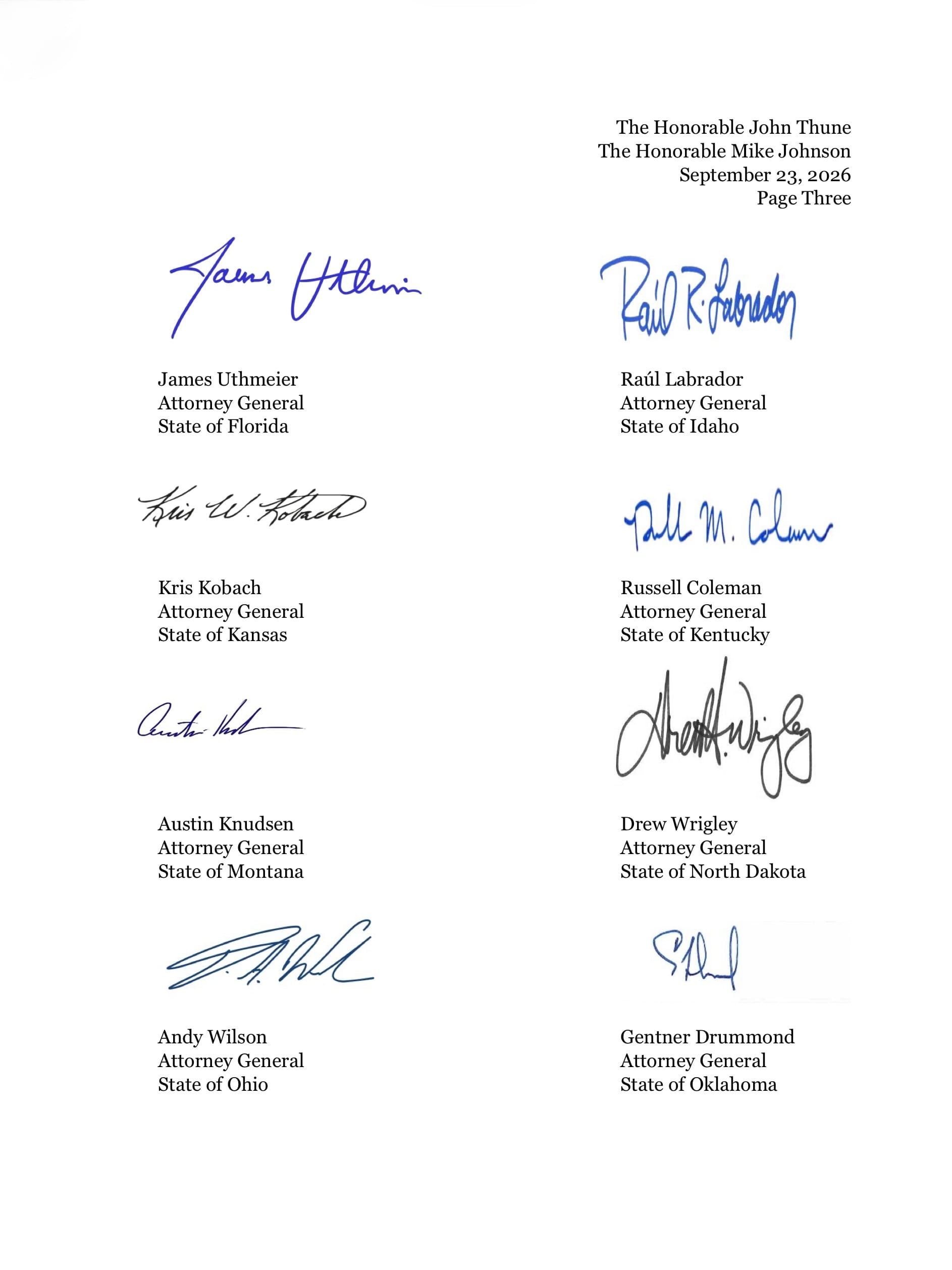
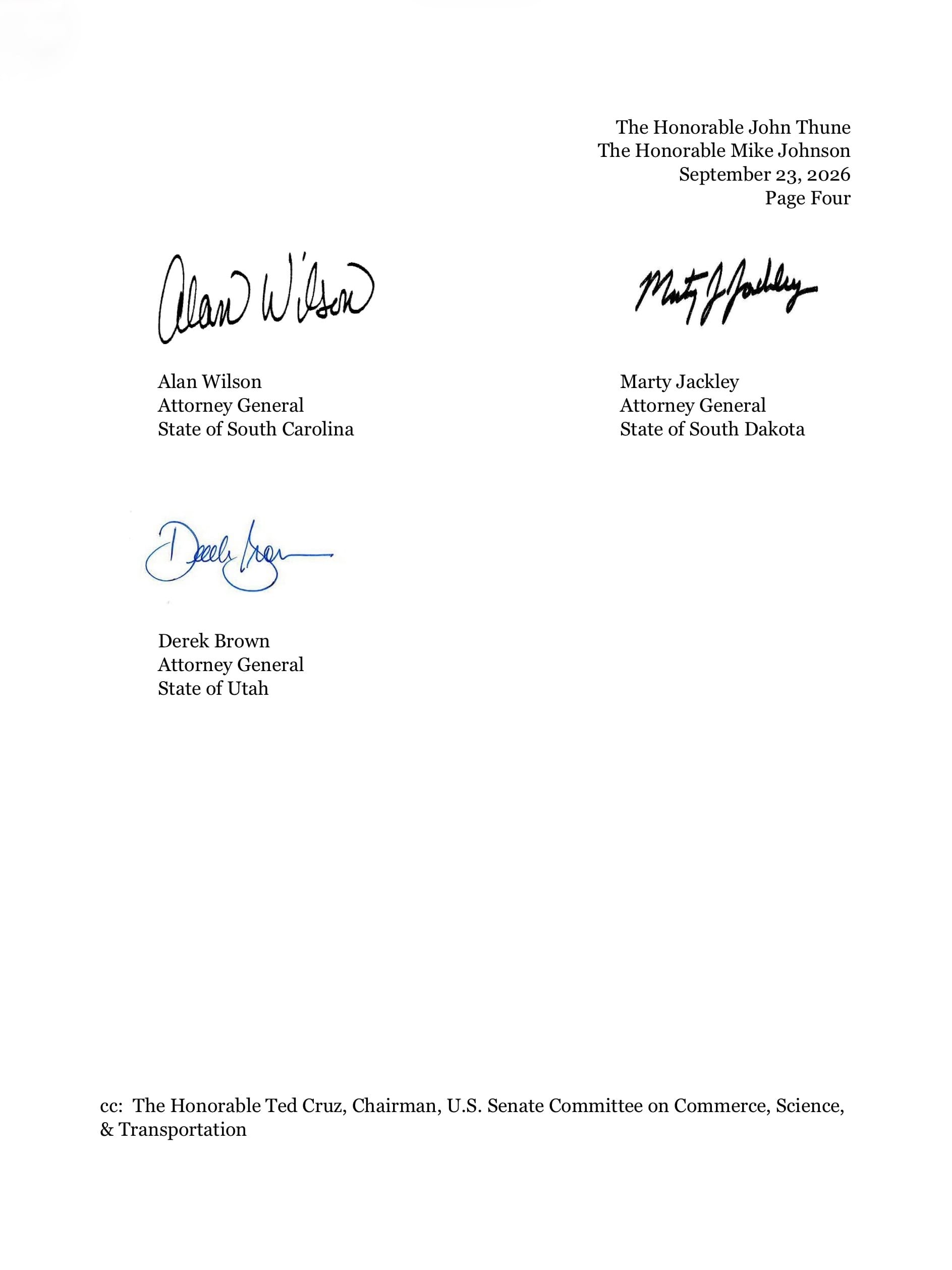
The letter was signed by the Attorneys General of Mississippi, Louisiana, Alabama, Arkansas, Florida, Idaho, Kansas, Kentucky, Montana, North Dakota, Ohio, Oklahoma, South Carolina, South Dakota and Utah.
The Protect College Sports Act was introduced by Cruz, along with Sens. Maria Cantwell, Eric Schmitt and Chris Coons. The measure would create a federal framework for NIL agreements and provide certain antitrust protections for colleges, conferences and athletic associations.
The bill already contains separate provisions aimed at preserving women’s and Olympic sports, including limits on reductions in teams, roster spots and scholarships. The Attorneys General’s concern is narrower: they want Congress to make clear that the federal law will not prevent States from enforcing their own eligibility laws governing participation on women’s teams.
The Trump administration has endorsed S. 4668, saying the measure would bring more stability to college sports and protect student athletes. In an August Statement, the White House said the President’s advisers would recommend he sign the legislation if it reaches his desk.
The AGs letter is attached below: