Alabama High Court Leaves 2022 Conecuh Sheriff Race Tied
Justices reject Randy Brock’s rehearing bid, leaving a 2022 Sheriff race tied as Conecuh County prepares to elect its next Sheriff
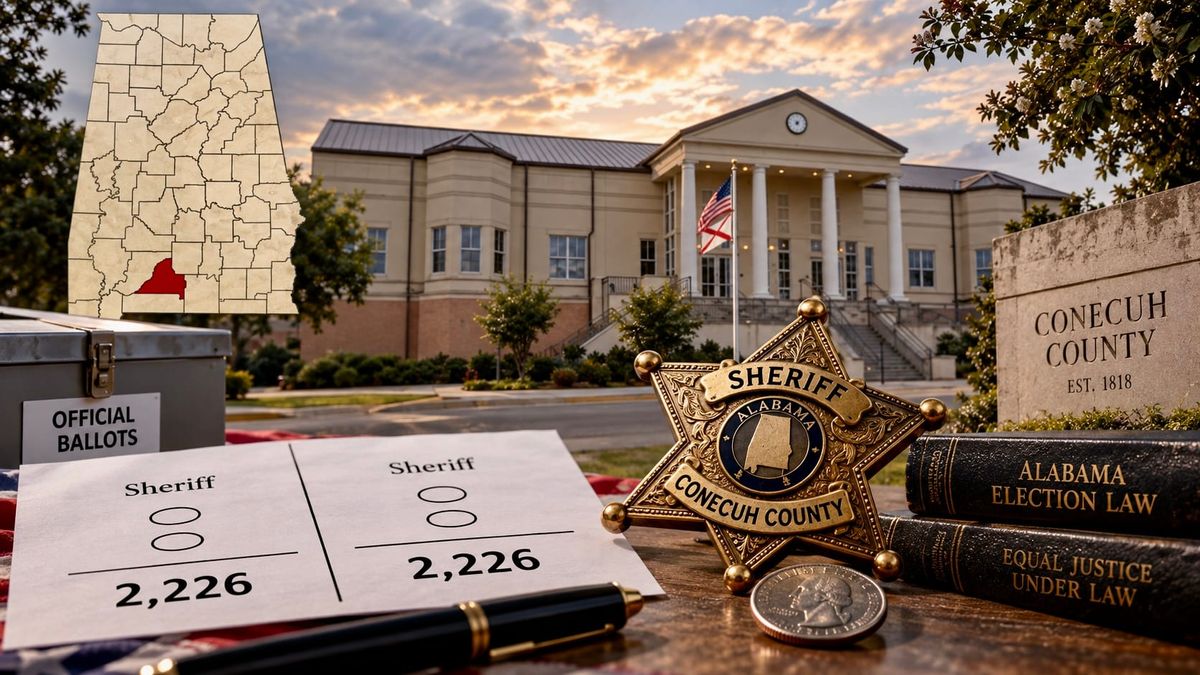
TL;DR: The Alabama Supreme Court has rejected Sheriff Randy Brock’s bid to rehear the disputed 2022 Conecuh County Sheriff’s election. The ruling leaves intact a June decision throwing out two improperly marked votes for Brock, turning his two-vote victory over Republican Mike Blackmon into a 2,226-2,226 tie. Alabama law calls for a tied county race to be settled by lot. Meanwhile, voters will choose a Sheriff for the next term on Nov. 3, when Democratic incumbent Brock faces Republican nominee Randal Brown.
Nearly four years after voters went to the polls, the Alabama Supreme Court has left the disputed 2022 Conecuh County Sheriff’s election exactly where it began: tied.
The Court on Friday, Sept. 4, overruled Democratic Sheriff Randy Brock’s application for rehearing in his election dispute with Republican Maxwell “Mike” Blackmon. The brief order stated, “APPLICATION OVERRULED; NO OPINION.”
The ruling leaves intact the Court’s June decision that two disputed ballots should not have been counted for Brock. That changes the legal vote total from a 2,228-2,226 Brock victory to a 2,226-2,226 tie.
The Alabama Republican Party celebrated the decision as an election integrity victory.
“This is a win not only for Mike Blackmon, but for every Alabama voter who expects our elections to be decided by lawful votes and according to the law,” ALGOP Chairman and State Rep. Scott Stadthagen (R-Hartselle) said. “When an election comes down to just two votes, every ballot matters.”
“We could not agree more. This decision sends a clear message that Alabama’s election laws matter and must be upheld.”
The dispute centers on two unusual ballots from the November 2022 election.
Blackmon and Brock were initially tied. During a recount, however, election officials counted two ballots for Brock that voting machines had rejected.
Neither voter had filled in the oval beside “ALABAMA DEMOCRATIC PARTY” to cast a straight-party vote. Instead, each had colored or scribbled over the Democratic Party logo.
The canvassing board interpreted those marks as straight-ticket Democratic votes. That gave Brock a 2,228-2,226 victory.
But…there was a problem.
The ballot specifically told voters, “TO VOTE YOU MUST BLACKEN THE OVAL COMPLETELY!” Both voters had also correctly filled in ovals elsewhere on their ballots when voting on constitutional amendments.
The Supreme Court found it impossible to determine what the marks over the Democratic logo meant.
Justice Chris McCool wrote that they could have been attempts to vote Democratic. But they could also have been “mere ‘scribblings’ or perhaps even a defiant ‘scratching out’ of the ‘logo’ of the political party they did not prefer.”
Without those two votes, the race is tied.
McCool wrote separately Friday to explain why he supported denying Brock’s rehearing request.
“Election integrity is therefore foundational to, and is the fundamental safeguard of, our system of government,” McCool wrote.
He argued that voters should be able to trust both that valid votes will be counted and that invalid votes will not.
Justice Will Sellers disagreed.
Sellers argued that the Court should rehear the case and affirm the trial court. He also questioned what practical purpose the ruling serves this late in Brock’s term.
“The majority’s decision to overturn the trial court’s ruling is futile because the election contest took nearly two and one-half years to be brought to trial and the next general election for Conecuh County Sheriff will take place on November 3, 2026,” Sellers wrote. Justice Greg Cook Mendheim joined his dissent.
McCool rejected that argument.
“When this Court is presented with a dispute in any type of case, I do not find it to be a futile act to uphold and enforce the law,” he wrote.
He added that the decision reaches beyond this race because it will guide the handling of ballots in future elections.
The case now returns to Conecuh Circuit Court with the 2022 election tied.
Under Alabama law, a tie for county office “shall be decided by lot by the judge of probate of the county in the presence of the candidates.” Conecuh County had prepared for a coin toss when the race first appeared tied in 2022, but the recount made it unnecessary.
Now the tie is back.
There is also an odd wrinkle created by the case’s extraordinary delay: the men fighting over the 2022 result will not simply have a rematch in November.
Blackmon announced last year that he planned to run again in 2026, but Randal Brown won the Republican nomination for Conecuh County Sheriff in the May 19 primary.
Brock, meanwhile, is seeking another term as the Democratic candidate. The Alabama Secretary of State lists the general election for Nov. 3, and the State has now certified the party candidates for the ballot.
That means Conecuh County is dealing with two Sheriff’s elections at once: a court fight over who legally won the 2022 term, and a general election on November 3 between Democrat Randy Brock and Republican Randal Brown to determine who serves the next term beginning in 2027.
Brock has served as Sheriff since January 2023.
Nearly four years after the ballots were cast, the legal winner of the 2022 election could still be determined by a coin flip — just weeks before Conecuh County voters go back to the polls to choose their next Sheriff.
Only in Alabama.