Alabama officials push to fast-track map appeals
Marshall, Allen seek quick rulings on Senate maps as courts weigh redistricting ahead of May 19 primary elections
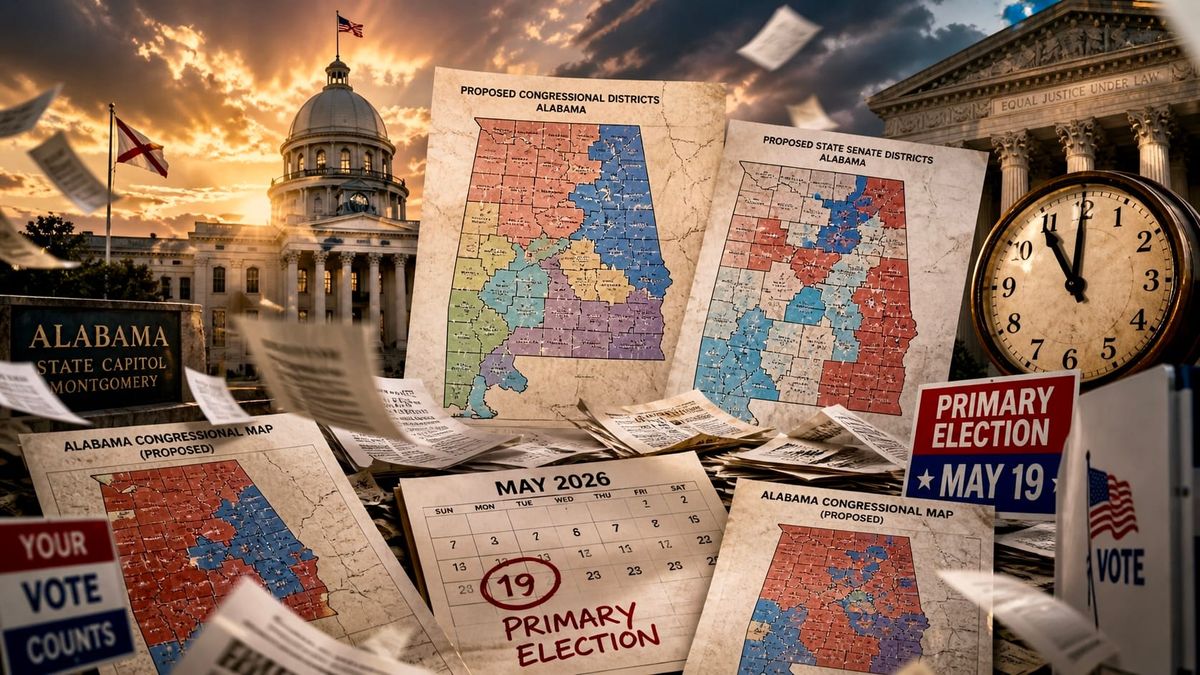
With Alabama’s primary election just two weeks away, State leaders are moving at a rapid clip to reshape the legal fight over redistricting.
Attorney General Steve Marshall and Secretary of State Wes Allen have both filed motions with the U.S. Court of Appeals for the Eleventh Circuit asking judges to quickly vacate or stay lower court orders blocking the State’s Senate map.
The filings center on a federal injunction that forced Alabama to abandon its 2021 State Senate districts and instead use a court-drawn plan. That order followed a ruling that the original map violated the Voting Rights Act of 1965 by diluting Black voting strength in the Montgomery area.
In a May 4 press release, Marshall said the State is seeking urgent relief ahead of the May 19 primary.
“Time is of the essence. We immediately filed a motion with the Circuit Court, urging a decision by May 8, because Alabamians deserve to vote using their own maps in our upcoming primary,” Marshall said.
He pointed to the recent Louisiana v. Callais decision as a turning point, arguing it undercuts the legal basis for the injunction.
“The South has changed, and the courts have acknowledged as much. We cannot be held indefinitely to a framework rooted in 1965,” Marshall added.
Allen echoed that urgency in a separate filing, asking the Eleventh Circuit to fast-track the appeal so election officials have clarity before ballots are finalized.
“As the appellant in both of Alabama’s redistricting cases, I am taking decisive legal action, in coordination with Attorney General Steve Marshall, to seek expedited judicial review,” Allen said. “Timely resolution is critical to provide clarity and stability for Alabama’s election process. The State has a primary role in drawing its legislative districts through its elected representatives, and continued delay prolongs federal court oversight beyond what is necessary.”

The push at the appellate level mirrors a broader legal strategy already underway in Washington. Both Marshall and Allen recently asked the Supreme Court of the United States to intervene in Alabama’s congressional redistricting fight, also citing the Callais ruling.
Both officials argued that earlier court orders blocking the State’s congressional map should be lifted in light of the high court’s new guidance. They also requested expedited consideration, warning that delays could disrupt upcoming elections.
In public remarks tied to those filings, Marshall said, “The Supreme Court has now made clear that you cannot assume race and politics are the same thing,” adding that Alabama “deserves the right to use its own maps, just like every other State.”
Allen similarly stressed the need for swift action, stating he has “taken the legal measures necessary… to ask the U.S. Supreme Court to take quick and decisive action.”
The legal scramble comes as Governor Kay Ivey has called a special legislative session to prepare for multiple possible outcomes. Lawmakers are weighing options for adjusting election timelines or authorizing new primaries if courts clear the way for different maps.
For now, the timeline is tight. State officials are pressing for rulings within days, not weeks, as ballots are set and campaigns enter the final stretch. And, as of Monday, May 4, Secretary Allen stated that “Alabama is proceeding with the May 19, 2026 Primary Election” as planned, while the State waits on the courts to rule.