Alabama's Beef Fight Is Missing the Actual Fix
Guest Opinion by Alicia Haggermaker
Guest Opinion by Alicia Haggermaker
Alabama's political class has found something to agree on, which is rare enough to notice. In the last two weeks, Rep. Shomari Figures has announced legislation to undo the Trump administration's tariff-free beef import expansion. Doug Jones and Ron Sparks have both put out statements accusing the White House of trying to lower prices "on the backs of American and Alabama farmers." And on the other side of the aisle, the Alabama Cattlemen's Association called the same policy "another slap in the face," Senator Katie Britt said she's hearing directly from worried constituents, and even the Republican nominee for agriculture commissioner warned the move "won't be sustainable in our capitalist economy."
Democrats and Republicans, cattlemen and candidates, all pointing at the same decision. That's worth pausing on, because it means the disagreement isn't really about whether the current approach is working. Nobody thinks it is. The disagreement is about what to do instead — and so far, what to do instead has mostly meant a bill to block imports, without much said about the actual hole underneath the imports.
Here's the hole. USDA counted 86.2 million cattle and calves nationally at the start of 2026, the lowest count in 75 years. Beef is a $2.5 billion industry in Alabama, and the state carries roughly a million and a quarter head of cattle on its own pastures. Every statement coming out of Montgomery this month is correctly describing the symptom — foreign beef flooding in while domestic prices stay high and Alabama producers eat rising fertilizer, diesel, and equipment costs. Almost none of it is addressing why the herd got this small in the first place, or what it would actually take to rebuild it.
Importing more beef doesn't put another cow on an Alabama pasture. Blocking the import doesn't either. Both sides of this fight are arguing about the valve, not the pipe.
The valve versus the pipe
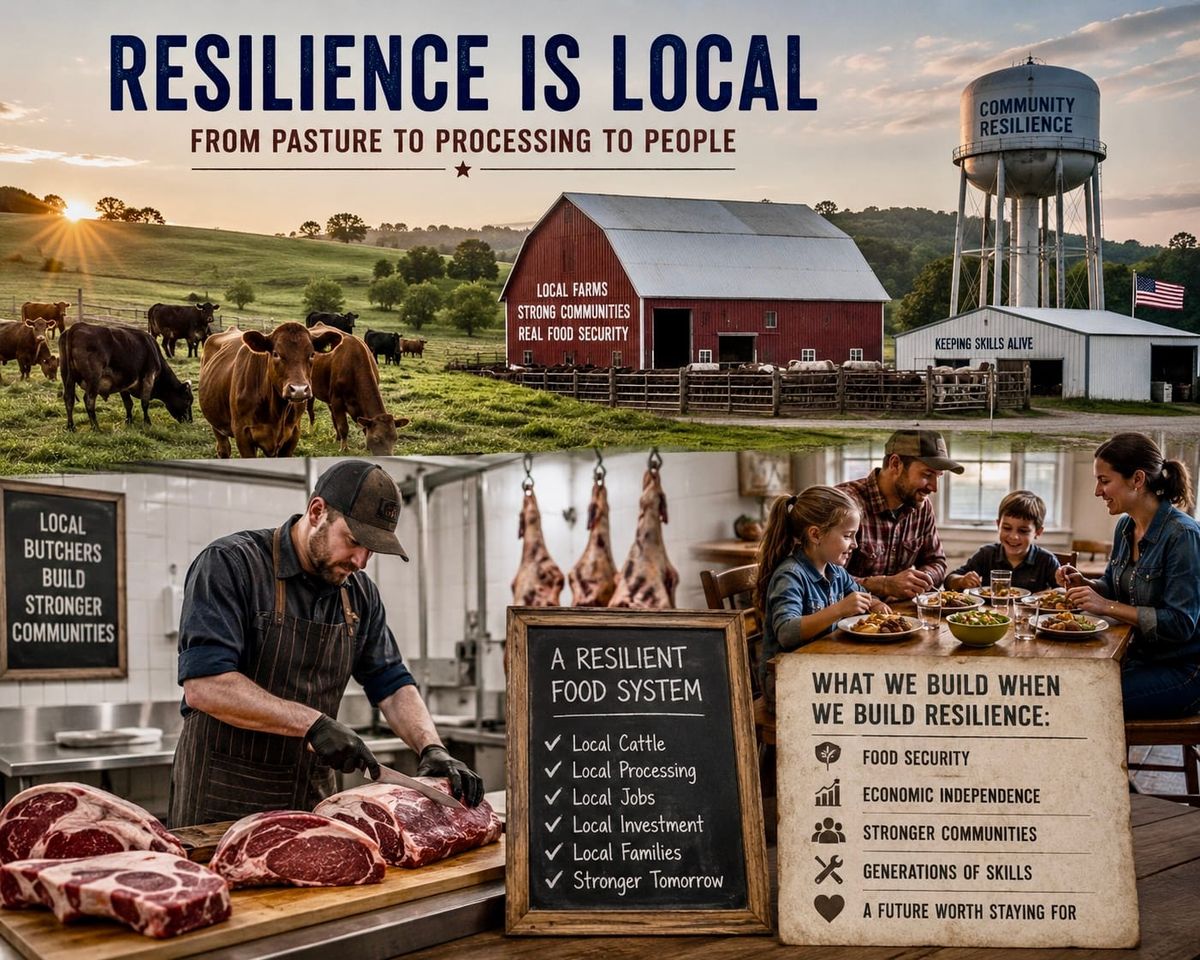
The actual bottleneck isn't just how many cattle exist — it's what happens to them after. Alabama doesn't lack pasture or ranchers willing to expand. It lacks the capital to expand a herd, the local processing capacity to turn more cattle into product without hauling them hours out of state, and the kind of predictable, committed demand that makes a lender willing to finance a new butcher shop instead of betting the shop will find customers after it opens.
That's a solvable structural problem, and it doesn't require picking a side in the tariff fight to solve it. A farmer with land and cattle but not enough capital to add ten more head doesn't need an import ban — they need ten families willing to commit to buying shares of that beef in advance, turning speculative expansion into something a bank will actually underwrite. A cooperative that aggregates that kind of demand across a community can do the same thing for a butcher who's been waiting to see if customers show up before investing in a bandsaw: walk in with six hundred households already committed, and the shop becomes financeable rather than a bet.
None of that shows up in this month's press releases, from either party, because it's slower and less quotable than a bill announcement. But it's the part that actually rebuilds a herd instead of just managing who gets to sell into the shortage.
The wrinkle nobody's mentioned yet
There's a complication worth naming, because it cuts across the partisan lines currently drawn on this issue. On August 28 — the same week Figures announced his bill — Trump posted that he was "authorizing legal documents to be drawn" to let farmers and ranchers process their own meat, framing it as breaking the grip of the four companies that handle roughly 85% of U.S. fed-cattle slaughter. Agriculture Secretary Brooke Rollins followed with a five-point outline: cutting processing red tape, expanding ranchers' ability to sell across state lines, rescinding "outdated guidance," funding support for small processors, and expanding truth-in-labeling requirements.
It's worth being precise about what that actually was at the time: an announcement that documents would be drawn, not a change to federal law or USDA regulation. There's already a real bill aimed at the actual barrier — Rep. Thomas Massie's PRIME Act, which would let state-inspected local slaughterhouses sell meat within their state without full federal inspection. A pilot version made it into the Farm Bill the House passed in April, but it isn't in the Senate's draft, still stuck in the Senate Agriculture Committee. Massie's own reaction to Trump's announcement was blunt: "This is great, but it should be a law, not just an executive order," he wrote, pointing back to his own bill's dozens of bipartisan cosponsors. Meat industry groups have already warned about "unwitting consumers" buying uninspected product if the wrong lever gets pulled, and at least one agricultural economist not tied to either side has said the actual volume shift would be too small to change the broader market on its own.
But if it's done carefully — with real inspection standards intact, not just a barrier removed — this is the same "build capacity instead of managing scarcity" argument Alabama's own cattlemen and its own Democratic candidates are both gesturing at, coming from a direction neither expected. It's an opening, not a solution by itself. Legal permission to process locally doesn't supply the capital, the trained butchers, or the accountability infrastructure a cooperative model would still need to build around it.
What Alabama could actually do
Alabama doesn't need to wait on Washington to resolve the tariff fight to start on the part that actually matters. A state or regional cooperative model — aggregating demand, financing local processing capacity, keeping cattle and capital inside Alabama's own communities instead of routing both through four national companies — is available right now, regardless of how the import fight shakes out. It's the kind of investment Ron Sparks gestured at when he said Alabama should be "investing in Alabama agriculture, not undercutting them," and the kind of self-sufficiency the Cattlemen's Association is implicitly asking for when it objects to depending on foreign supply to fill a domestic gap.
Both sides are already describing the same problem. Nobody in Montgomery has proposed the fix that doesn't require winning the other side's votes first.
Alicia Haggermaker is an investigative journalist, systems analyst, and community organizer based in Huntsville, Alabama. She publishes at Unprecedented Times (unprecedentedtimes.org) and is the founder of the Mycelium Network — a sovereign community coordination platform built as an alternative to the infrastructure this series documents.
unprecedentedtimes.org | mycelium.unprecedentedtimes.org
Opinions do not reflect the views and opinions of ALPolitics.com. ALPolitics.com makes no claims nor assumes any responsibility for the information and opinions expressed above.