Chatrie Ruling Puts Flock Cameras on Defense
The new Supreme Court ruling on geofence warrants is already shaking up cases involving Flock license plate readers
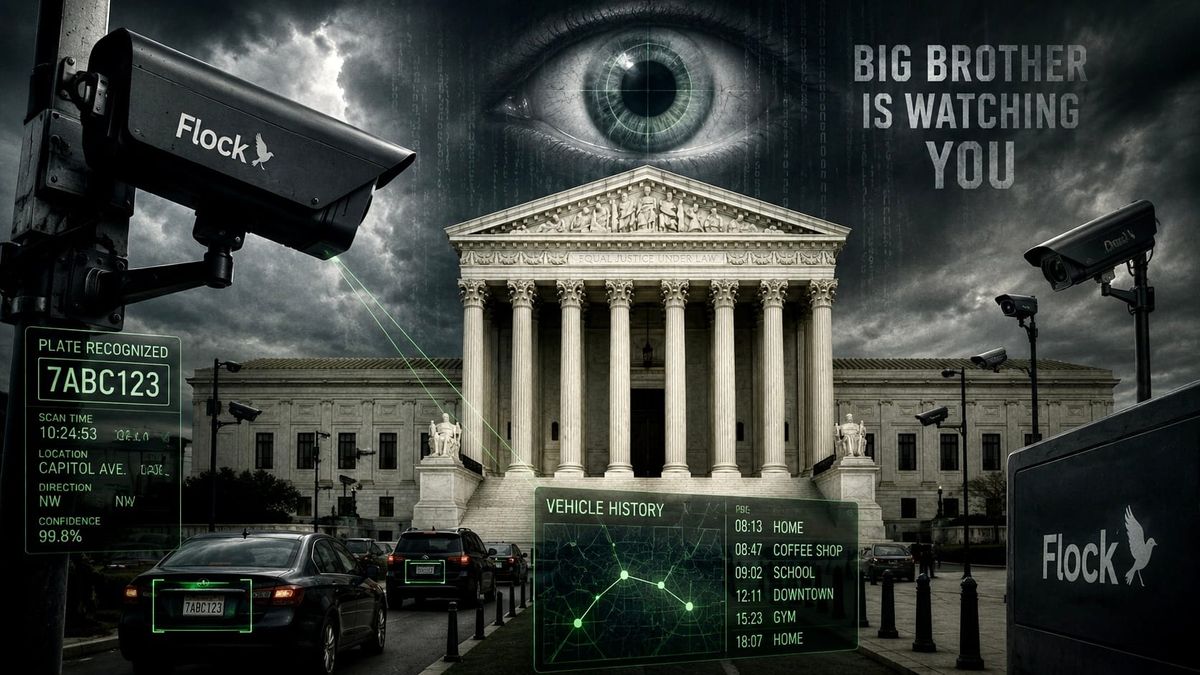
The U.S. Supreme Court’s new Fourth Amendment ruling in Chatrie v. United States is already sending shock waves into other surveillance cases.
One of the first places that ripple is showing up is Schmidt v. City of Norfolk, a Fourth Circuit case challenging Norfolk, Virginia’s use of Flock Safety automated license plate readers.
In Chatrie, the Supreme Court ruled that police conducted a Fourth Amendment search when they obtained Okello Chatrie’s Google location history after a 2019 Virginia bank robbery. The Court did not throw out the evidence. It sent the case back to the Fourth Circuit to decide whether the warrant met the Fourth Amendment’s rules for probable cause and particular detail.
The case centered on a geofence warrant. That type of warrant lets police draw a digital boundary around a crime scene and ask a company like Google to identify devices that were inside that zone during a set time.
The Court rejected the idea that Chatrie lost his privacy interest just because Google held the data. As the Court put it, “It does not matter if the time period scrutinized was only two hours,” and it did not matter that the data came from “a third-party tech company.”
That matters far beyond Google.
In Norfolk, Lee Schmidt and Crystal Arrington sued over the city’s Flock camera network. The Institute for Justice says Norfolk installed more than 176 cameras that record cars as they move through the city. The cameras collect plate data, upload it to a database, and allow officials to search past movements without a warrant.
Norfolk won in federal district court in January. The court held the city’s ALPR system did not violate the Fourth Amendment because it did not capture the “whole” of a person’s movements. Schmidt and Arrington appealed to the Fourth Circuit.
Now Chatrie has complicated that defense.
The defense of the City of Norfolk leaned on a 2024 Fourth Circuit panel ruling in United States v. Chatrie, which held that the collection of geofence data was not a search. But that panel ruling was later vacated, and the Supreme Court’s ruling in Chatrie replaced it with a very different rule.
That does not mean Norfolk loses automatically. Cell phone location data and license plate cameras are not the same thing. But the core issue is close enough to matter: Can the government use a private company’s giant database to reconstruct where people have been without first getting a warrant?
Flock’s system raises that question in a stark way.
Cato says Norfolk’s Flock cameras use AI to record not only plates, but also vehicle make, type, color and special features, including bumper stickers — as the company itself has confirmed. Cato also says officers can chart a person’s movements across the city with “almost no restrictions or oversight.”
The ACLU, ACLU of Virginia and Electronic Frontier Foundation filed an amicus brief in Schmidt arguing that ALPR systems collect sensitive location data from people not suspected of any crime. They warned that the data can be searched weeks, months or even years later across city and State lines.
That is the Fourth Amendment problem. One plate scan may not reveal much. A citywide web of scans over time can reveal a person’s church, doctor, gun range, school, workplace, political activity and home life.
The privacy concerns become even more pronounced when Flock cameras are viewed as a network rather than as isolated devices. In a landmark 2013 study, researchers at MIT's Media Lab and the Université catholique de Louvain found that just four discrete spatiotemporal data points were enough to uniquely identify 95% of 1.5 million supposedly anonymous cell phone users. The researchers concluded that human mobility patterns are so distinctive that even coarse location data provides "little anonymity."
Critics argue that Flock's growing camera network creates much the same effect. Every time a vehicle passes a Flock camera, another point is added to its travel history. As more cameras are installed, those individual observations can combine into what privacy advocates describe as a "digital fingerprint" of a person's daily life. The addition of Bluetooth and Wi-Fi sensing devices such as SignalTrace — developed by Leonardo US Cyber & Security Solutions and marketed as an add-on for automated license plate reader systems — that some agencies deploy alongside license plate readers, can make those movement profiles even more precise by linking nearby wireless devices with vehicle sightings. SignalTrace uses Bluetooth, Wi-Fi, RFID and other radio-frequency signals to associate electronic devices with vehicles and create what the company calls an 'electronic signature.' Although SignalTrace is not a Flock product, privacy advocates warn that it demonstrates how ALPR infrastructure can evolve from identifying vehicles to identifying the people traveling inside them.
While the technologies serve different purposes, together they can substantially increase the government's ability to reconstruct (or follow in real time) where people travel, whom they meet, and the routines that define their private lives.
In light of the above, Justice Neil Gorsuch’s separate Chatrie opinion may be even more important over time.
Gorsuch agreed with the result but wrote separately to question two pillars of modern Fourth Amendment law: the “reasonable expectation of privacy” test and the third-party doctrine. Reason summarized his critique as an attack on doctrines that are “indefensible in theory and unworkable in practice.”
Under the third-party doctrine, the government often argues that people lose Fourth Amendment protection when they share data with a bank, phone company or tech platform.
Gorsuch was not buying it.
He wrote that the third-party doctrine can let the government search “almost whatever it wants whenever it wants.” He suggested a better path is the text of the Fourth Amendment, which protects “persons, houses, papers, and effects.”
That approach could pose real trouble for mass surveillance networks. If a person’s digital location history — a significant part of their “digital fingerprint’ — can be treated as a protected “effect,” courts may soon ask whether stored license plate histories deserve similar treatment.
Flock and its defenders argue that the cameras help solve crimes, recover stolen cars and find suspects. Those benefits are real. But they do not answer the core concern. A tool can help police and still pose a grave threat to privacy if it tracks everyone first and asks questions later.
The misuse record is no small matter.
404 Media reported in June that there have been “more than a dozen” cases around the country where police used Flock to stalk people. In one Florida case, officer Jarmarus Brown allegedly searched his ex-girlfriend’s plate at least 69 times, her mother’s plate at least 24 times and her father’s plate at least 15 times.
The Institute for Justice later updated its own review and found at least 21 cases of officers allegedly abusing ALPR data to stalk romantic interests. Nearly all were charged and lost their jobs, according to IJ.
“The fundamental problem with these systems is that they place private information about people’s movements over time in the hands of every officer,” IJ attorney Michael Soyfer said. “Without the constitutional safeguard of a warrant requirement, that predictably allows officers to abuse their access to these systems for things like stalking romantic partners.”
Cities are starting to notice.
Business Insider reported that Dayton, Ohio workers covered Flock cameras with trash bags after an internal review found “egregious violations” of city policy, including thousands of immigration-related search requests. Evanston, Illinois moved to end its Flock contract after a State audit found Illinois license plate data had been shared with federal agencies.
The Guardian reported that Mountain View, Santa Cruz, South Pasadena and other California cities have terminated or paused Flock systems amid concerns over data sharing, ICE access and contract language.
Privacy groups also point to the scale. State of Surveillance reported that Flock scans more than 20 billion license plates per month and says more than 5,000 law enforcement agencies use the network.
That scale is the point. This is not a single patrol officer seeing a plate on a public road. It is a private, networked, searchable record of mass travel.
Chatrie does not decide the Flock issue. But it removes one of the strongest supports for those who want courts to treat modern digital dragnets like old-fashioned police observation.
The Supreme Court has now said that even a limited slice of location data held by a third party can trigger the Fourth Amendment.
The Fourth Circuit must now decide whether Norfolk’s Flock system is just a set of cameras on public roads, or a warrantless search engine for the daily lives of ordinary drivers.
That question is no longer theoretical. It is headed straight for the courts, city councils and every town that has put a Flock camera on a pole.
For more information on automated license plate readers, including a map of Flock cameras deployed nationwide, visit https://deflock.org.