SCOTUS Reins In Digital Dragnet Warrants
High Court says police searched Chatrie’s data, as Gorsuch warns old privacy doctrines no longer fit modern surveillance in 4th Amendment case
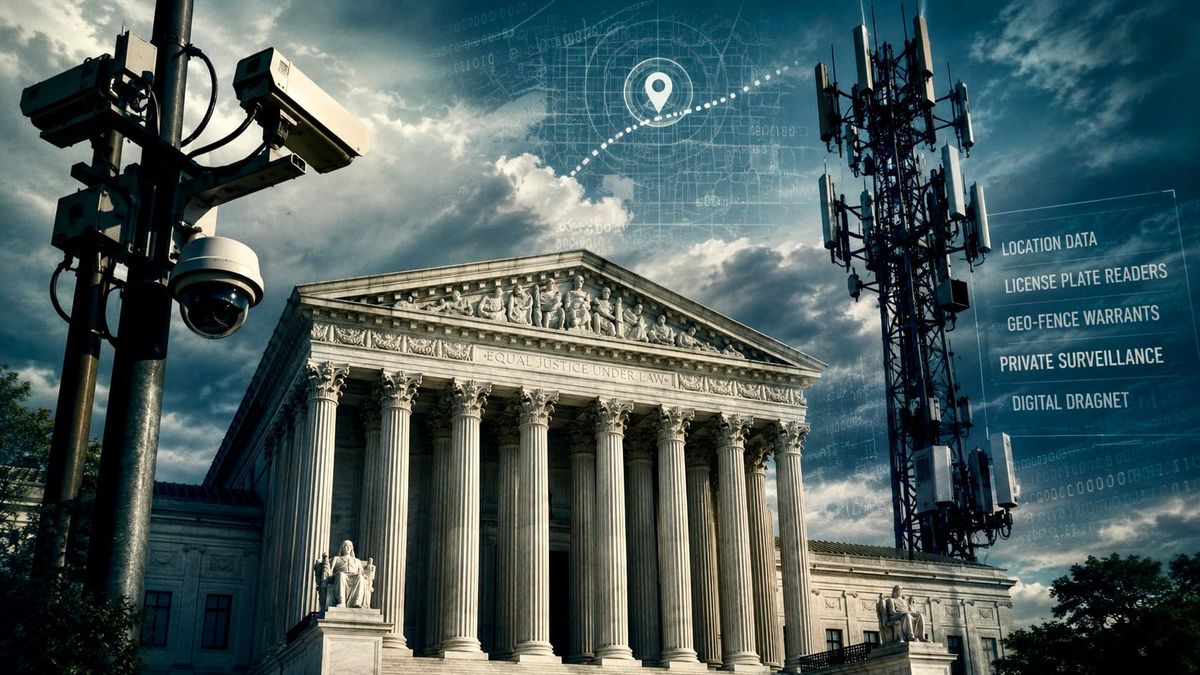
The U.S. Supreme Court has handed down a major Fourth Amendment ruling that could reshape how police use digital dragnets, geofence warrants and private surveillance tools.
In Chatrie v. United States, the Court ruled that police conducted a Fourth Amendment search when they obtained Okello Chatrie’s Google location history after a 2019 Virginia bank robbery. The Court did not throw out the evidence or decide whether the warrant was valid. Instead, it sent the case back to the Fourth Circuit to decide whether the warrant met the Fourth Amendment’s rules for probable cause and particular detail.
Justice Elena Kagan wrote for the Court that people have a real privacy interest in their cell phone location data. The Court rejected the government’s claim that Chatrie lost that privacy right because Google held the data.
“It does not matter if the time period scrutinized was only two hours,” the Court said. “Nor does it matter that the materials obtained were handed over by a third-party tech company.”
The ruling marks a clear warning to law enforcement: police cannot avoid the Fourth Amendment by asking a tech firm for data that tracks where people have been.
The case centered on a geofence warrant. That type of warrant lets police draw a digital boundary around a crime scene and ask a company like Google to identify devices that were inside that zone during a set time.
The Court said even short-term location tracking can expose intimate facts. Citing past precedent, the opinion noted that short-term monitoring can reveal “a wealth of detail” about a person’s family, faith, politics and private life.
Justice Neil Gorsuch agreed with the result but wrote alone to take aim at two doctrines he sees as deeply flawed: the Katz “reasonable expectation of privacy” test and the third-party doctrine.
Under Katz, courts ask whether a person had a reasonable expectation of privacy. Under the third-party doctrine, the government often argues that people lose privacy rights when they share data with a bank, phone company or tech platform.
Gorsuch said that mix has left courts guessing. He compared it to the old obscenity test, writing that courts now seem to know a “reasonable expectation of privacy” and an exception to the third-party doctrine only “when we see it.”
Gorsuch argued for a more direct approach rooted in the text of the Fourth Amendment. The amendment protects “persons, houses, papers, and effects.” In his view, digital location history may be one of a person’s protected “effects,” even if Google stores it.
“Mr. Chatrie's Location History data qualifies as his personal property,” Gorsuch wrote. “Why is the Court so protective of Location History data, email, and electronically stored photos and calendars?“ he went on. “Because, it turns out, 'a user reasonably understands' all those things 'as his own.' Put another way, they are his effects. And why does the Court hold Mr. Chatrie's effects protected by the Fourth Amendment even though a third party stores them? Because, the Court says, those effects remain his 'even though [they are] stored on Google's servers.' Put another way, entrusting your effects to a third party for certain agreed purposes doesn't mean they are no longer yours."
That critique could matter well beyond Google geofence warrants.
Across the country, police departments are using private surveillance tools such as Flock Safety license plate readers. Flock’s own marketing says its systems let users search vehicles, time and location “in seconds” and share evidence across agencies.
Privacy groups say that is the problem. The Electronic Frontier Foundation and ACLU of Northern California sued San Jose in 2025, arguing the city’s nearly 500 license plate readers let police conduct warrantless searches of “millions of drivers’ private habits, movements, and associations.”
EFF has also warned that Flock cameras photograph cars, log plates, record time and place, and upload that data to a searchable database that can be shared with other agencies. This information has already been used to monitor protests against ICE, at least one No Kings rally, and more.
And lest we forget, Google cell phone data — exactly as was addressed in Chatrie — was used to surveil and arrest protestors at the Capitol building on January 6, 2021.
The Chatrie ruling does not decide whether Flock searches need warrants. But it gives future challengers a stronger argument. If police need Fourth Amendment scrutiny before searching Google’s location history, courts may soon have to ask the same hard question about private camera networks that track cars across cities, counties and State lines.
The decision is also a warning about the government’s growing habit of using private companies as a back door around constitutional limits.
For now, Chatrie is not the end of the fight. It is the start of the next one.
The full ruling in Chatrie may be read HERE.