
Dept. of Ag & Industries Pushes Back on Sparks’ Gas Pump Claims
The Department says Alabama still regulates fuel pumps, disputing claims that consumers are left on an “honor system”
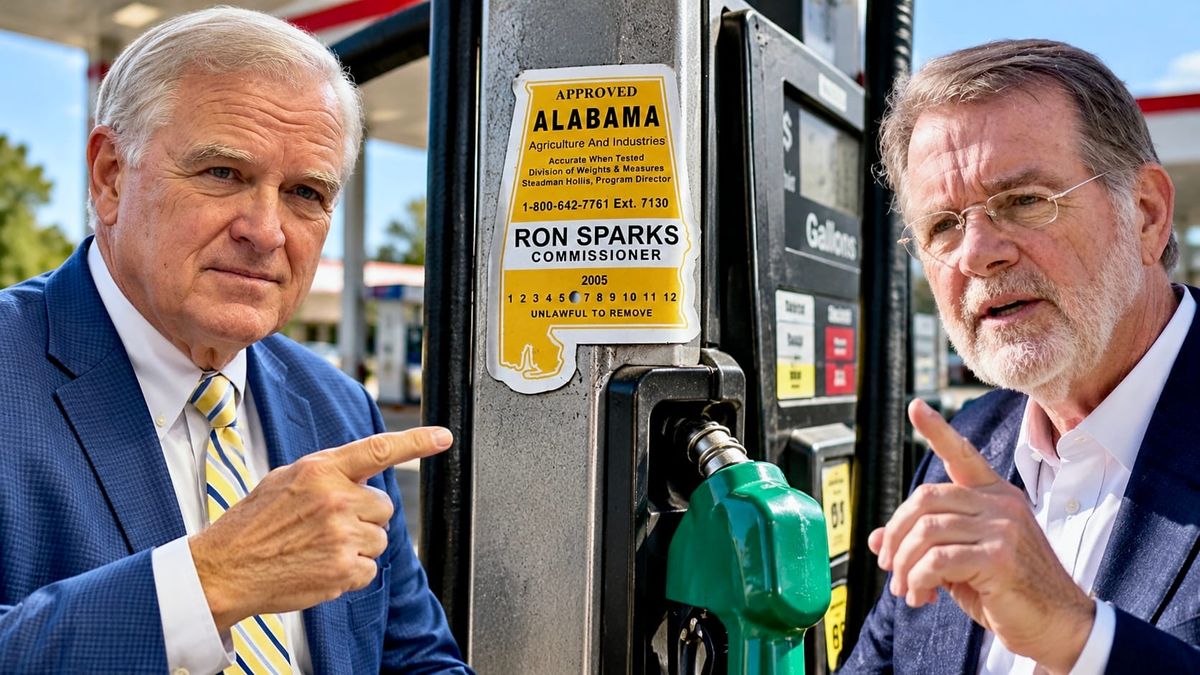
TL;DR: Alabama’s Department of Agriculture and Industries is pushing back on campaign claims from Democratic Agriculture Commissioner nominee Ron Sparks and former Republican Attorney General Troy King that gas-pump oversight has largely shifted to an “honor system.” Sparks says the State-run inspection program he used as Commissioner ended in 2015. ADAI says the system changed, but State oversight and enforcement did not end. The agency says ADAI and licensed technicians reported inspecting more than 104,000 pumps and meters in a recent fiscal year, while State inspectors still investigate complaints, conduct inspections and can shut down faulty pumps.
The Alabama Department of Agriculture and Industries is pushing back on claims that the State no longer provides meaningful oversight of gas pumps, putting the agency squarely in the middle of an issue raised in this year’s race for Agriculture Commissioner.
In an October 1 statement titled “ADAI Addresses Weights & Measures Misinformation,” the department disputed recent claims that Alabama consumers are relying on an “honor system” at gas stations and that businesses must report their own violations.
The statement comes after Democratic nominee and former Agriculture Commissioner Ron Sparks made gas-pump inspections a campaign issue.
On his campaign website, Sparks promises, “You Pay for a Gallon, You Get a Gallon of Gas.” He argues that a State inspection program used during his prior tenure was later halted.
“During my time as Commissioner, I implemented a law that required the Department of Agriculture & Industries to inspect and certify every gasoline pump across our State, both for accuracy and safe operation,” Sparks says on his website. “Unfortunately, this program was stopped in 2015, meaning that there are no elected officials looking out for your pocketbook and peace of mind at the pumps.”
Sparks promises to restore that system if elected.
“When I am again elected Commissioner of Agriculture in Alabama, I will bring this program back into full operation,” Sparks continues. “In these uncertain economic times, your elected officials in Alabama must do everything possible to ensure efficiency and accuracy so that you can go to your favorite gas station without having to worry that unscrupulous operators are giving you less than what you paid for.”
The dispute gained more attention this week after former Republican Attorney General Troy King endorsed Sparks and raised similar concerns.
As reported by WTVY, Sparks said State employees no longer conduct inspections the way they did during his tenure.
“I want to bring the inspectors back. They no longer inspect from the department side. It’s public. It’s out in the private sector now,” Sparks said.
King went further in a campaign ad, claiming that Alabama consumers are now “on the honor system” and suggested businesses can avoid consequences unless violations are self-reported.
ADAI says that characterization is wrong.
“Recent claims suggesting that Alabama consumers are operating on an ‘honor system’ at the gas pump and that businesses must self-report violations are vastly inaccurate,” the department said. “ADAI continues to actively regulate commercial weighing and measuring devices throughout the State and remains the enforcement authority.”
There is an important distinction at the heart of the dispute. Alabama now relies in part on registered private service technicians to service and calibrate commercial measuring devices. But those technicians operate under a system licensed and overseen by the State.
In fact, the Alabama Administrative Code requires commercial weighing and measuring devices to be serviced and calibrated at least once each fiscal year by a registered service agent. That rule took effect in June 2014.
ADAI says those private technicians do not replace the department’s enforcement role.
The department licenses and monitors technicians, conducts its own inspections, investigates consumer complaints and can take enforcement action. The agency’s current Weights and Measures webpage says the division “inspects and regulates” commercial weighing and measuring devices across Alabama, including gas pumps.
State inspectors also retain the power to condemn devices that fall outside required standards and remove them from commercial use until the problem is fixed. ADAI can issue stop-sale orders when products violate State or federal requirements.
“The suggestion that Alabama consumers are operating on an honor system is an inaccurate representation of the work being done by this department,” Agriculture Commissioner Rick Pate said. “Our employees are in communities across Alabama every day protecting consumers and maintaining fairness in the marketplace.”
“To suggest that businesses can simply cheat consumers unless they choose to report themselves is misleading and discounts the work our inspectors perform every day,” Pate continued. “Anyone who says otherwise is either uninformed or disingenuous.”
Pate made a similar point to WTVY, telling the station that while the inspection system changed after Sparks left office, enforcement did not disappear.
“It’s not on the honor system in any shape, form, or fashion,” Pate said. “I condemned four or five gas pumps last week.”
The department says Alabama has about 5,000 retail fuel locations with more than 100,000 gas pumps, plus more than 25,000 commercial scales.
State records provide support for ADAI’s claim that a large inspection and testing program remains in place. An Alabama State performance report lists 104,100 pumps and meters inspected and 8,256 petroleum products tested during the reported fiscal year. The figures cited by ADAI include work performed by the department and licensed service technicians rather than State inspectors alone.
Current State rules also carry real penalties. Under the Alabama Administrative Code, a business operating a petroleum measuring device that has gone without required servicing or calibration for two fiscal years can face a $5,000 fine per location. An audit of prior years can push the maximum penalty to $25,000 per location.
“All complaints received by our division are addressed within 24 to 48 hours,” Weights & Measures Director Stacy Boshell said. “The costs of violations are substantial, up to as much as $25,000.”
“We work to ensure everyone is treated equally and fairly,” Boshell went on. “Protecting both consumers and businesses through accurate weights and measures remains our priority.”
That leaves the campaign dispute resting on a narrower question than whether Alabama has any gas-pump oversight at all.
Sparks is arguing for a return to the more direct State inspection model used during his tenure. ADAI says the current model uses licensed private technicians to extend its reach while keeping inspection, complaint and enforcement powers in State hands.
Consumers who suspect a gas pump, scale, price system or other regulated device is inaccurate can contact ADAI’s Weights & Measures Division at 334-240-7133. The department says complaints are addressed within 24 to 48 hours.