Do Polls Overstate Democrat Support?
Past Senate polling misses raise doubts about a blue tsunami. A six-point test shows how quickly several races could turn red

TL;DR: Senate polls have often overstated Democratic margins in recent cycles, especially in three Midwest states. Another miss could turn a Blue Tsunami into a trickle. But six points is a hypothetical adjustment, not a proven rule for 2026.
The threatened Blue Tsunami could still crash over the shore of the Senate. Or, it could arrive as a trickle — or fail to materialize at all.
Recent polling history gives Republicans grounds to question narrow Democratic leads. It does not give either party grounds to declare the election settled this far in advance of Election Day.
Republican pollster Patrick Ruffini’s review of 3,312 Senate polls across the 2018, 2020, 2022 and 2024 cycles found that 73% overstated the Democrat’s margin compared with the final result. The average error favored Democrats by 3.7 percentage points.
The gap was widest in summer, peaking near 5.9 points in late July before narrowing to 2.6 points by Election Day. Ruffini found a key difference, though: Midterm Senate polls became fairly accurate by Election Day, while polls in presidential years retained a Democratic lean.
That leaves reason for doubt, rather than a fixed six-point rule.
His October follow-up focused on Iowa, Michigan and Ohio. Across past-cycle polls in those states, 93% overstated the Democrat. At 33 days before the election, polling averages missed by 6.2 points in Democrats’ favor. In midterm cycles, the miss at that stage averaged 6.6 points.
The Gateway Pundit highlighted that record as a warning against treating current Democratic leads as settled outcomes. Its examples include Iowa’s 2020 Senate race, where a polling lead for Theresa Greenfield gave way to a clear win for Republican Joni Ernst.
President Donald Trump has pressed the same broad argument.
“The Polls have ALWAYS underestimated MAGA,” he wrote in his October 4 Truth Social post:
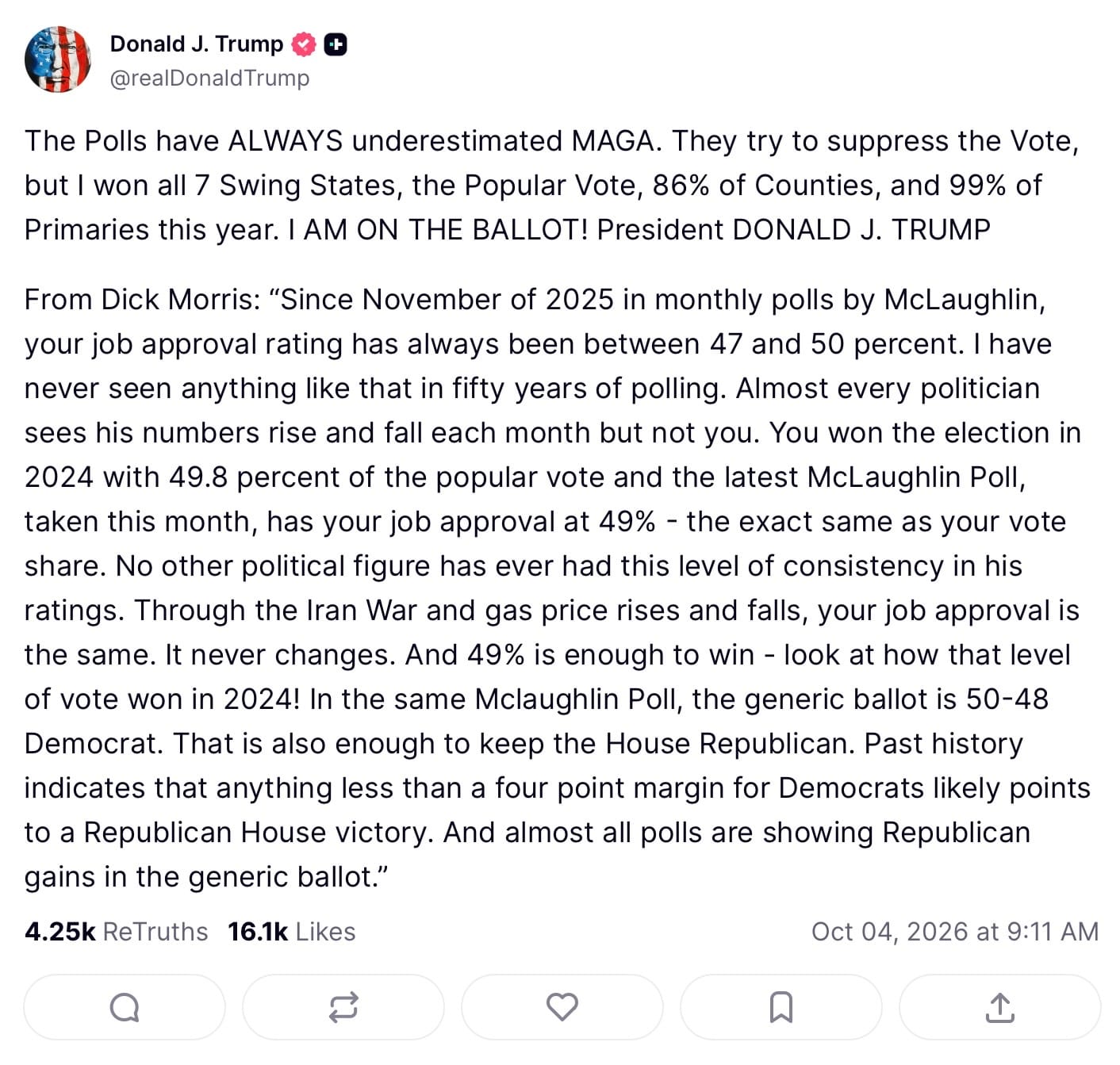
Ruffini’s findings support skepticism about some Senate polls. They do not, however, establish Trump’s claim that polls always miss in one direction, or prove that pollsters seek to suppress votes.
Nor does Ruffini dismiss the GOP’s problems. In his October analysis, “The cost of ignoring the cost of living,” he points to voters’ concern over living costs and a gap between what they want Trump to address and what they believe he has made a priority.
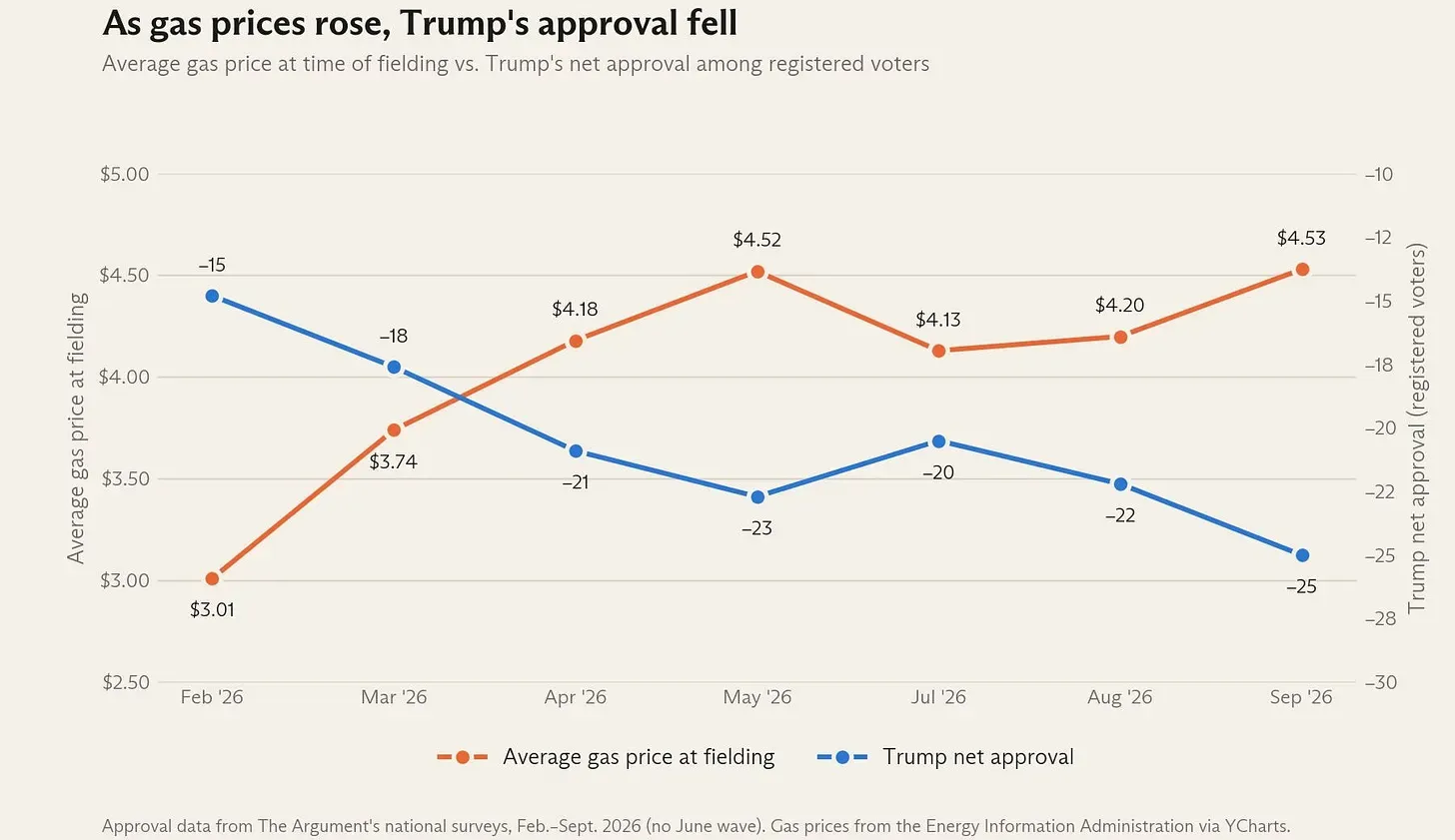
Republicans still have to earn the votes. Hoping for a polling miss is no substitute for effective campaigning.
The being said, the Senate map shows why a miss could matter. Republicans hold a 53–47 majority. Democrats need a net gain of four seats to control the chamber outright. Several small leads could vanish together if surveys share the same flaw.
That led ALPolitics.com to ask: What would a six-point adjustment do, in critical Senate races?
The table below uses recent public polls located through October 15. It subtracts six percentage points from each Democrat’s reported support while holding the Republican’s share steady. Those six points remain unallocated.
This shifts the margin six points toward Republicans. Moving six points directly from one candidate to the other would shift the margin 12 points. Ruffini’s historical finding concerns the margin, not a uniform six-point excess in each Democrat’s vote share.
|
Senate race |
Poll and field dates |
Reported support |
Hypothetical: Democrat minus 6 |
Resulting margin |
|
Iowa |
Marist, Oct. 8–11 |
Josh Turek 48%, Ashley Hinson 45% |
Turek 42%, Hinson 45% |
Hinson +3 |
|
Michigan |
InsiderAdvantage, Oct. 9–10 |
Abdul El-Sayed 48%, Mike Rogers 46% |
El-Sayed 42%, Rogers 46% |
Rogers +4 |
|
Ohio |
co/efficient, Oct. 5–6, head-to-head |
Sherrod Brown 45%, Jon Husted 46% |
Brown 39%, Husted 46% |
Husted +7 |
|
Texas |
InsiderAdvantage, Oct. 13–14 |
James Talarico 48%, Ken Paxton 49% |
Talarico 42%, Paxton 49% |
Paxton +7 |
|
Maine |
InsiderAdvantage, Oct. 13–14 |
Troy Jackson 49%, Susan Collins 47% |
Jackson 43%, Collins 47% |
Collins +4 |
|
Kansas |
InsiderAdvantage, Oct. 13–14 |
Adam Hamilton 47%, Roger Marshall 48% |
Hamilton 41%, Marshall 48% |
Marshall +7 |
|
North Carolina |
SurveyUSA for WRAL/WSOC, Oct. 7–11 |
Roy Cooper 54%, Michael Whatley 40% |
Cooper 48%, Whatley 40% |
Cooper +8 |
|
Alabama |
RMG/Napolitan, reported by Yellowhammer News, Sept. 21–25 |
Everett Wess 33%, Barry Moore 54% |
Wess 27%, Moore 54% |
Moore +27 |
Slide to see full chart
The reported figures come from the linked surveys; the adjusted figures are arithmetic scenarios.
These are individual surveys, not a single forecast. Pollsters differ, and close results carry sampling error. Ohio’s co/efficient poll already favored Husted; CNN’s roughly contemporaneous poll instead had Brown ahead 49% to 43%, which would become a 43–43 tie under the same exercise.
Alabama’s poll also differs from the others: It surveyed 800 registered voters, rather than likely voters, and was commissioned by the conservative group Alabama Policy Action. There is no evidence that Alabama needs the same adjustment as the Midwest States. It has been included here for comparison and completeness.
Even with the limits stated above, this exercise shows how fragile a Senate wave can be. Iowa, Michigan and Maine change leaders. Texas, Kansas and Ohio become stronger Republican holds in the selected surveys. North Carolina remains a clear Democratic opportunity, while Barry Moore’s already large Alabama lead grows.
If the old polling pattern returns, the blue tsunami could become a blue drip — or not happen at all. If enough close races break toward Republicans, the Democrat’s hoped-for Senate takeover may not happen at all. That remains a plausible scenario — just not a result anyone has counted on in most mainstream media.