FEMA tells States: Prepare to Handle Disasters Alone
Washington plans to shift more disaster costs and response work to States, even as Alabama seeks federal help after Hurricane Isaias
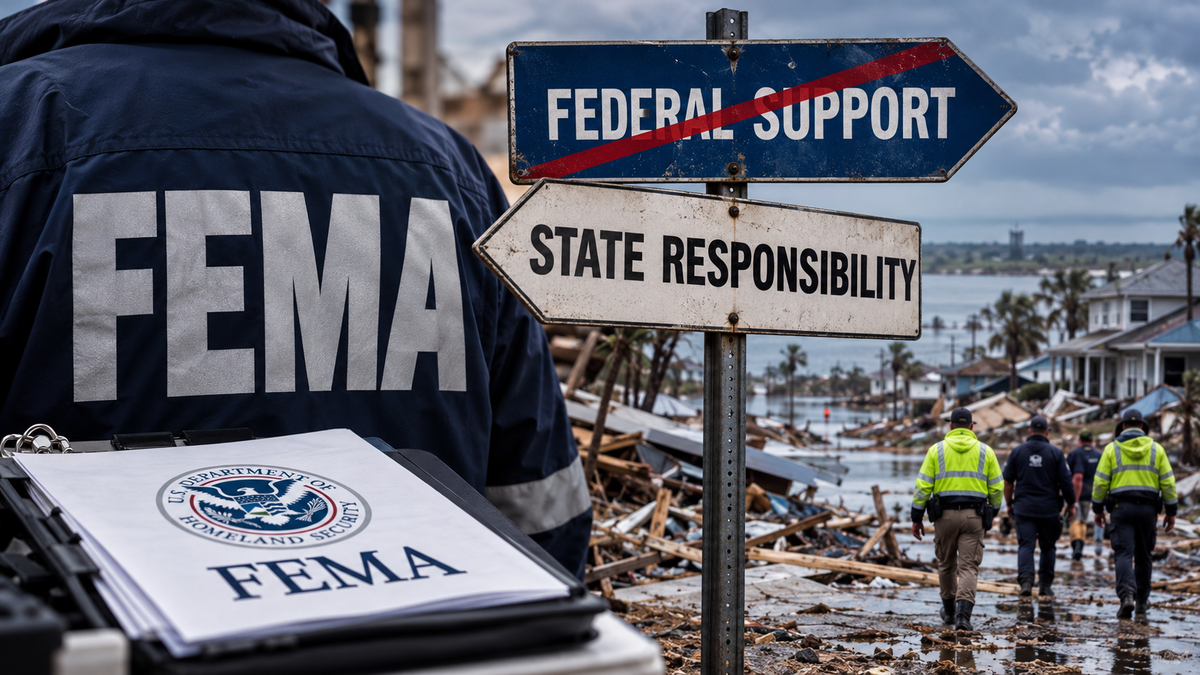
TL;DR: FEMA Administrator Cameron Hamilton says States should build enough cash reserves and response capacity to handle most disasters without federal aid. The shift could begin within six months. The plan comes after years of complaints over slow federal aid, including after Hurricane Helene devastated North Carolina and East Tennessee. For Alabama, the timing is critical: FEMA teams are now assessing Hurricane Isaias damage to see if the State qualifies for more federal assistance.
The head of the Federal Emergency Management Agency (FEMA) has delivered a blunt warning to Governors and State emergency officials: Prepare to handle more disasters yourselves.
FEMA Administrator Cameron Hamilton told State officials Tuesday that they need larger financial reserves and stronger emergency response systems so they are less dependent on Washington after hurricanes, floods, tornadoes and other disasters.
According to POLITICO, Hamilton outlined the Trump administration's plans during a meeting of the National Emergency Management Association in Little Rock, Arkansas.
“Every State must have the appropriate financial reserves” and other abilities “to ensure that recovery efforts can start immediately and not necessarily be held up simply because of the federal [disaster] declaration process,” Hamilton said, according to a recording obtained by POLITICO.
Hamilton said he hopes States eventually become strong enough that far fewer disasters require presidential disaster declarations.
“A future that I hope we would shoot for is one where we wouldn’t require as many disasters because the capability of States is so high and so substantial,” Hamilton said, using “disasters” to refer to federal disaster declarations.
The changes could begin “in the next six months,” according to Hamilton.
The idea fits President Donald Trump's long-running push to reduce FEMA's role and place more responsibility on Governors. Rather than having Washington serve as the primary backstop for disasters, the administration wants States to build their own capacity and rely more heavily on agreements in which States help one another.
Hamilton also argued that States could sometimes begin recovery faster without federal aid. FEMA assistance can require damage assessments, applications, a presidential declaration and compliance with a long list of federal rules before money begins flowing.
“Federal dollars should be building greater capability, not creating greater dependency,” Hamilton said.
That argument is not without its appeal, especially given recent events. FEMA has spent years facing complaints about red tape, long waits and confusing rules. But there is an obvious problem with asking States to replace much of its role: major disasters can overwhelm even well-funded State governments.
Under FEMA's traditional Public Assistance system, Washington generally pays at least 75 percent of eligible costs for debris removal, emergency work and repair of public infrastructure after a qualifying disaster. State and local governments cover the balance. FEMA's description of the Public Assistance program explains that the program was designed as supplemental aid when State and local resources are not enough.
Former FEMA Administrator Craig Fugate, who previously ran Florida's emergency management system, has warned that even States accustomed to major hurricanes may lack the resources to replace federal disaster assistance.
“Most States don't even have the ability, including Florida, to manage these disasters” without federal money and support, Fugate said.
FEMA's own record is fueling the debate. The proposed shift comes after FEMA has faced harsh criticism for slow or inadequate aid following several major disasters.
Hurricane Helene brought catastrophic flooding to western North Carolina and East Tennessee in September 2024. Roads vanished, bridges washed out and mountain communities were cut off.
Some early claims that FEMA had simply abandoned the region were, according to FEMA, false or greatly overstated. Federal records show a large response. By Oct. 7, 2024, FEMA reported more than $208 million in approved disaster aid nationwide from Helene, while nearly 7,000 federal personnel had been deployed. North Carolina alone had about 800 FEMA workers and more than 1,200 urban search-and-rescue personnel during the first 10 days. A Government Accountability Office review later documented the scale of that response.
But the criticisms were not based on rumor, but on social media reports from local residents both immediately after the floods and during the still-ongoing recovery.
In western North Carolina, WBTV reported that more than 500 families had been approved for FEMA trailers or manufactured homes after Helene. FEMA had said 103 temporary homes would be delivered by the end of Thanksgiving weekend.
By Dec. 4, only 46 had been delivered.
FEMA apologized, citing an internal communications failure and problems involving utilities, roads, weather and preparing sites for the homes. Hundreds of displaced families were still waiting as winter temperatures reached the mountains.
Two years later, recovery problems remain. A September 2026 WBTV investigation found thousands of North Carolina residents still seeking stable housing, with nonprofit groups continuing to rebuild homes where government programs had moved slowly.
East Tennessee communities hit by the same storm voiced similar frustration. A later Reuters Context report found local volunteers and private groups filling gaps as communities in Tennessee and North Carolina struggled through a long recovery.
Tennessee ran into federal delays again after severe storms and flooding in 2025. Disaster requests from Tennessee, Arkansas and Missouri waited weeks for approval, while some aid was initially denied before the administration ultimately approved tens of millions of dollars. The Tennessee Lookout reported that those delays raised concerns about whether a smaller FEMA could respond quickly when States faced costs beyond their own budgets.
Under the current administratio, Washington's answer to complaints that FEMA is too slow may increasingly be that States should not wait for FEMA in the first place.
Alabama could be an early test of the new approach.
The State is still assessing damage from Hurricane Isaias, which struck the Gulf Coast earlier this month.
President Trump approved an emergency declaration for Alabama on Oct. 9 covering Baldwin, Escambia and Mobile Counties and the Poarch Band of Creek Indians. The declaration authorized federal help for emergency protective measures at a 75 percent federal cost share. FEMA's Alabama declaration allowed federal personnel, equipment and other resources to support the State's response.
Alabama is now trying to determine whether the storm damage meets the higher threshold for a major disaster declaration.
The Alabama Emergency Management Agency said Monday that FEMA teams had joined State and county officials to conduct preliminary damage assessments. If the damage clears federal thresholds, Governor Kay Ivey could request a major disaster declaration that could open the door to Individual Assistance for residents and Public Assistance for damaged roads, bridges and other public infrastructure.
Alabama EMA Director Jeff Smitherman had already warned County officials in August that major FEMA changes were coming.
“The money’s coming – we need to be postured and prepared to handle it. If we aren’t doing that work now, then when that money does come then we, collectively as a State, are going to be left behind and other States are going to get that funding,” Smitherman said.
Hamilton's latest remarks suggest the change may go much further than simply altering the paperwork.
If the administration follows through, Alabama and other disaster-prone States could be expected to keep more money in reserve, expand State and local response teams and absorb a larger share of recovery costs before Washington steps in.
For Alabama's Gulf Coast, where hurricanes can cause billions of dollars in damage in a matter of hours, that could turn FEMA reform into a major State budget issue.
The basic question is no longer whether FEMA will change.
It is how much of FEMA's job — and its bill — Washington intends to hand back to the States.
And then, of course, it becomes a question about how the States will handle it.