Ground Broken on $3.2B Mobile River Bridge
After decades of plans and delays, Alabama has formally started work on the largest transportation project in State history
TL;DR: Alabama broke ground Friday on the $3.2 billion first phase of the I-10 Mobile River Bridge and Bayway project. The plan calls for a new six-lane cable-stayed bridge and six lanes of capacity on the existing Bayway, with a new Bayway planned later. Phase One is expected to open around late 2031. Drivers using an ALGO Pass would pay $3 per crossing or could buy a $60 unlimited monthly pass, while several existing routes will remain toll-free.
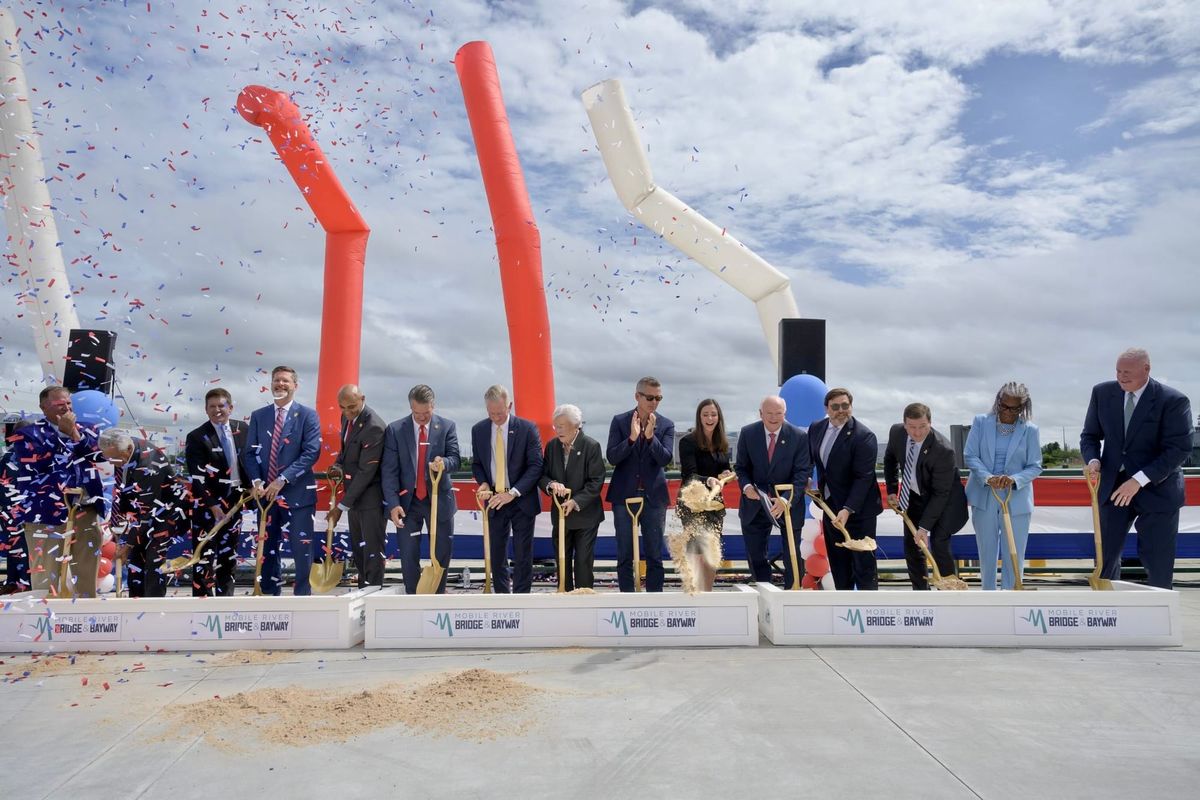
After decades of studies, plans, funding fights and false starts, Alabama officials put gold shovels in the dirt Friday and formally broke ground on the new I-10 Mobile River Bridge and Bayway project.
Governor Kay Ivey joined U.S. Transportation Secretary Sean Duffy, Sens. Tommy Tuberville and Katie Britt, Reps. Barry Moore and Shomari Figures, and State and local leaders at Cooper Riverside Park in downtown Mobile. University of South Alabama President Jo Bonner served as Master of Ceremonies.
The ceremony marked the start of what the Alabama Department of Transportation calls the largest transportation infrastructure project in Alabama history. The first phase carries a $3.2 billion construction price tag and is expected to take about five years.
“Y’all, it’s a great day for Alabama and a great day for the entire gulf region, so let’s build this bridge and let the good times roll,” Ivey told the crowd.
The groundbreaking comes nearly three decades after formal planning and environmental work began. The project has gone through several versions and survived a failed effort in 2019 before being revived in 2021 at the request of the Mobile and Eastern Shore metropolitan planning organizations.
The current plan will be built in phases.
Phase One includes a new six-lane, cable-stayed bridge across the Mobile River. The existing Bayway will be restriped to provide three travel lanes in each direction across Mobile Bay. About one mile of the Bayway will be rebuilt to connect with the new bridge, while major interchanges and traffic flow along the I-10 corridor will also be improved.
A new Bayway structure is planned for a later phase as more funding becomes available. Future toll revenue is expected to help finance that work.
The scaled-back approach allowed the state to move forward after rising construction costs and engineering issues made building both the new bridge and a full Bayway replacement at the same time too costly. Federal flexibility also allowed Alabama to preserve grant funds while splitting the work into phases, according to the project's official fact sheet.
Financing for Phase One closed in September. It includes a $2.52 billion Transportation Infrastructure Finance and Innovation Act loan through the U.S. Department of Transportation's Build America Bureau, along with bonds sold to investors.
Ivey formally cleared construction to begin last week when ALDOT, acting for the Alabama Toll Road, Bridge and Tunnel Authority, issued a notice to proceed to the Kiewit Massman Traylor design-build team.
“At long last, we are officially moving from talking about the need for the Mobile River Bridge and Bayway project to actually building it,” Ivey said in her announcement authorizing construction. “This project will transform travel through Baldwin and Mobile counties, strengthen a vital interstate corridor and benefit Alabama for generations to come. This is a win for the citizens in Baldwin and Mobile counties, a win for the state of Alabama and a win for the Gulf Coast region. It’s time to build the bridge, y’all!”
Friday's ceremony also showed the broad political coalition that eventually pushed the project forward. Britt called it a product of cooperation among local, state and federal leaders.
“This event is a testament to what can happen when local, state and federal leaders work together as a team,” Britt said in a statement.
Figures, however, said more federal funding should still be sought to reduce the burden placed on drivers. He credited the Biden administration with securing earlier federal funds while calling for the Trump administration to put more direct federal money into the project.
“I think it’s important to like understand how we got here today,” Figures told FOX10 News. “Essentially, what the Trump administration did this go around was pave the way for us to borrow billions of dollars that our commuters are going to have to pay back to the tune of as high as fifteen-dollar tolls. That’s not acceptable so between now and the bridge being completed in the next four or five years, we have to get more federal investments for it.”
Moore, who has made the project a priority while serving AL-01 in Congress, praised Friday’s groundbreaking.
"I look forward to great things for the State of Alabama. As President Trump talks often about the golden age of America, we're looking at a golden age for Alabama, our GDP for the first time, since we've been keeping records outpaced New York and California. So, we're seeing things in Alabama. There are opportunities for high paying jobs for generations to come. And part of that investment is made here today,” Moore said.
Under the current state plan, passenger vehicles using an ALGO Pass would pay $3 per trip. A $60 monthly pass would provide unlimited crossings. Other payment methods could cost more.
No tolls will be charged during construction. Tolling is set to begin only after the new bridge and Phase One improvements open, now projected for late 2031. The Wallace Tunnel, Bankhead Tunnel, Africatown Bridge and Causeway will remain toll-free alternatives.
Beyond easing the daily I-10 bottleneck, the new bridge will provide an interstate route across the Mobile River for hazardous-material freight that cannot use the Wallace Tunnel. State officials also expect it to improve access to the Port of Mobile, strengthen hurricane evacuation routes and cut travel delays between Mobile and Baldwin Counties.
For a project discussed in one form or another for roughly a generation, Friday represented a basic but long-awaited change: The debate over whether the bridge will be built has given way to the work of actually building it.