Hawley Hearing puts Flock Surveillance Under Microscope
Alabama has nearly 2,800 Flock cameras, and Sen. Katie Britt faces questions over privacy, federal funding and her support for CORCA
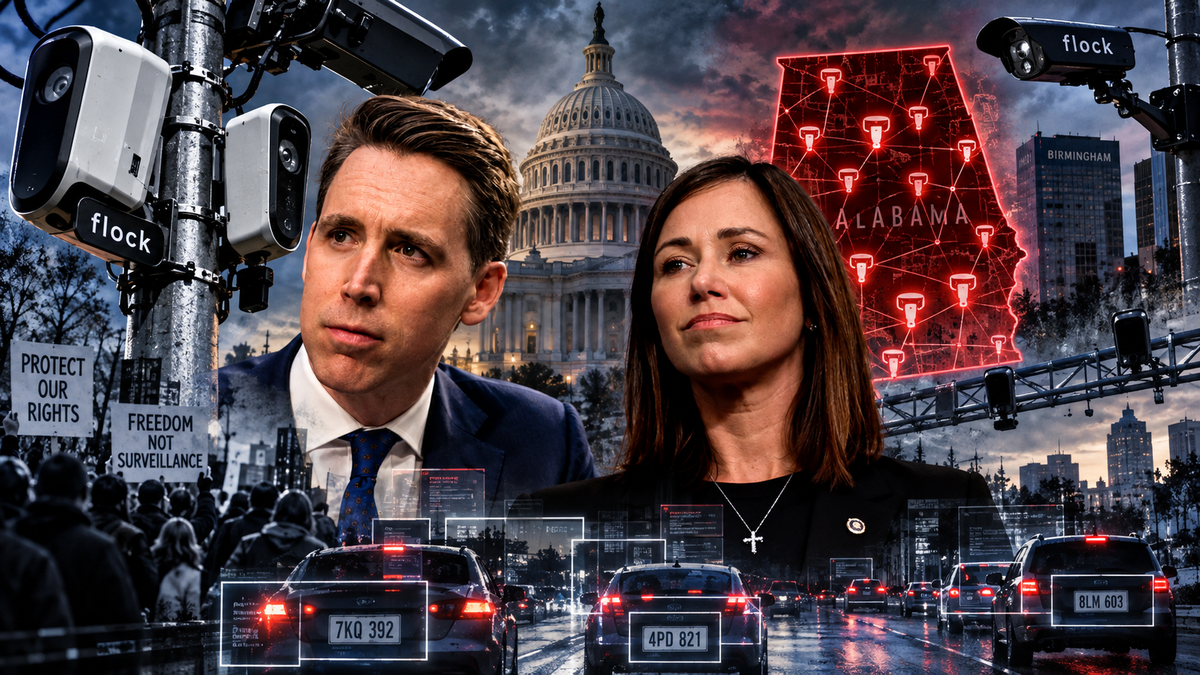
TL;DR: Sen. Josh Hawley will hold a Senate hearing Wednesday on Flock Safety and the rapid growth of nationwide license plate surveillance. Alabama Sen. Katie Britt sits on the subcommittee and has called for safeguards against abuse, but she is also an original cosponsor of CORCA, a retail-crime bill critics fear could expand federal access to surveillance data. The issue hits close to home: nearly 2,800 Flock cameras reportedly operate in Alabama, while Alabama Power has become a major middleman for municipal surveillance systems across the State.
A Senate panel will put one of America's fastest-growing surveillance networks under the microscope Wednesday, with Alabama Senator Katie Britt sitting in a particularly interesting seat.
Sen. Josh Hawley (R-MO), Chairman of the Senate Judiciary Subcommittee on Crime and Counterterrorism, will convene a hearing titled “Always Watching: Flock’s Nationwide AI Surveillance Network” at 2:30 p.m. Eastern/1:30 p.m. Central in the Dirksen Senate Office Building.
Britt is one of six Republican members of Hawley's subcommittee.
The hearing comes as the surveillance cameras mounted on poles along American roads face growing scrutiny from privacy groups, conservatives, civil libertarians and lawmakers from both parties.
At issue is not merely whether Flock Safety cameras can help police find stolen cars or suspects. Police departments point to numerous cases in which they have done exactly that — although, the effectiveness of these cameras in meaningfully increasing crime clearance rates is debatable.
The larger question is what happens when thousands of cameras photographing millions of innocent drivers become part of a searchable national tracking system.
Hawley has made clear that is where his concern lies.
“Americans do not surrender their privacy rights when they drive to work, drop their kids off at school, or go to church,” Hawley said when announcing his investigation in August.
His office says Flock operates roughly 120,000 AI-powered cameras nationwide. Hawley originally invited the CEOs of Flock, Axon Enterprise, Motorola Solutions and Verkada to testify.
The Judiciary Committee's current witness list instead includes wrongfully accused Florida driver Lindsey Isaacs; Institute for Justice legislative counsel Alasdair Whitney; Pinal County, Arizona Sheriff Ross Teeple; cybersecurity engineer Benn Jordan; and ACLU senior policy counsel Chad Marlow.
Isaacs' story illustrates one danger lawmakers will examine. She was wrongly identified as the driver in a fatal Florida hit-and-run investigation after authorities relied on license plate reader data.
The ACLU says the Institute for Justice has now cataloged more than 240 incidents involving ALPR abuse, including stalking, wrongful stops and detentions and use for purposes unrelated to law enforcement. It also says more than 200 cities have terminated ALPR contracts since the beginning of 2026.
The national scope of Flock's network is central to the debate.
A Flock camera does more than read a tag. It can record a vehicle's plate, make, model, color, distinguishing features, location and time, creating a record that can later be searched.
And the officer doing the searching may be hundreds or thousands of miles away.
The Electronic Frontier Foundation obtained records covering more than 12 million Flock searches by more than 3,900 agencies from December 2024 through October 2025. EFF found that police routinely searched large numbers of camera networks, sometimes without evidence that the vehicle being sought had left the local area.
The experience of Alpharetta, Georgia, provides a remarkable example.
Records obtained from the Atlanta suburb show its Flock system connected to an enormous web of outside users. WIRED reported that Alpharetta was sharing Flock data with more than 2,000 organizations around the country, while receiving data from more than 1,300. Those organizations ranged from police and federal agencies to universities and wildlife agencies.
An analysis of Alpharetta records lists 1,562 sharing partners spanning 35 States and the District of Columbia. The city's cameras generated more than 10.7 million hot-list alerts over seven years.
That enormous reach matters because misuse is no longer hypothetical.
An Alpharetta police officer resigned in August after investigators found that he repeatedly used Flock to track two fellow officers, including a former romantic partner. Records showed 56 searches for his former partner's vehicle and another 29 for the second officer's vehicle.
Similar cases have emerged elsewhere in Georgia.
As ALPolitics.com previously reported, Albany officers have faced criminal charges over alleged misuse of license plate data, three Fayetteville officers were fired following an audit, and a DeKalb County sheriff's deputy was arrested in a separate case.
Flock says its audit logs and newer monitoring tools can expose improper searches. Indeed, those records have helped uncover some of the misconduct.
Critics counter that the same examples prove the underlying point: once a nationwide tracking system exists, authorized users can abuse it.
The cameras have also moved beyond ordinary searches for stolen vehicles. Protestors are already being tracked, which raises serious questions about the right of free assembly.
EFF's examination of Flock records found more than 50 federal, State and local agencies conducted hundreds of searches connected with protests and demonstrations during 2025.
Some search justifications consisted of a single word: “protest.”
During a June “No Kings” protest, Beaumont, Texas police searched two vehicles across 1,774 Flock networks. San Bernardino County authorities searched for another vehicle across 711 networks. Tempe police searched 425 networks while apparently looking broadly for a red vehicle.
And Alabama was part of the dragnet.
EFF found that Homewood police ran four searches involving three vehicles in July 2025, listing “PROTEST CASE” and “PROTEST INV.” as reasons. Those searches reached 1,308 camera networks and coincided with protests following the police shooting of Jabari Peoples.
That means the debate over Flock is no longer simply about whether a police department should be able to check a plate against its own cameras.
The technology can allow a local officer to query a surveillance network spread across much of the country — and this nationwide “dragnet” potential with a single warrantless query raises significant privacy and due process concerns.
An emerging Flock feature raises another concern. What happens when just driving near someone becomes an association to them?
Flock's Convoy Search is designed to identify vehicles repeatedly seen traveling near a target vehicle.
Analysis of Flock's interface found the company describes the feature as a way to “Identify vehicles that have been seen together so you can verify a potential accomplice and getaway car.”
That may be useful when police are hunting an organized robbery crew. But, it also creates an obvious problem.
A coworker, neighbor, family member, rideshare driver or ordinary commuter could repeatedly pass the same cameras as a person under investigation. So could drivers leaving a church, political rally, gun show, big box store or public meeting.
The software observes cars traveling near one another. It cannot know whether the people inside know each other.
Privacy advocates call that association by inference — taking innocent proximity and using it to generate another person for police scrutiny.
As Comrade Beria said, “Show me the man, and I’ll find you the crime.”
That brings the issue back to Britt, and the issue of CORCA.
Britt isn’t only a member of the committee questioning the surveillance industry Wednesday.
She’s also an original cosponsor of S.1404, the Combating Organized Retail Crime Act (CORCA), introduced by Sen. Chuck Grassley (R-IA). The bipartisan bill is intended to fight organized retail theft and cargo crime.
Supporters, including the U.S. Chamber of Commerce and major retail and law enforcement groups, argue organized theft rings increasingly cross State lines and use sophisticated networks to steal, transport and resell goods. CORCA would create an Organized Retail and Supply Chain Crime Coordination Center within the Department of Homeland Security to improve cooperation among federal, State and local police and the private sector.
The House overwhelmingly approved its version, 348-60.
But civil liberties groups see another possibility: a new federal clearinghouse capable of pulling information from the same vast private and public surveillance systems now facing scrutiny.
The distinction is important. CORCA does not mandate Flock cameras, require retailers to turn over ALPR records or explicitly fund Flock.
Critics instead focus on its broad information-sharing structure.
They fear license plate records, private camera footage and other data could be fed into a DHS-centered system without strong enough limits on what may be collected, how long it may be kept or whether information gathered for retail theft could later be used for another purpose.
That creates an unusual set of circumstances for Wednesday's hearing.
At least six members of Hawley's 11-member subcommittee are CORCA sponsors or cosponsors, according to congressional records and an analysis of the committee membership. Britt was among the original Senate cosponsors.
Britt, however, has now acknowledged many of the concerns surrounding ALPR abuse.
Just one day before the hearing, Britt joined Sen. Raphael Warnock (D-GA) in sending Attorney General Todd Blanche a letter seeking federal guidance for State and local police using automated license plate readers.
“We are deeply concerned about the misuse of ALPR systems and believe that appropriate safeguards are necessary to protect against unauthorized access and abuse, including by individuals who might misuse the technology to stalk and harass their victims,” Britt and Warnock wrote.
The senators cited reports of police using the systems to stalk romantic partners, track people without warrants and monitor personal contacts.
That makes Britt's questions at Wednesday's hearing especially relevant: what safeguards does she believe are needed for Flock, and should comparable safeguards be written into CORCA before the federal government creates another major information-sharing hub?
For Alabama residents, this is hardly an abstract Washington debate — because, like it or not, Flock cameras are here in…large flocks.
The Alabama Policy Institute reported in August that more than 2,800 Flock cameras are operating across Alabama, making the State one of the nation's heavier users of ALPR technology. State Sen. Arthur Orr (R-Decatur) has already called the status quo “totally unacceptable” and said lawmakers need to “tighten the screws on the license plate readers in a big way.”
The cameras are spread across major cities and smaller communities, including Birmingham, Huntsville, Montgomery, Mobile, Tuscaloosa, Auburn, Hoover, Gulf Shores, Dothan, Madison, Decatur and numerous Birmingham suburbs.
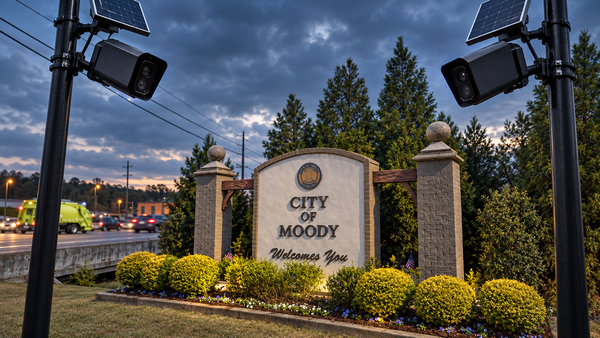
Police point to real successes. Moody police, for example, recently said Flock data combined with business surveillance footage helped locate a vehicle in the reported kidnapping of a 13-year-old girl. The child was found safe in the Bessemer area.
But Alabama's network has another unusual feature.
Alabama Power has served as what Flock has called its “longest-standing reseller.” Since at least 2019, the utility has marketed ALPRs and other surveillance equipment to Alabama governments, using its poles, power connections and existing infrastructure to make deployment easy.
An Alabama Power representative said in 2025 that the company had surveillance partnerships with more than 80 municipalities.
Under typical agreements reviewed by Inside Climate News, cities effectively lease the equipment through Alabama Power. Installation, electricity, connectivity and related services can be rolled into the municipality's utility bill. The typical cost was around $250 per camera per month.
For 2,800 cameras, that’s $700,000 per month, and $8.4 million per year.
Alabama Power says it installs and maintains the equipment but does not operate the systems or access the data. The government or other customer controls the information and decides how it is used and shared.
Birmingham shows how large those arrangements can become.
The city approved 330 surveillance cameras in 2024. In 2025, it expanded its Alabama Power agreement by roughly 100 more cameras and license plate readers as part of a contract worth about $9.7 million.
And Britt has a direct connection to that expansion.
Birmingham officials credited her with helping secure a $4.2 million Department of Justice grant used for the city's Real Time Crime Center and related technology. During City Council discussions, Mayor Randall Woodfin said Birmingham police were working closely with Alabama Power to maximize federal surveillance funding secured through the partnership with Britt.
The city's camera infrastructure carries an ongoing cost estimated at about $2 million per year, according to Councilman Darrell O'Quinn. Police Chief Michael Pickett told council members more surveillance requests should be expected.
“The more cameras a city has—the more eyes you have—the safer it will be,” Pickett said. “Yes, in the future, we will request more.”
Because, as Larry Ellison has said, "Citizens will be on their best behavior because we are constantly recording and reporting everything that's going on."
That premise is now receiving a national test.
Police and billionaire Tech Bros like Ellison see Flock and other ALPRs as a powerful tool for finding missing children, stolen cars and violent suspects — and keeping the plebes on their “best behavior.“ Privacy advocates, and those who have read the Constitution and Bill of Rights, see a system that records innocent people first and asks questions later — with the ability to search those movements across hundreds or even thousands of jurisdictions.
Alabama already has nearly 2,800 of those eyes.
On Wednesday, one of the senators questioning how those eyes should be controlled will be Britt — a senator who helped secure money for Birmingham's surveillance infrastructure, cosponsored legislation that would expand federal crime-data coordination, and now says stronger safeguards against ALPR abuse are needed.
The questions she asks — and what safeguards she is willing to put into law — will matter well beyond Wednesday's hearing.
Because George Orwell told us what could come next: “You had to live – did live, from habit that became instinct – in the assumption that every sound you made was overheard, and, except in darkness, every moment scrutinized.”