Heart of Dixie Podcast Digs into Alabama Local Controversies
Hosts Still and Mosley tackled disputes over city government, courts, policing, high school football and Alabama’s cannabis laws
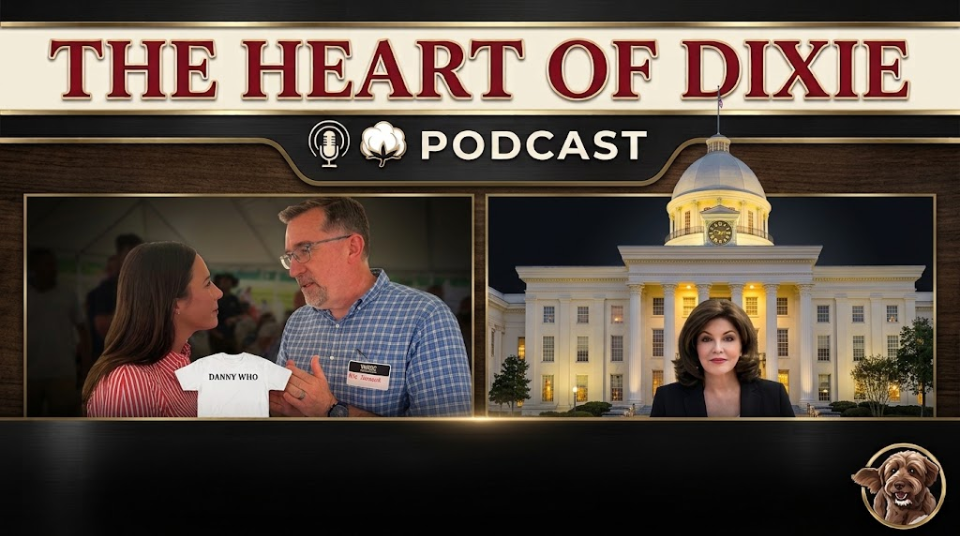
The latest episode of the Heart of Dixie podcast ranged from St. Clair County politics to a brewing fight over high school football in Baldwin County, with hosts Harry Still and Brandon Mosley joined by Margaret Mayor Matthew Tortorice and attorney Beverly Barber.
Much of the discussion centered on a common theme: what happens when local government, courts and other public bodies become locked in disputes with the people they serve.
Tortorice opened with a look inside Margaret, a fast-growing St. Clair County city where local politics have been marked by years of sharp disputes.
Tortorice was elected mayor in August 2025 after serving on the Margaret City Council. The city's official election certificate shows he won the office in the Aug. 26 municipal election and began his term in November. He remains listed as mayor on the city's website.
On the podcast, Tortorice described his struggle to manage the city's growth while dealing with what he characterized as a hostile political environment. He raised claims involving election conduct and the use of city resources.
Those claims were presented by Tortorice and were not independently established by the podcast.
The friction in Margaret did not begin with his election as mayor. City records show that, while serving on the council in 2023, Tortorice pushed to have the Regional Planning Commission of Greater Birmingham redraw council districts. At the time, city figures showed large gaps in registered voters between districts. Tortorice also sought city funding for equipment to livestream council meetings.
The discussion then shifted from city government to the courts.
Barber described her own legal battles in St. Clair County, including a property dispute and broader concerns she has raised about the local justice system. She also discussed allegations involving DNA evidence in a murder case, environmental violations and judicial conduct.
Again, those were allegations and claims discussed on the program, not findings established by the podcast.
Barber has been involved in litigation against St. Clair County officials. Federal court records show she filed a civil-rights case in 2025 naming the St. Clair County Commission, Sheriff's Office and another defendant. That case was dismissed in March after the court found she had failed to serve the defendants by the deadline.
A separate habeas matter reached the 11th U.S. Circuit Court of Appeals this summer. The appeal was initially dismissed for want of prosecution, but the clerk later granted Barber's motion to reinstate it.
From St. Clair County, Still and Mosley turned south to Baldwin County, where another local-government fight has unfolded in Summerdale.
Police Chief Michael Gaull was placed on administrative leave after Mayor Randy Farris asked him to resign over allegations that have not been made public. The Town Council then met in a packed special meeting and, after an executive session, voted 4-2 to reinstate Gaull.
The episode used the Summerdale fight to discuss how personal relationships and political pressure can collide with the day-to-day management of small towns.
Baldwin County also supplied one of the show's other major topics: the growing dispute between Robertsdale High School and the Alabama High School Athletic Association.
The hosts discussed the suspension of Robertsdale football players — dubbed the "Robertsdale 11" during the program — and the broader questions surrounding recruiting, NIL money and the AHSAA's authority over high school athletics.
The controversy has already spilled into court.
Robertsdale head football coach Justin Jones sued the AHSAA, its executive director, the Baldwin County Board of Education and school officials after he was suspended from coaching. On Sept. 18, Baldwin County Circuit Judge Ashley Siebert granted Jones a temporary restraining order that allowed him to return to the sidelines while the case proceeds. The order also temporarily blocked prior AHSAA directives involving Jones.
The dispute comes as high school sports struggle to adapt to a world reshaped by NIL payments and increasingly blurred lines between amateur athletics, recruiting and money.
The final major topic was cannabis — or, more precisely, the maze Alabama has created around marijuana, medical cannabis and hemp-derived THC products.
Still and Mosley discussed businesses that have used distinctions in state and federal law to sell cannabis-derived products even though recreational marijuana remains illegal in Alabama.
That legal landscape changed sharply this year.
Under Alabama's 2025 hemp law, which took effect Jan. 1, 2026, consumable hemp products containing THC are regulated by the Alabama Alcoholic Beverage Control Board. Retailers must be licensed, buyers must be at least 21, and products must comply with testing, packaging and labeling rules.
State rules generally limit consumable hemp products to 10 milligrams of total THC per serving. Alabama law also expressly includes delta-8, delta-9 and delta-10 THC derived from hemp within its definition of THC.
Selling regulated hemp products without a license now carries steep penalties, beginning with a $5,000 civil fine and potentially reaching a Class C felony after repeated violations.
Taken together, the episode offered a tour through several disputes that rarely draw national attention but can have an immediate impact on Alabama communities.
From a mayor fighting with city officials in St. Clair County to a police chief's reinstatement in Summerdale, a courtroom battle over Friday-night football and the state's effort to regulate intoxicating hemp products, Still and Mosley focused this week's program squarely on the often messy intersection of local government, law and politics.
This episode of the Heart of Dixie podcast may be seen on YouTube and below: