ADEM Clears Permit for Massive Brookwood Data Center
The 2-million-square-foot project lands amid a Statewide fight over power, water, health risks, tax breaks and lasting jobs
The Alabama Department of Environmental Management (ADEM) has approved a construction permit tied to a vast hyperscale data center planned near a Tuscaloosa County school and one of the region’s best-known waterways.
The permit marks the latest sign that Alabama’s data center boom is pushing deeper into small towns and rural areas. It also lands in the middle of a fierce Statewide debate over whether these projects offer real growth or leave local families carrying the costs.

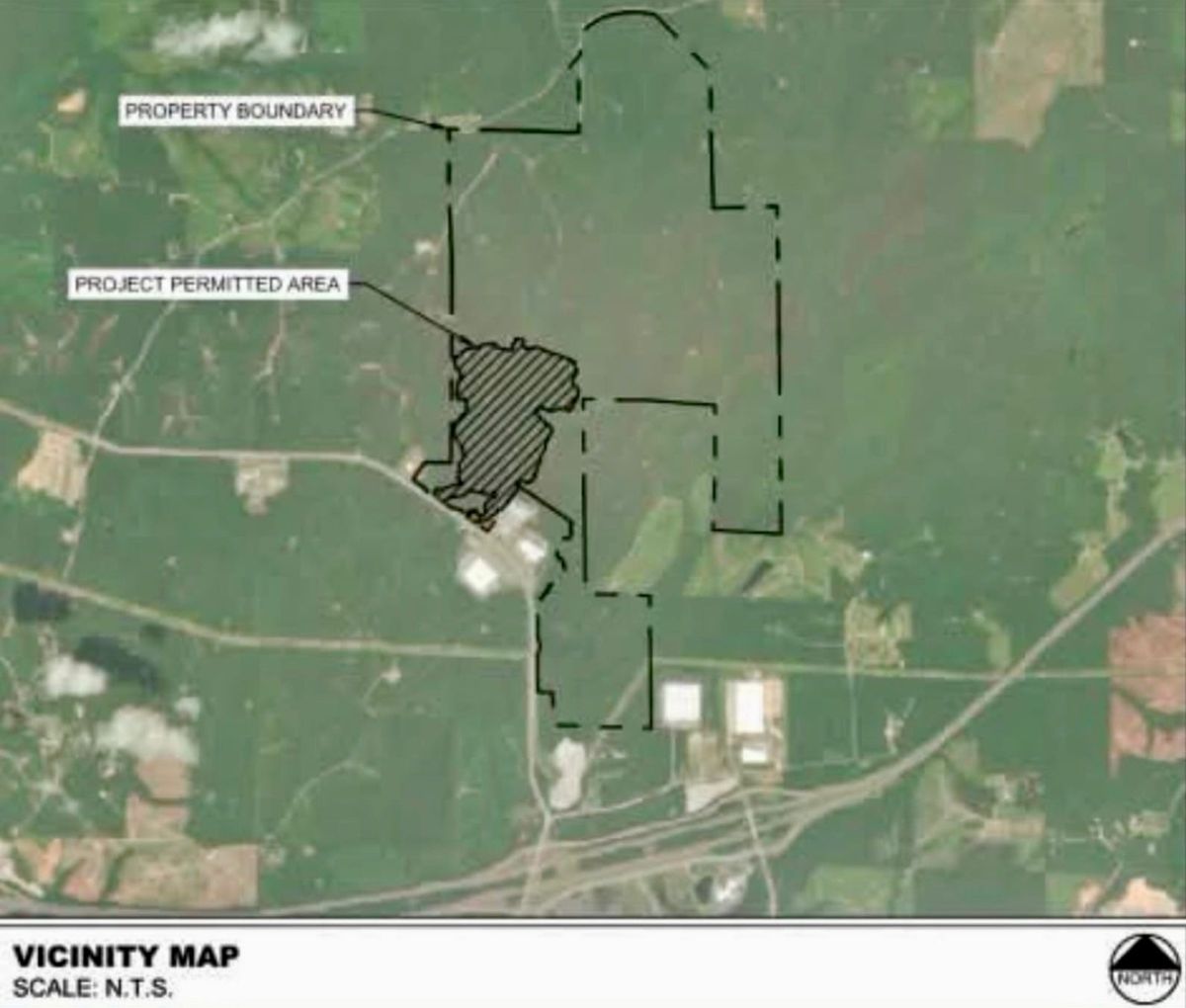
According to records obtained by WBRC, the proposed Brookwood data center would cover about 2 million square feet, an area roughly equal to 35 football fields. The site would be built on more than 130 acres of a nearly 1,300-acre tract along Brookwood Industrial Parkway, near Brookwood Middle School.
ADEM issued the permit to APLD BHM-01 LLC on July 20. State business records link the Dallas-based firm to Applied Digital Corporation, which builds and runs hyperscale data centers for artificial intelligence and other high-demand computing services.
The permit allows stormwater from construction to flow into Hurricane Creek and several unnamed tributaries. Work could have started as early as July 22 and is listed for completion by Dec. 31, 2028. The permit does not specify how much water the center would use, where that water would come from or what type of cooling system would serve the site.
Applied Digital, however, said the project is not yet final.
“Applied Digital continually evaluates potential sites in many locations. No decision has yet been made whether or not to proceed with a project at that particular location,” Nick Phillips, the company’s Executive Vice President of External Affairs, told WBRC.
The company announced in June that it planned to build an artificial intelligence campus in an unnamed Southern State. It has not been confirmed if Brookwood is that site.
The Brookwood Planning and Zoning Commission is scheduled to meet Aug. 11, with “Project Brookwood” listed on its agenda. The City Council has not yet voted to approve a data center plan.
Hurricane Creekkeeper John Wathen said the scale of the project makes public review vital.
“It will cause impacts to the water shed. It has the potential to cause a great deal of impact to the power grid. Where’s the power going to come from? Water. Are they going to drill down and tap the aquifer? If so, Hurricane Creek is in danger of going dry,” Wathen said.
Brookwood Mayor Joe Barger has stressed the short-term jobs and city revenue that could come with such a large construction project.
“Not only would we see upwards of 2,000 jobs and workers coming to our immediate area, the city itself will also receive real business license revenues that will go to fix our infrastructure, better our parks and make our community even better,” Barger said at a recent council meeting.
Wathen said residents deserve more details before city leaders move forward.
“They know what’s going on. They knew what was going on and that to me that’s dishonest. It’s disingenuous when you try to represent a community and hide things from them. I think transparency is critical to projects like this because after all it has the potential to be a massive undertaking,” Wathen said.
The gap between the promised construction workforce and the number of permanent jobs is now a key issue in Alabama’s data center fight.
Large centers can employ thousands of trade workers while they are being built. However, a review cited by ALPolitics.com found that about 80 percent of data center jobs are tied to construction. Once completed, even the largest sites often employ fewer than 150 people, with some using as few as 25 workers.
No firm count for permanent Brookwood jobs has been released.
The debate has also become one of the sharpest dividing lines in Alabama’s race for Governor.
Republican nominee Tommy Tuberville has pledged to welcome more data centers. Speaking to the Alabama Sheriffs Association in Opelika last month, Tuberville dismissed warnings about noise and environmental harm and suggested that foreign rivals are helping fuel public opposition.
“I think there are 27 States that said we aren’t going to build data centers — we’re not going to do that,” Tuberville said. “It makes too much noise. It’s going to ruin the climate — bull crap. They are listening to all this nonsense they see on social media that’s coming from China because China does not want us to grow.”
Tuberville said the projects would bring major tax gains.
“We’re going to do data centers. It will help you tremendously,” Tuberville said. “The tax money that comes from those things is unbelievable for schools, for law enforcement, for anything that’s done.”
Democratic nominee Doug Jones is calling for an immediate pause on new projects until the State adopts what he calls real guardrails.
“To say this opposition is coming from China is one of the most ridiculous things Tommy Tuberville has ever said, and that's a high bar. The people raising these concerns aren't foreign agents. They're Alabama families who found out about massive projects in their own communities after decisions had already been made. Instead of listening to them, Tuberville insults them.
“Alabama is not a dumping ground for every data center looking for a rubber stamp. People deserve transparency before deals are cut, not after construction starts. This is about the health, safety, and quality of life of the families who live there.
“That's why we need an immediate moratorium until Alabama has a real Statewide plan. I'd ban non-disclosure agreements between developers and local governments, and require every approved project to have an independently funded community advisory board with the resources to hold these companies accountable,” Jones said.
Jones has described the proposed pause as lasting six months to one year. He argues that the State needs time to set rules for power costs, water use, public notice and environmental reviews before more permits are issued.
Brookwood’s permit approval shows how quickly projects can move while political fights remain unsettled.
Birmingham recently completed its own effort to place guardrails on hyperscale projects.
On June 9, the Birmingham City Council voted 6-3 to approve an ordinance containing 20 conditions for future data centers. The action followed a temporary city moratorium and months of meetings, revisions and public debate.
The rules require a 500-foot setback from homes and urban neighborhoods, water conservation plans, closed-loop cooling systems, sound studies and noise barriers. They also restrict diesel generators and on-site gas turbines, require disclosure of expected power demand and mandate notice to property owners within 500 feet.
Hunter Garrison, Birmingham’s Deputy Director of Resilience and Sustainability, called the package “unmatched” in the Southeast.
“No single protection stands alone — each condition works in tandem to regulate environmental impacts, energy use, noise, land compatibility, and community notification,” Garrison said.
Critics still objected to the council’s decision to remove a special-exception process that would have required more public hearings for projects meeting all 20 terms. Supporters said the set standards would give developers clear rules while retaining notice requirements.
No Alabama proposal has drawn more anger than Project Marvel in Bessemer.
The proposed QTS campus could involve about $14.5 billion in investment, 18 large server buildings and power demand of roughly one gigawatt — an amount comparable to the use of about 1 million homes. The site expanded to about 1,600 acres after the Bessemer City Council approved the rezoning of about 900 more acres in April.
Residents have packed meetings and challenged what they describe as a secretive approval process. Their concerns include nondisclosure agreements signed by public officials, limited notice, noise, traffic, clear-cutting, creek damage, water demand and the cost of supplying power to the site. Lawsuits have also challenged parts of the review process.
The project has been linked to about 330 permanent jobs. If the full $14.5 billion is invested, that works out to nearly $44 million in capital spending for each lasting job.
The developer has said it will not seek a property tax break from Bessemer. Still unknown is the full value of possible State incentives, utility terms, infrastructure spending or other public aid tied to the center.
Alabama has long used tax policy to attract data centers, as it has other industries.
Under State law, a project investing at least $400 million has been able to qualify for sales tax relief and property tax abatements while creating as few as 20 jobs paying at least $40,000 per year. Property tax relief could run for up to 30 years for projects reaching the highest investment level.
Lawmakers passed HB399 this year to scale back parts of that package. The legislation limits some construction tax relief for centers using more than 100 megawatts and cuts certain abatement periods from 30 years to 20.
Alabama does not issue a full public report showing how much tax revenue is lost each year to data center breaks or how much each company receives. That alone makes it hard for taxpayers to measure the return on each deal.
Meta’s Montgomery center offers one example. The project was first announced as an $800 million investment that would create about 100 permanent jobs. The initial agreement included an estimated $42 million tax exemption — roughly $420,000 for each planned operational job. Investment later rose above $1.5 billion, but the expected permanent workforce remained just over 100.
Meta’s Huntsville site has produced a stronger job count, with more than 300 operational positions tied to an investment of more than $1.5 billion. Even then, the investment equals roughly $5 million for each permanent job.
Supporters say those figures do not reflect indirect work for vendors, repair crews, security firms and local service businesses. They also point to revenue, road work, school grants and the broader need for digital infrastructure. Research cited by ALPolitics.com, however, found that rural counties often gain fewer than 100 permanent jobs and may rely on skilled workers and contractors brought in from outside the area.
The public dispute is not limited to jobs and taxes.
Large data centers run around the clock. Their cooling plants, fans, transformers and generators can produce steady low-frequency noise. Residents and health advocates say that constant sound may disturb sleep, raise stress and harm quality of life in quiet rural areas.
Backup diesel generators also release fine particles and other air pollutants when tested or used during power failures. Those emissions may worsen asthma and other breathing problems, especially when many generators operate at one large site. Critics say permit reviews may not always account for the total effect of repeated testing over many years.
Water is another significant concern. Some cooling systems use vast amounts of water, while construction runoff can carry soil and other material into creeks. Data centers also require major power upgrades, including substations, transmission lines and new generation. Unless contracts place those costs on developers, families and existing businesses could be asked to help pay for the buildout through higher rates.
Those questions are now coming to Brookwood.
The city could gain a burst of construction work and new business license revenue. That being said, residents still do not know how much power the site would require, how it would be cooled, how much water it would consume, what tax aid it might receive or how many people would still work there after construction ends.
ADEM’s permit clears one major hurdle. It does not settle the wider question facing Brookwood and the rest of Alabama: whether the State will set firm rules before the next wave of hyperscale development arrives — or try to deal with its effects after the concrete has been poured and the servers turned on.