Rep. Ernie Yarbrough Can't Have It Both Ways
Guest Opinion by Jarrod Schulte
Guest Opinion by Jarrod Schulte
Rep. Ernie Yarbrough recently published an opinion piece defending his record on education. In it, he says he loves Alabama's public school teachers, principals, coaches, and students. He argues that school choice is not an attack on public education, but a way to strengthen it.
Those are reassuring words.

But words alone are not enough.
Public officials should ultimately be judged not by what they write in opinion columns, but by the legislation they sponsor, the votes they cast, and the impact those decisions have on the people they represent.
If Rep. Yarbrough wants Alabamians to believe he is a champion of public education, then his legislative record deserves the same level of scrutiny as his public statements.
For years, teachers, education advocates, and public school supporters have expressed concern that many of the policies championed by Rep. Yarbrough move Alabama in a different direction. They argue those policies divert taxpayer dollars away from traditional public schools, weaken organizations that represent educators, and redirect public resources toward private education.
Supporters call it expanding educational freedom.
Critics call it weakening the public school system that serves the overwhelming majority of Alabama's children.
That debate is legitimate.
But what deserves equal attention is the contrast between Rep. Yarbrough's words and the concerns consistently raised by many of the very educators he says he supports.
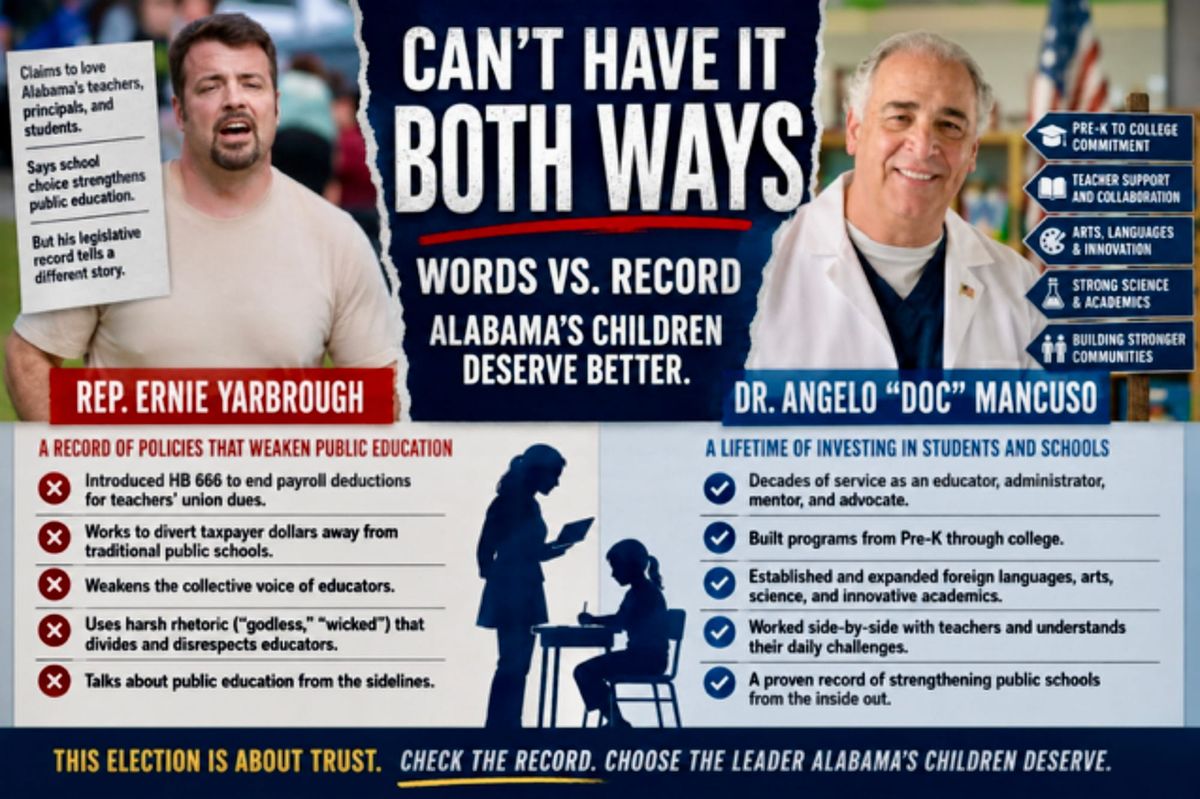
One example is House Bill 666, legislation Rep. Yarbrough introduced during the 2026 legislative session that would end payroll deductions for teachers' union dues by public employers. Under the bill, educators could still belong to professional organizations, but they would no longer be able to have their voluntary dues deducted through payroll. Rep. Yarbrough described the proposal as a measure to protect liberty and reduce government involvement while criticizing the National Education Association and its political influence.
Whether someone supports or opposes teachers' unions is a matter of political philosophy. But it raises an important question. If you believe teachers are the backbone of Alabama's education system, why make it more difficult for those same educators to financially support organizations that advocate on their behalf? Many teachers view those organizations as their collective voice on issues such as classroom resources, compensation, benefits, and working conditions.
Rep. Yarbrough has every right to disagree with teachers' unions.
But disagreeing with organizations that represent educators while simultaneously portraying yourself as one of education's strongest champions are two different things.
If public school teachers repeatedly tell lawmakers that proposed legislation will make their jobs harder, reduce resources, or weaken public education, should those lawmakers continue describing themselves as champions of public schools?
That is a fair question.
Rep. Yarbrough has also argued that recent education legislation reflects Alabama's Christian values and represents a return to faith in public life. He has also used the words "godless" and "wicked" when describing his view of the forces and ideology he believes have influenced public education, rhetoric that carries an unmistakably harsh implication for the teachers and administrators working within that system.
Faith is deeply important to many Alabama families.
But faith should never become a substitute for accountability.
Regardless of political affiliation or religious belief, every elected official should be willing to answer honest questions about the long-term impact of the policies they support.
This election is about more than campaign rhetoric.
It is about records.
And when voters compare those records, another contrast becomes impossible to ignore.
Dr. Angelo "Doc" Mancuso is not simply talking about public education from the sidelines.
He has spent decades building it.
His commitment to education did not begin with a campaign, and it will not end with one.
Throughout his career, Dr. Mancuso has served students from pre-kindergarten through college. He has been an educator, administrator, mentor, and advocate who understands the challenges facing Alabama classrooms because he has spent his career inside them.
He is no stranger to teachers.
He has worked alongside them, supported them, and understands the daily realities they face. He knows that strong schools are built by investing in educators, creating opportunities for students, and strengthening classrooms from the inside out.
His work extends far beyond traditional instruction.
Throughout his career, Dr. Mancuso has helped establish foreign language programs, expand opportunities in the arts, strengthen science education, and develop innovative academic programs designed to prepare students for success beyond graduation. His record reflects a belief that every child deserves access to a well-rounded, high-quality education regardless of where they live.
That is not a campaign promise.
It is a career.
While others debate the future of public education, Dr. Mancuso has spent decades helping shape it.
One candidate points to opinion pieces defending his record.
The other points to a lifetime of investing in students, teachers, and schools.
That distinction matters.
Parents entrust public schools with their children every day.
Teachers dedicate countless hours beyond the classroom because they believe in their students.
Communities rely on strong public schools as the foundation for economic growth and opportunity.
Those institutions deserve leaders whose records reflect the same level of commitment.
Ultimately, voters must decide which vision they believe will best serve Alabama's children.
One vision emphasizes expanding school choice and redirecting public education funding toward additional educational options.
The other emphasizes strengthening the public schools that educate the overwhelming majority of Alabama students while supporting the teachers and administrators who make those schools successful.
This election is not simply about education policy.
It is about trust.
Do voters place greater weight on campaign messaging, or on decades of demonstrated service?
Words are important.
Opinion pieces are important.
Campaign promises are important.
But records matter most.
When voters step into the voting booth, they will not simply be choosing between two candidates.
They will be choosing between two very different visions for the future of Alabama's public education system.
One candidate asks voters to trust what he says.
The other offers a lifetime of work with students, teachers, schools, and higher education as evidence of what he has done.
That contrast may ultimately be the most important issue in this race.
Jarrod Schulte is a husband, father and host of The Limestone Lowdown podcast.
Opinions do not reflect the views and opinions of ALPolitics.com. ALPolitics.com makes no claims nor assumes any responsibility for the information and opinions expressed above.