Supreme Court Takes Religious Land-Use Case
Justices will decide when local zoning rules place a “substantial burden” on a church’s religious use of its own property
TL;DR: The U.S. Supreme Court will hear a Kentucky church’s challenge to zoning rules that blocked a planned Marian grotto. The case could set a nationwide test for when land-use rules impose a “substantial burden” on religious exercise under federal law.
The U.S. Supreme Court has agreed to hear a religious liberty case that could set a new nationwide standard for how far local zoning laws can go when they restrict the use of church property.
The justices on Thursday granted review in Missionaries of Saint John the Baptist, Inc. v. Frederic, a Kentucky dispute over a Catholic group’s effort to build a grotto for prayer and reflection on property next to its church.
The petition was filed in March, and the Court granted it Oct. 1. The justices limited their review to one key question: whether a land-use rule that bars a religious group from building a religious structure on its own property amounts to a “substantial burden” on religious exercise under the Religious Land Use and Institutionalized Persons Act (RLUIPA).
The dispute dates to 2021, when Missionaries of Saint John the Baptist sought approval to build an outdoor grotto near Our Lady of Lourdes Church in Park Hills, Kentucky, just south of Cincinnati.
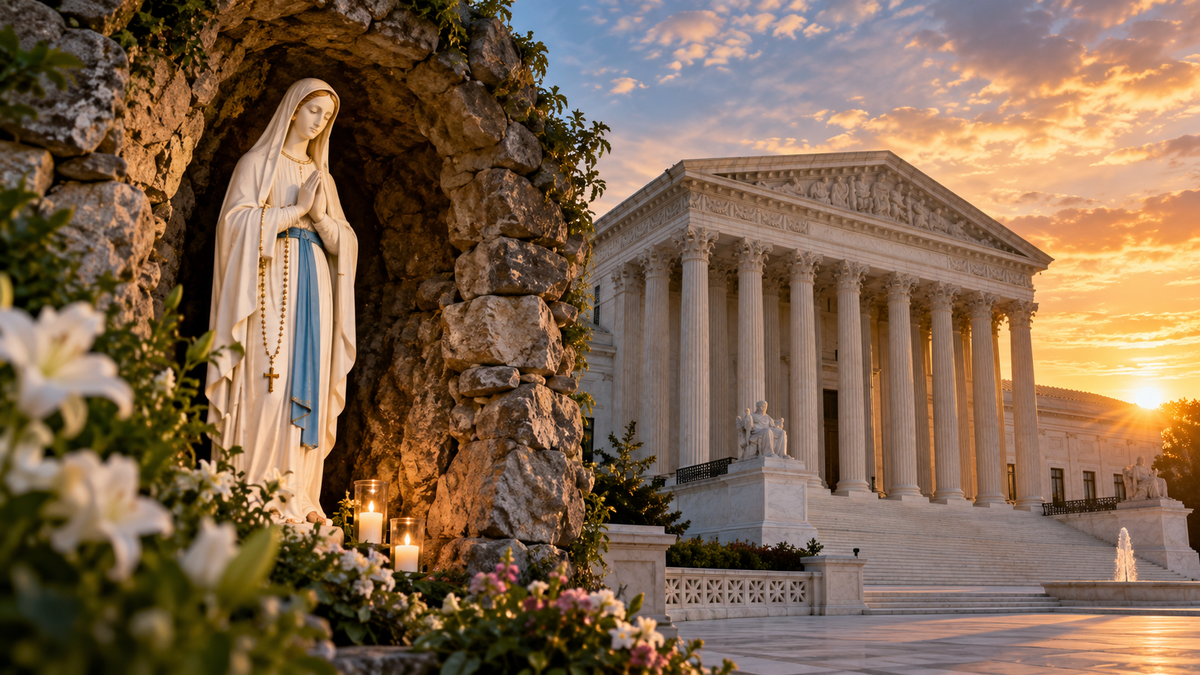
The proposed 16-by-39-foot grotto would include a shrine to the Virgin Mary, a plaza, a walking path and a retaining wall. The site was meant to honor the reported appearance of Mary to Saint Bernadette at Lourdes, France.
The Park Hills Board of Adjustment approved a conditional-use permit and setback variances for the project. But two neighbors challenged that decision in state court.
A trial court sided with the church and zoning board. The Kentucky Court of Appeals later reversed, and in December 2025 the Kentucky Supreme Court ruling upheld the result.
The Kentucky high court agreed that construction of the grotto was religious exercise. The harder question was whether stopping the project imposed a “substantial burden” under federal law.
The court concluded that it did not.
Among other points, the Kentucky court found that the church had other options, including the possibility of a smaller shrine. It also noted that the church knew the zoning limits when it sought approval for the project. The court held that the restriction amounted more to an inconvenience than the level of burden needed to trigger RLUIPA protection.
That is now the issue before the nation’s highest court.
Congress passed RLUIPA in 2000 to protect religious exercise from some State and local land-use rules. Under the statute, a government may not impose a land-use regulation that places a substantial burden on religious exercise unless the government can show the burden serves a compelling interest and uses the least restrictive means to achieve it.
The law also expressly says that using, building or converting real property for religious purposes counts as religious exercise. The U.S. Department of Justice’s RLUIPA guidance says the law protects houses of worship and other religious institutions from certain burdens and discrimination in zoning and landmark laws.
But Congress did not define exactly what counts as a “substantial burden.” The Kentucky Supreme Court noted that the U.S. Supreme Court has not yet set that standard in the land-use context. Federal appeals courts have developed different tests, creating the split the Missionaries asked the justices to resolve.
First Liberty Institute, which represents the Missionaries along with Quinn Emanuel and Breidenstein Legal Services, said the case could strengthen federal protection for religious property rights nationwide.
“Telling a church it can’t build a modest place for prayer and reflection on its own property is outrageous,” First Liberty President, CEO and Chief Counsel Kelly Shackelford said. “Federal law provides clear protections for how faith-based organizations can use their property to support their mission. This is an important case for religious freedom.”
John Bash, a partner and co-chair of Quinn Emanuel’s national appellate practice, said Congress enacted RLUIPA in part to protect churches from local land-use barriers.
“Congress acted to protect religious organizations from unlawful burdens within local zoning laws and the protests of neighbors. We are grateful for the opportunity to present this important case before the Supreme Court,” Bash said.
The Court declined, however, to take up a second question raised by the Missionaries. That issue asked whether the Park Hills zoning rules also violated RLUIPA’s “equal terms” provision by placing limits on religious groups that are not imposed on some secular uses. The grant was expressly limited to the first question concerning “substantial burden.”
That narrower issue could still have broad effects.
Churches, synagogues, mosques, religious schools and other faith-based groups routinely deal with local zoning boards when they build, expand or change the use of their property. A Supreme Court ruling that sets a clearer and more protective definition of “substantial burden” could limit how much weight local officials and courts may give to zoning restrictions, alternate sites and neighborhood objections when religious use is at stake.
A ruling the other way could preserve wider power for cities and counties to enforce neutral zoning rules, even when those rules prevent a religious group from carrying out a planned religious use on a particular piece of property.
The case is No. 25-1131, Missionaries of Saint John the Baptist, Inc. v. Frederic. Oral argument has not yet been scheduled.