
The Dieselpocalypse Is Nigh!
Record diesel prices, low reserves, two wars, harvest & holiday shipping season — the fallout from their collision will soon affect every American wallet
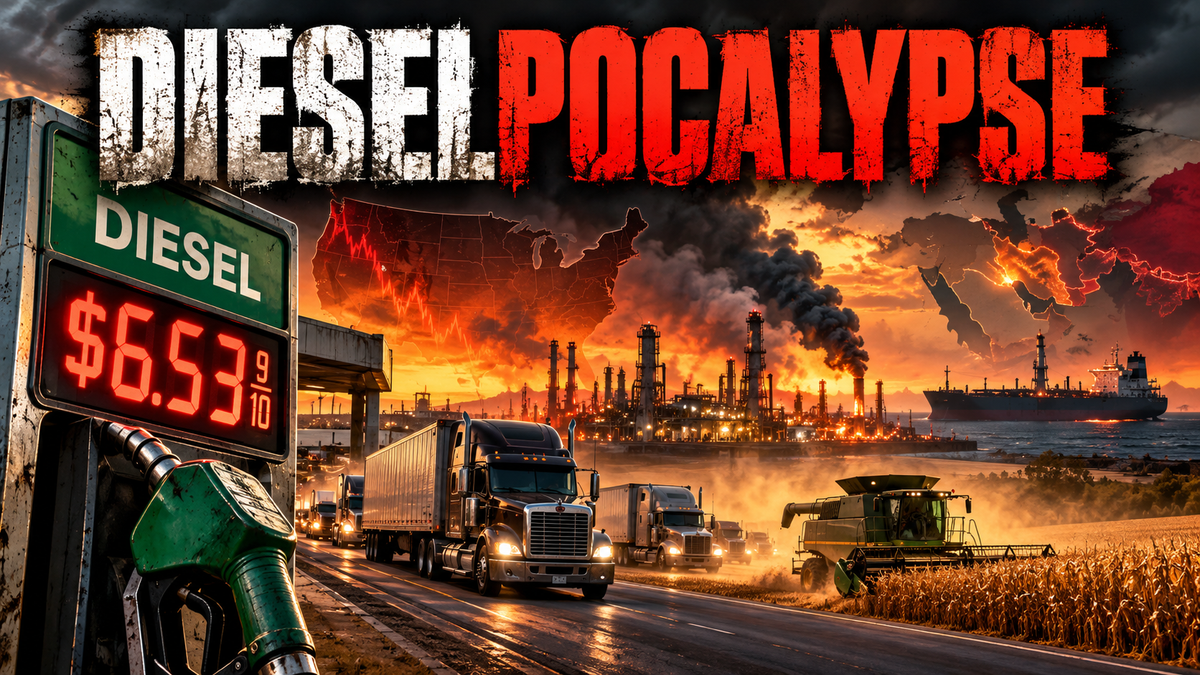
TL;DR: America's diesel crisis is no longer just a warning. Diesel hit a record $6.53 per gallon this month, while U.S. stocks fell to their lowest level for this time of year in more than four decades. Wars involving Iran and Russia have battered global fuel supplies just as U.S. exports surged. Refineries are already running hard, leaving little spare capacity. With harvest season underway and winter approaching, high diesel costs threaten to push up the price of food, freight, construction and consumer goods. Alabama farmers and loggers are already getting emergency relief from Gov. Kay Ivey.
Call it what it is: the Dieselpocalypse.
America is heading into October with record diesel prices, historically thin fuel stocks, refineries running near their limits and two wars disrupting some of the world's most important sources of oil and refined fuel.
Now comes harvest season, the holidays, and winter.
The question isn’t whether or not diesel has become expensive. It has. The question is whether an already strained system can make it through the next few months without something else going wrong.
As of Tuesday, AAA reported the national average price for diesel at $6.44 per gallon. It reached a record $6.53 on Sept. 22.
Alabama drivers are getting little better deal at the pump. AAA puts Alabama diesel at $6.07 per gallon, up from $3.42 a year ago.
That is a 77 percent increase in 12 months — but the price of diesel doesn’t stay at the pump.
It powers the trucks hauling groceries to stores. It runs tractors and combines. It fuels bulldozers, excavators and logging equipment. It moves parts to factories and finished goods to warehouses.
When diesel goes up, the cost of moving and making almost everything goes up with it.
The problem isn't a lack of American oil. That’s one of the strangest parts of this crisis.
The United States has plenty of crude oil. The real problem is turning crude into enough diesel — and getting that diesel where it needs to go.
The U.S. Energy Information Administration reports that the country entered 2026 with about 18.2 million barrels per day of refinery capacity.
But there were only 130 operable petroleum refineries at the start of this year, according to the EIA. In the early 1980s, there were more than 300.
That does not mean U.S. refining capacity has been cut in half. Modern refineries are far larger than the plants they replaced, and total capacity has held up much better than the raw refinery count suggests.
Still, the system has become concentrated, and there is little spare capacity left when something breaks.
Energy Secretary Chris Wright said last week that U.S. refineries were already operating at roughly 94 percent of capacity.
Building a new refinery is not a quick answer, mainly because they can‘t be built quickly. A large modern plant costs billions of dollars, can take years to permit and build, and must compete in a market where long-term demand is clouded by electric vehicles and energy policy.
That leaves America heavily dependent on the plants it already has.
Unfortunately, diesel, like oil itself, is a global market, and the world just lost access to a major supplier.
Russia was one of the world's largest diesel exporters. Then, Ukraine began hammering its refineries.
Reuters reported that half of Russia's largest diesel-producing refineries have cut output after drone attacks. Those six plants account for roughly half of Russian diesel production. As a consequence, Moscow has restricted exports as it tries to protect its own domestic fuel supply.
Then, of course, there’s the war with Iran — that 64 percent of the American people think was a bad idea.
The conflict has badly disrupted normal energy flows through the Persian Gulf and Strait of Hormuz. Attacks have also spread to Saudi energy infrastructure.
A Sept. 11 drone attack knocked out Saudi Arabia's East-West Pipeline, a critical route used to bypass Hormuz. The pipeline has since restarted, and crude and refined-product shipments have resumed from the Red Sea port of Yanbu.
But full flows are not yet back to normal, and with the Houthis continuing to flex regularly, they likely won’t be for some time.
Take Russian diesel off the market, disrupt Middle Eastern refining and shipping, and the rest of the world has to find fuel somewhere else.
Increasingly, it has turned to America.
U.S. refineries have been running hard to fill the global gap, but America is exporting its way into a squeeze.
American diesel exports are up more than 20 percent from last year and have been running around 1.3 million barrels per day, according to a recent Reuters analysis.
That has been lucrative for U.S. refiners. It has also made it much harder to rebuild inventories at home.
U.S. diesel and other distillate stocks have fallen to their lowest level for this time of year in more than four decades.
The situation is even more striking when diesel is compared with crude.
ZeroHedge reported that the front-month U.S. diesel crack spread — roughly the difference between the value of diesel and the crude used to make it — hit a record $102 per barrel in August.
“This is absolutely unprecedented,” ZeroHedge wrote.
The significance is simple, and scary: diesel is becoming scarce and expensive much faster than crude oil itself.
That is why pumping more crude or releasing crude from the Strategic Petroleum Reserve does not automatically solve the problem.
The oil still has to be refined.
On Tuesday, the Trump administration announced another offer to loan up to 40 million barrels of crude from the Strategic Petroleum Reserve, part of a wider international response to the energy crisis.
It may help. But, crude oil is not diesel.
So, the obvious question becomes “why not just stop exporting diesel?” It sounds simple, but unfortunately, it’s not.
President Donald Trump has discussed restricting U.S. diesel exports to keep more fuel at home.
Energy Secretary Wright says it could backfire.
“Definitely doesn't work,” Wright said when asked about a diesel export ban.
The reason comes down to how refineries work. Refiners do not turn a barrel of crude into one barrel of diesel. They produce a mix of products, including gasoline, diesel and jet fuel.
If Gulf Coast refiners were blocked from exporting excess diesel, storage could begin filling. Refiners could then be forced to cut the amount of crude they process.
That means less diesel. It also means less gasoline and jet fuel — which would drive their prices up still further, which nobody wants.
The White House later denied reports that it was preparing a 90-day ban. The administration is instead looking at ways to persuade refiners to keep more diesel at home without cutting total refinery output.
War explains why the diesel crisis exploded this year, but it’s been years in the making, according to some. There is a growing debate over whether years of energy policy left Western nations less able to handle the shock.
Economist Daniel Lacalle argues in a ZeroHedge analysis that taxes, regulation, refinery closures, sanctions and weak investment have left Western fuel markets with too little spare capacity.
“The geopolitical risk premium attached to oil prices is relevant, but the market was already weakened by policy choices,” Lacalle wrote.
That argument is strongest in Europe, where refinery capacity has fallen sharply and fuel taxes are much higher.
The U.S. picture is more mixed. America has far fewer refineries than it once did, but its remaining plants are much larger. Total U.S. refining capacity did not collapse along with the refinery count.
It did, however, fall by more than 250,000 barrels per day during 2025, according to the EIA. Two refinery closures accounted for much of the loss.
The result is a highly productive system with very little room for error.
October could be the month that brings the crisis back home.
Economist Eric Meux of Sentinel Economics recently modeled several paths for U.S. diesel inventories.
In his best-case scenario, U.S. refineries continue running near peak levels while exports move back toward more normal levels. Under those conditions, the country could get through the fall transition without a severe inventory draw.
His middle scenario assumes current trends largely continue. Supplies would remain historically tight, but the system would likely remain functional.
The danger lies in his worst-case model.
Refineries routinely shut units for maintenance during the fall as summer driving demand fades. If that seasonal maintenance cuts refinery output while exports remain high, Meux calculates that U.S. distillate inventories could fall to roughly 86 million barrels — or roughly 30 days supply.
If that happens, Meux argues that inventories would fall to levels not seen since the 1990s and could approach the minimum amount needed to keep the nation's fuel distribution system working normally. At that point, localized shortages and supply disruptions could become possible.
That is Meux's model, not an EIA forecast, and it should be treated as such, but the underlying problem is real.
Because October is harvest season.
Combines, tractors and grain trucks will be running hard across farm country. Freight demand continues, and typically increases as stores receive their holiday shipments. At the same time, refiners often perform maintenance as the summer driving season ends. Then cold weather adds demand for heating oil, which competes for the same pool of distillate fuel.
Geopolitical strategist Peter Zeihan makes a this case in "The Diesel Shortage Hits America."
Zeihan argues that the U.S. problem is made worse by geography. Much of America's refining capacity sits along the Gulf Coast. Other regions have far less. Moving fuel from where America makes it to where America needs it is not always easy.
Pipelines have limits. Shipping between U.S. ports is constrained by the Jones Act. Trucks can move fuel almost anywhere, but they burn diesel to do it.
The result is a system that can have enough diesel nationwide while still facing severe regional price spikes or local shortages.
For Alabama, the Dieselpocalypse is not just speculation — it’s already being addressed.
Last Thursday, Governor Kay Ivey ordered the Alabama Law Enforcement Agency to halt enforcement involving dyed diesel for 120 days to provide relief to farmers and timber operators.
Dyed diesel (or “red diesel”) is normally tax-exempt and restricted to off-road uses.
“The increase in diesel fuel prices has been particularly sharp relative to other fuel prices, directly affecting Alabama’s agricultural and timber industries,” Ivey wrote in her directive.
Ivey also directed the Alabama Department of Revenue to seek penalty relief from the IRS.
“As we are in the beginning of peak harvest season in Alabama, I am committed to doing what we can to support our state’s farmers and their families,” Ivey said. “When we can responsibly provide relief, I am all for it, and this is a measured, doable and commonsense action to help out Alabama’s agricultural and timber communities.”
Alabama's harvest season runs through November 15.
And at $6.07 per gallon, diesel in Alabama now costs about $2.65 more than it did one year ago.
For a farmer, logger or trucker burning hundreds of gallons, that difference adds up quickly.
Unfortunately, the price “ripple effect” won't stop with diesel — and that may be the most important part of the story.
Most Americans do not own diesel vehicles — but all Americans buy things delivered by one.
Food travels by truck. So do clothes, medicine, building supplies, auto parts and countless other goods.
Farms use diesel. Construction uses diesel. Logging uses diesel. Freight trucks use diesel. Freight trains burn diesel to power their electric generators.
When their fuel bill rises, businesses can absorb the increase, cut costs elsewhere or pass it along.
Eventually, much of it reaches consumers. So, the diesel shock poses a particular inflation risk because fuel costs work their way through supply chains.
And there is little sign that the underlying global shortage is about to vanish.
Russia's refinery problems remain unresolved. The Strait of Hormuz remains disrupted. Global refining capacity is stretched. China is dealing with its own unusually low fuel stocks. U.S. inventories remain thin.
The White House is now urging European nations to release emergency diesel reserves to help calm the market.
There are several ways this situation could get better.
Middle East tensions could ease. Russian refinery output could recover. U.S. exports could slow. Refiners could maintain high production. A mild winter could limit heating demand.
But there are also a number of ways it gets worse.
Another refinery outage. Another pipeline attack. A cold winter. More damage in Russia. Another disruption in the Persian Gulf.
Any or all of these could make a bad situation much, much worse.
That is the uncomfortable part of the Dieselpocalypse.
America is not out of diesel. But, at the start of the harvest and holiday seasons, diesel is already at record prices, domestic stocks are at a four-decade seasonal low, refineries are running near capacity and the global supply system has very little cushion left.
The trucks are still rolling. The combines are still running. The pumps still have fuel.
For now.