The Dream Team: Trump Took Winners to Beijing While Washington Sent Talkers for Decades
Guest Opinion by Perry Hooper, Jr.
Guest Opinion by Perry Hooper, Jr.
When America faces China in the biggest economic and technological competition of the modern era, President Donald Trump is not sending a debating society onto the field. He is sending an all star roster built to win championships.
Great coaches do not enter the Super Bowl with a roster full of consultants, bureaucrats, and motivational speakers. They bring quarterbacks, closers, blockers, grinders, innovators, and proven winners. They recruit talent. They recruit toughness. They recruit people capable of executing under pressure when the stakes are highest.
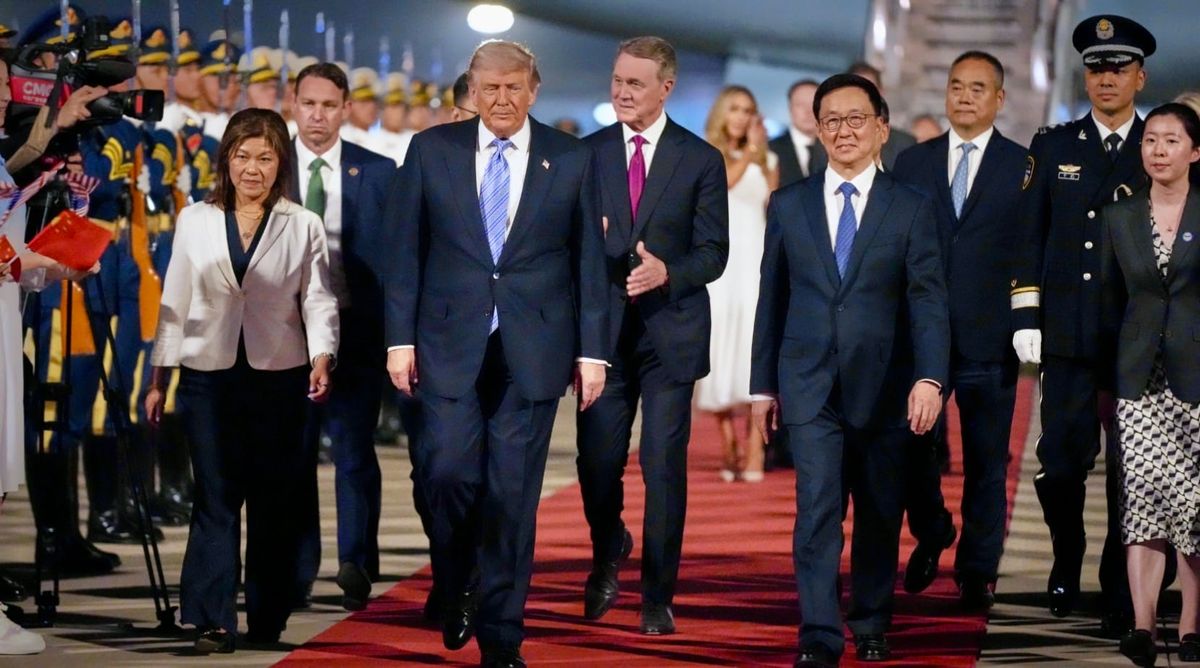
That is exactly what President Trump’s current trip to China is signaling to the world.
For decades, Americans watched administrations fill important international trips with polished bureaucrats, career diplomats, consultants, political handlers, and people whose greatest talent often seemed to be managing conference calls, drafting talking points, and appearing on Sunday television shows. The result was predictable. America talked while China built. America debated while China manufactured. America hosted conferences while our competitors secured supply chains, expanded industrial capacity, strengthened their economic influence across the globe, and quietly positioned themselves for long term strategic dominance.
The consultant class kept talking while China kept building.
The Obama Biden model often looked less like an industrial strategy and more like a permanent global policy seminar built around technocrats, regulatory managers, ESG consultants, climate panels, bureaucratic agencies, and career political operatives. The assumption appeared to be that America could regulate its way to prosperity while outsourcing industrial capacity, weakening energy independence, and becoming increasingly dependent on foreign supply chains.
Meanwhile China played an entirely different game.
China focused relentlessly on factories, ports, engineering, semiconductors, logistics, rare earth minerals, artificial intelligence, energy infrastructure, industrial production, and long term strategic leverage. China understood something many in Washington forgot years ago: economic power is national power. President Trump’s current trip to Beijing is sending a completely different signal.
President Trump did not arrive in China with a delegation designed to impress the faculty lounge crowd at Georgetown, the Davos crowd, or the cocktail circuit in Washington. He arrived with what looked like an American economic and technology dream team assembled to compete, build, and win.
This delegation was built the way legendary sports franchises build championship rosters.
In sports, great coaches understand a simple principle. If you want to win titles, you recruit talent. You do not ask whether the quarterback, the left tackle, the point guard, or the cleanup hitter agrees with every political opinion inside the locker room. You ask whether they can perform under pressure, execute the game plan, and help the team win championships.
That is exactly what President Trump’s delegation is projecting to the world.
Instead of surrounding himself exclusively with political loyalists and professional talkers, President Trump brought builders, operators, engineers, financiers, manufacturers, innovators, and executives who have actually created companies, factories, technologies, and industries that shape the modern global economy.
The roster itself tells the story.
Elon Musk, whose companies have transformed aerospace, artificial intelligence, robotics, satellite communications, energy systems, and advanced manufacturing.
Jensen Huang, the man whose semiconductor technology sits at the center of the global AI revolution and modern computing infrastructure.
Tim Cook, one of the world’s foremost experts on supply chains, manufacturing logistics, and global production networks.
Stephen Schwarzman and Larry Fink, financial leaders who understand capital flows, investment, and economic leverage at a global scale.
Kelly Ortberg representing American aerospace manufacturing and strategic industrial capability.

This was not a public relations exercise.
This was not a seminar panel.
This was not another bureaucratic committee organized around political correctness, ideological conformity, or carefully scripted talking points.
This was a roster built to compete.
And here is what may be the most important point of all: many of these individuals do not always agree with President Trump politically.
Some support Democrats. Some have publicly criticized Republicans. Some certainly disagree with President Trump on trade, climate policy, regulation, immigration, labor issues, or social policy.
And guess what? President Trump brought them anyway.
Because championship teams are not built around ideological purity tests. They are built around performance, execution, capability, discipline, toughness, and results.
Every championship locker room has strong personalities, disagreements, and competing viewpoints. Tom Brady did not agree with every coach. Michael Jordan did not agree with every executive. Nick Saban certainly coached plenty of players with different personalities and opinions. But championship organizations understand something Washington forgot years ago: winning matters more than uniformity.
President Trump understands the same principle.
America cannot compete with China by sidelining its best builders simply because they fail some partisan litmus test. When the stakes involve artificial intelligence, semiconductors, manufacturing, energy dominance, aerospace, logistics, national security, and economic leadership, you put the best players on the field regardless of whether they voted Republican, Democrat, or independent.
In today’s Washington, too many people ask who you voted for before asking whether you can actually build anything. President Trump appears to be reversing that equation.
As President Trump recently said, “We are bringing wealth, jobs, and manufacturing back to America.” That is not just campaign rhetoric. This delegation demonstrates what that philosophy looks like in practice.
This delegation reflects a belief that America’s future strength will come from innovation, manufacturing, engineering, energy production, artificial intelligence, industrial capacity, strategic infrastructure, and economic leadership rather than simply expanding government bureaucracy and regulatory management.
It reflects a belief that national strength still matters.
It reflects a belief that America should once again be a country that builds things instead of merely regulating those who do.
President Ronald Reagan once famously said, “Freedom is never more than one generation away from extinction.” Economic leadership works much the same way. Industrial dominance, technological leadership, and manufacturing strength are not permanent guarantees. They must be rebuilt, defended, and expanded by serious leaders willing to compete.
And for the first time in a very long time, America showed up in Beijing looking less like a committee preparing America for managed decline and more like a championship front office preparing to win the future. China understands competition because China has spent decades studying power, manufacturing, technology, logistics, and industrial dominance while too many American leaders were busy managing narratives instead of rebuilding national strength. China respects strength because strength is the languageserious nations understand, and this week President Donald Trump sent a message that could not have been clearer. America is no longer content to simply hold conferences, issue statements, and negotiate its own decline while other nations outbuild, outproduce, and outcompete us. By bringing builders, innovators, manufacturers, engineers, financiers, and proven operators to the table, President Trump signaled that America intends to compete again, manufacture again, innovate again, and lead again. The message from Beijing was unmistakable: America is putting its best players back on the field, and the rest of the world noticed the difference.
Perry O. Hooper Jr. is a longtime Alabama Republican figure, former Alabama Legislator and Montgomery businessman. He served as Co-Chair of “Alabama Trump Victory” in 2016, and served as an at-large delegate to the Republican National Convention. He is a noted civic leader in Montgomery with deep family roots in Alabama’s legal and political history.
Opinions do not reflect the views and opinions of ALPolitics.com. ALPolitics.com makes no claims nor assumes any responsibility for the information and opinions expressed above.