The Promise and the Parts
Part 2 of a four-part series — Guest Opinion by Alicia Boothe Haggermaker
Guest Opinion by Alicia Boothe Haggermaker
Part 2 of a four-part series
Assembled With Dependency — Part 2
Part 1 showed that the loudest cry of "foreign influence" in the data-center fight is aimed at the wrong target. This part turns to what America First actually promised — and what the supply chain behind the buildout is really made of. The complete version appears at unprecedentedtimes.org.
Update — July 18, 2026. Shortly after this piece first published, the White House and TSMC announced an additional $100 billion in Arizona chip investment, raising TSMC's U.S. total to a record $265 billion across twelve planned facilities. It is being held up as proof the reshoring is working, so it is worth addressing directly.
It does not change the argument here, for a simple reason: TSMC is Taiwanese, and Taiwan was never the China dependency this series is about. The dependencies documented here are transformers, switchgear, batteries, and rare-earth processing — the imported, largely Chinese-sourced parts of the buildout — none of which a logic-chip fab in Arizona addresses. Advanced chips were already coming from Taiwan. Moving that production to Arizona changes our exposure to a Taiwan Strait chokepoint; it does nothing about the grid hardware or the minerals.
I will concede one honest update. Below, I note that Arizona wafers still travel back to Taiwan for advanced packaging, so the loop does not close on this continent. The new announcement adds domestic advanced-packaging capacity aimed at exactly that gap — so on paper, the loop starts to close, though the full build-out runs well into the 2030s. It closes on a blueprint, not yet in reality.
Everything else in the announcement reinforces what is written here. TSMC's own first-listed constraint is water supply in Arizona's desert — a resource this series devotes a section to in Part 3. The company said the expansion would only "likely" produce the new plants, gave no committed construction timelines, and said the pace would track "the market situation" — the market-driven, no-structural-loyalty problem described below, stated by the chairman himself. And the trade framework now being credited traces back through a deal entered under the prior administration. Real investment. Still foreign-owned, still years away, still gated by the water. The dependency is now.
There is a Facebook post making the rounds. Someone named Brenda summarized the whole thing in three sentences that the entire U.S. defense and technology establishment has apparently been unable to process: The 2024 National Defense Authorization Act restricts Chinese components in national security infrastructure. All data centers use Chinese components. A county in Texas used this to block one. She added: Just Sayin'…
Brenda is not wrong. What follows is what happens when you take Brenda seriously and pull the thread all the way down.
I voted for the America First premise. Not blindly. Not without reservation. But because the core argument was sound: American workers, American manufacturing, American supply chains, American communities making decisions about their own infrastructure. The value circulating inside the economy that generates it rather than being extracted outward to entities with no stake in what they leave behind.
That premise deserved to be tried.
What follows is the documented record of what was built instead.
The Infrastructure We Were Promised
On January 21, 2025, President Trump announced Stargate — a $500 billion AI infrastructure investment, the largest in American history. One hundred thousand jobs. American AI dominance. The construction of colossal data centers that would secure American technological leadership against China.
The America's AI Action Plan published in July 2025 was explicit: "America must bring semiconductor manufacturing back to U.S. soil. A revitalized U.S. chip industry will generate thousands of high-paying jobs, reinforce our technological leadership, and protect our supply chains from disruption by foreign rivals."
The premise was clear. American infrastructure. American jobs. American supply chains. American security.
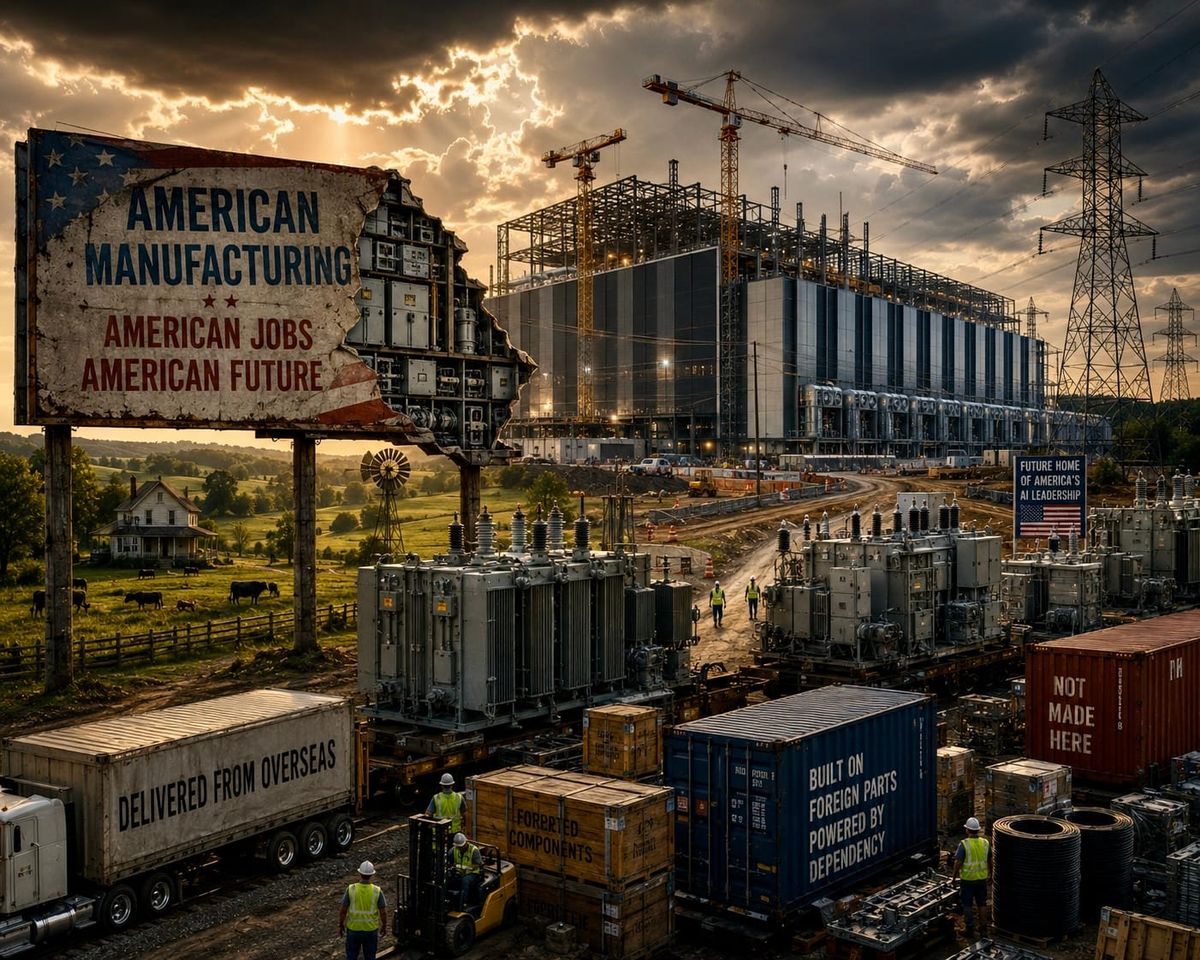
Here is what the supply chain actually looks like:
U.S. imports of transformers, switchgear, and lithium-ion batteries — the foundational components every data center requires — nearly doubled between 2020 and 2025, from $33 billion to $77 billion annually. The United States produces very little of this domestically. As of April 2026, almost half of U.S. data centers planned for this year are expected to be delayed or canceled. The primary causes include shortages of the exact components the AI Action Plan said we would manufacture at home.
Someone will say: but we are building fabs now. True. And it is worth being precise about what that building actually is, because the precision is the story. Since the CHIPS Act passed in 2022, announced U.S. semiconductor investment has exceeded $700 billion — the largest industrial capital allocation to a single sector in American history. TSMC alone has committed $165 billion to its Arizona campus. Micron is building memory in Idaho, Virginia, and New York. Intel, Samsung, and Texas Instruments are pouring concrete across a half-dozen states. The cranes are real.
But read what is under the cranes. The leading edge — the advanced chips the AI race actually needs — is mostly being built by foreign-owned companies on American soil. TSMC is Taiwanese. Samsung is Korean. We are hosting the factory, not owning the company. The most advanced nodes do not come online until 2027 to 2029, years after the data centers depending on them are already standing. Even the wafers made in Arizona still travel back to Taiwan for advanced packaging before they become finished chips — the loop does not close on this continent. And the entire surge is driven by the same AI demand straining everything else, not by a deliberate decision that dependency was dangerous. We are not reshoring because we learned the lesson. We are reshoring because the market briefly found a reason — and a reason the market found, the market can unfind. SanDisk already canceled a $55 billion fab in Michigan. NXP is closing an Arizona facility. Manufacturing construction spending peaked in 2024 and has fallen since. A factory built on a market rationale carries the same flaw as everything else in this story: no structural incentive for loyalty.
The FY2024 National Defense Authorization Act did not leave the threat vague. Section 889 prohibits federal agencies, contractors, and grant recipients from using telecommunications equipment from named Chinese firms when it functions as a substantial or essential component of any system. Section 805 prohibits the Defense Department from contracting with entities on the Chinese Military Companies list beginning June 2026, and from procuring items containing components from those entities beginning June 2027. The government formally recognized — in writing, and signed into law — that Chinese-manufactured technology embedded in critical infrastructure is a national security threat. And then the construction cranes went up anyway, on the same supply chain the law was written to replace.
China saw the same chokepoint a decade earlier and did the opposite. In 2015 it published its Made in China 2025 roadmap — explicit targets and deadlines for domestic semiconductor market share, with a stated goal of replacing foreign imports with Chinese-made products in the industries that matter. It treated hardware manufacturing as a national security project, because that is what it is. China identified the vulnerability and spent ten years building its way out of it. We identified the same vulnerability, passed a law acknowledging it, and kept buying from Beijing anyway.
The law exists. The infrastructure is being built. Both are true simultaneously.
The Chips We Banned Are Already There
The NDAA restrictions were not the first attempt to limit China's access to American AI technology. Export controls on advanced chips had been building for years. The policy architecture was real.
What was also real was the evasion infrastructure built around it.
Epoch AI estimates that between 290,000 and 1.6 million Nvidia H100-equivalent chips reached China through the end of 2025 — representing roughly a third of China's total AI compute capacity. Because much smuggling goes undetected, the actual number is likely higher.
Federal prosecutors charged Supermicro's co-founder in March 2026 with running a $2.5 billion operation that worked as follows: servers were assembled in the United States using restricted Nvidia GPUs, shipped to Taiwan under the cover of regional distribution, forwarded to Southeast Asia where identifying markings were removed, and delivered to buyers in mainland China. Legal purchase. Legal assembly. Falsified transit. Chinese military end-user.
Applied Materials paid a $252 million civil penalty for shipping semiconductor manufacturing equipment to China through a Korean subsidiary. Cadence Design Systems paid $95 million after admitting employees transferred chip design technology to a Chinese university the U.S. government believes uses it for nuclear weapons simulation.
These are not black market operations run from warehouses. These are major American technology companies with compliance departments, legal teams, and government contracts.
Then there is the UAE door.
G42, the UAE's state AI company, received a license from the Trump administration to import 60,400 Nvidia GPU equivalents — nearly three times the volume approved under the previous administration. The House Select Committee on Strategic Competition with China documented G42's ties to Chinese military companies including Huawei. Microsoft invested $1.5 billion in G42. OpenAI, Nvidia, Oracle, Cisco, and SoftBank are building Stargate UAE — a 5 gigawatt AI campus in Abu Dhabi — in partnership with an entity congressional testimony identified as having Chinese military company ties.
In December 2025, the Commerce Department reversed restrictions on H200 chip sales to China. The Council on Foreign Relations called the result "strategically incoherent." In May 2026, the President traveled to Beijing with Nvidia CEO Jensen Huang.
The administration that passed the restrictions reversed them. The law stayed on the books. The chips moved anyway.
Next, in Part 3 — Who Is Building This, and What It Takes: follow the money into who is actually funding the buildout, and what it draws out of the communities that host it, starting with the water.
Alicia Haggermaker is an investigative journalist, systems analyst, and community organizer based in Huntsville, Alabama. She publishes at Unprecedented Times and is the founder of the Mycelium Network. The complete version of this series appears at unprecedentedtimes.org.
Sources (Part 2):
White House Stargate announcement, January 2025; America's AI Action Plan, July 2025; Coalition for a Prosperous America import data; Arnold & Porter FY2024 NDAA analysis; Congressional Research Service Report R48642 (NDAA Sections 889 and 805); CSIS "Made in China 2025" semiconductor analysis; SIA/SemiconductorX U.S. fab investment totals 2026; Tom's Hardware and Manufacturing Dive on TSMC Arizona and Micron construction status 2026; White House and Department of Commerce announcement of TSMC's $265 billion Arizona expansion, July 16, 2026, with UPI, TechTimes, and 9to5Mac reporting on its timelines and constraints; Epoch AI chip-smuggling estimate 2025; DOJ Supermicro criminal complaint, March 2026; Applied Materials DOJ civil penalty; Cadence Design Systems settlement; CSIS and House Select Committee on the CCP findings on UAE/G42; Council on Foreign Relations chip-export analysis; CNBC on the May 2026 Beijing summit.
Opinions do not reflect the views and opinions of ALPolitics.com. ALPolitics.com makes no claims nor assumes any responsibility for the information and opinions expressed above.