Tracking Jared Hudson’s Bulls**t in Alabama
Release a poll. Push it aggressively online. Watch friendly influencers and lazy reporters repeat it unquestioned. Manufacture momentum. Repeat.

Opinion
Trying to follow the Jared Hudson campaign's bullshit over the last eight months has been exhausting. Literally.
Not because the race itself has been complicated. It really has not. What has been difficult is trying to keep track of the nonstop spin, hype, inflated polling narratives, and media-driven fantasy world surrounding Hudson’s campaign from the very beginning.
One month, Hudson was “surging.” The next month, he was “leading.” Then, suddenly, social media posts and campaign allies were claiming he was on the verge of outright dominating the field.
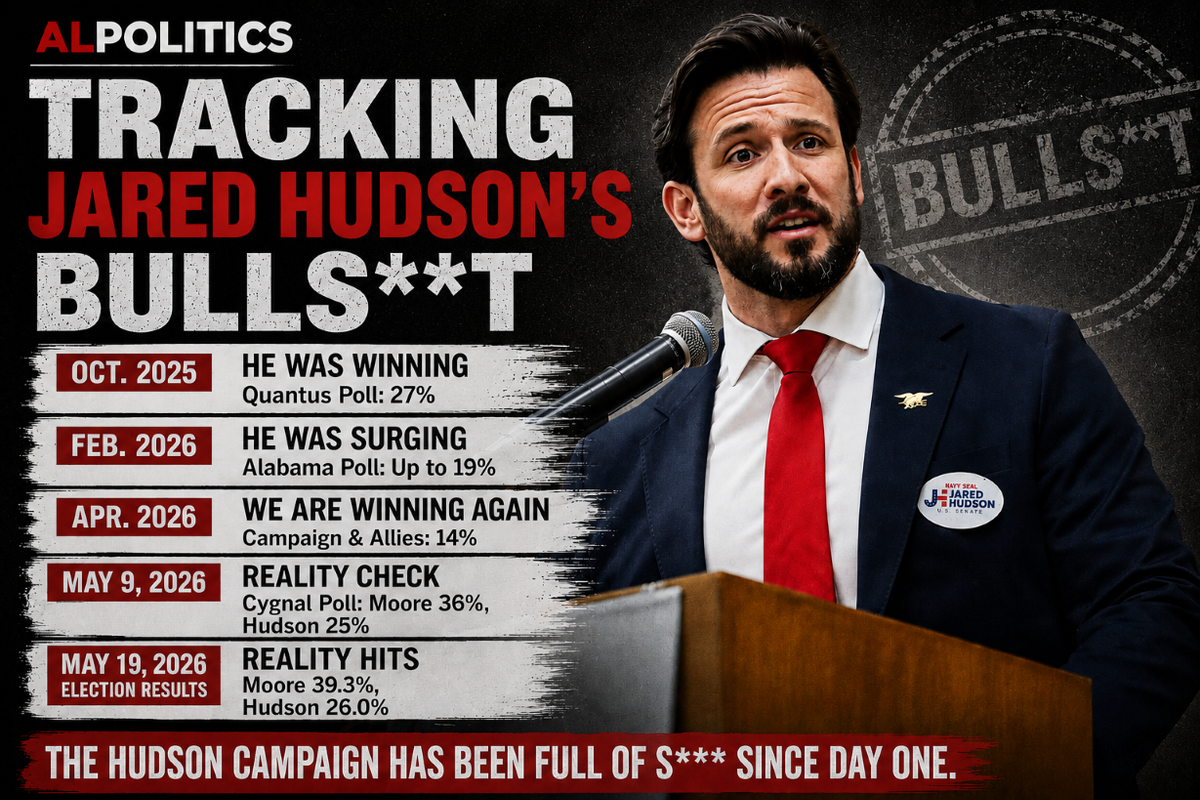
Back in October, Quantus polling showed Hudson supposedly leading the Republican Senate primary at 27 percent. At the time, the narrative pushed by supporters was that Hudson had become the breakout outsider candidate, and momentum was exploding statewide.
Then came another round of polling.
In February, “The Alabama Poll” showed Hudson climbing to 19 percent while the media dutifully repeated the idea that he was rapidly consolidating conservative support. By March and April, additional polling and campaign messaging pushed the idea that Hudson was once again surging, with supporters claiming the race was effectively his to lose.
It became a cycle.
Release a poll. Push it aggressively online. Watch friendly influencers and lazy reporters repeat it unquestioned. Manufacture momentum. Repeat.
That is the part many Alabama voters have grown tired of.
Political campaigns spin numbers all the time. That is politics. But the Hudson campaign seemed to build its entire public identity around hype, selective polling, and exaggerated momentum narratives that rarely matched reality on the ground.
And unfortunately, too much of Alabama's political media played right along.
Far too many reporters simply copied press releases and poll memos into stories without seriously examining methodology, sample makeup, undecided voter percentages, or even whether the numbers aligned with actual voter behavior.
If a poll generated clicks, it got coverage.
No skepticism. No context. Just another recycled headline feeding the latest narrative.
Looking back now, the polling history tells the real story. <- You will want to click this link we found to help you follow the bulls**t.
Many of the surveys most aggressively promoted by Hudson supporters came from outfits like Quantus and “The Alabama Poll,” both of which repeatedly showed dramatic swings and inflated momentum claims throughout the race. Meanwhile, the Cygnal poll released in early May ended up being one of the closest snapshots of the actual electorate before voting began.
That survey showed Barry Moore leading Hudson by eleven points with a massive undecided bloc still in play, a much more realistic picture than the fantasyland social media narrative claiming Hudson was steamrolling the field.
Then came Election Night.
Barry Moore finished first with nearly 40 percent of the vote, while Hudson landed around 26 percent. Suddenly, all the “unstoppable momentum” talk looked a lot different.
The bigger issue here is not Jared Hudson himself. Campaigns are going to campaign.
The bigger problem is a political media environment where too many people are willing to print any s**t handed to them without asking basic questions. If enough polls, graphics, tweets, and influencer posts get blasted across the internet, a fake narrative can temporarily become “truth.”
Until voters finally get their say.
And when they did, much of the Hudson hype machine collapsed under the weight of reality. Panic has set in. Jared has become angry in his social posts and even went as far as to jab at his opponent's faith.
Maybe Jared should stop exaggerating the truth and practice what he preaches.