Trump Demands Rehearing in Birthright Citizenship Case
President calls the ruling a “miscarriage of justice” as birth-tourism ads expose the cost of automatic citizenship
President Donald Trump says he will ask the U.S. Supreme Court to reconsider its sweeping birthright citizenship ruling after a Texas hospital was caught marketing low-cost maternity packages to women living outside the United States.
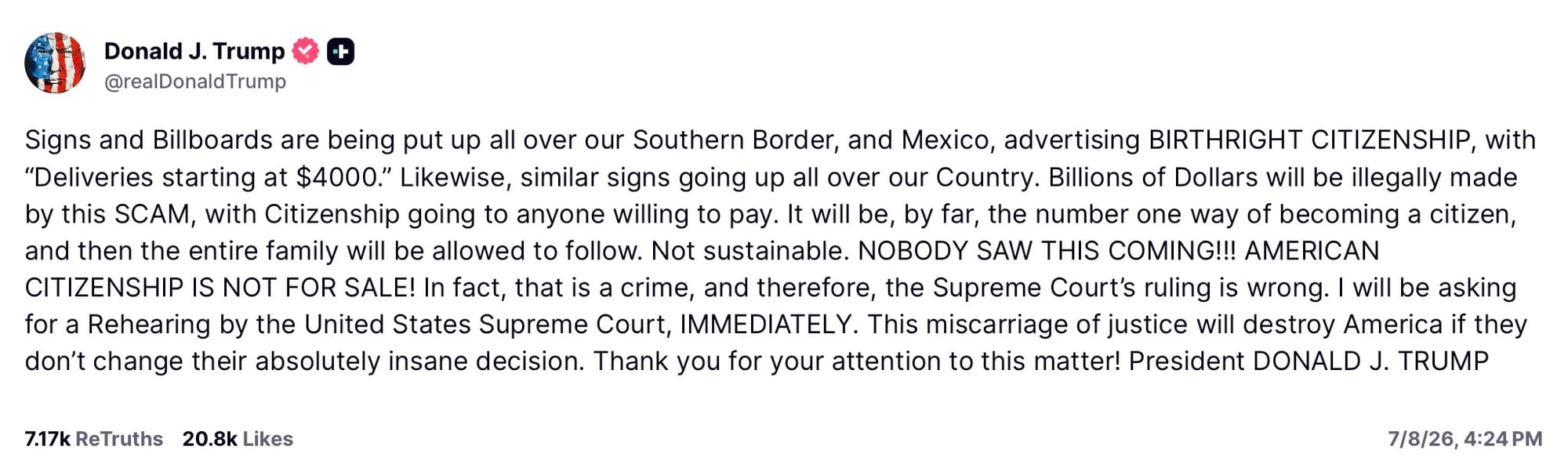
Trump announced Wednesday that his administration would seek a rehearing in Trump v. Barbara, the 6-3 decision that struck down his Executive Order limiting automatic citizenship for children born to illegal immigrants and temporary foreign visitors.
“In fact, that is a crime, and therefore, the Supreme Court’s ruling is wrong,” Trump wrote on Truth Social. “I will be asking for a Rehearing by the United States Supreme Court, IMMEDIATELY. This miscarriage of justice will destroy America if they don’t change their absolutely insane decision. Thank you for your attention to this matter!”
The President’s demand was quickly mocked in parts of the national press as a request for a “do-over.” Yet a petition for rehearing is a lawful part of Supreme Court procedure — even though such requests are rarely granted.
Under Supreme Court Rule 44, a party may seek rehearing of a decision on the merits within 25 days. The petition must be filed in good faith and cannot be used merely to cause delay. Rehearing requires a majority of the Court and must be initiated by at least one justice who joined the original judgment.
That means Trump must persuade one of the six Justices who voted to block his order to reopen the case. Chief Justice John Roberts and Justices Sonia Sotomayor, Elena Kagan, Amy Coney Barrett and Ketanji Brown Jackson found the order unconstitutional. Justice Brett Kavanaugh agreed that it could not stand, but based his vote on federal law rather than the 14th Amendment.
Kavanaugh’s narrower position may give the administration its most plausible opening. His opinion left room for Congress to amend the citizenship law, while declining to join Roberts’ broader constitutional reading.
Roberts held that children born in the United States to parents who are here illegally or only for a short time are “subject to the jurisdiction” of the United States and are therefore citizens at birth.
“Under the Constitution, they are citizens at birth,” Roberts wrote.
The ruling did far more than reject one Executive Order. It placed the Court’s broad form of birthplace citizenship inside the Constitution itself, making it far harder for Congress or a future president to correct.
That was not the only path open to the Court.
Kavanaugh said Trump’s order conflicted with the current wording of federal citizenship law. Congress, under his view, could revise that statute and force the courts to confront the constitutional issue again.
Roberts instead chose the most far-reaching route. He claimed the 14th Amendment adopted an English common-law rule granting citizenship to nearly every child born on American soil, aside from narrow cases such as the children of foreign diplomats.
That view was sharply challenged by Justices Clarence Thomas, Samuel Alito and Neil Gorsuch.
Alito called the ruling “one of the most important decisions in the history of the Court” and “a serious mistake.” He argued that citizenship should apply to children who owe allegiance to the United States, not to every child whose mother happens to be inside the country when labor begins.
Thomas said the majority’s account was “not historically accurate.” He argued that the Citizenship Clause was enacted to secure citizenship for freed slaves and their children, not to give foreign visitors a permanent right to create American citizens through a brief stay.
Critics have also faulted Roberts for brushing aside serious procedural issues to reach the constitutional question. Thomas and Gorsuch questioned whether the vast class certified by the lower court had proper standing and whether the challengers had a valid right to bring the case.
The decision has also drawn unusually sharp criticism from prominent constitutional scholars who argue that the Court did not merely reaffirm precedent but fundamentally rewrote the original meaning of the Fourteenth Amendment.
Among the most detailed critiques came from Richard Epstein, Professor Emeritus at the New York University School of Law and a senior fellow at the Hoover Institution. In an opinion in The Wall Street Journal, Epstein argued that Chief Justice John Roberts misread both the text and history of the Citizenship Clause by equating the phrase "subject to the jurisdiction" of the United States with simply being born within its borders.
Epstein contends that the framers of the Fourteenth Amendment deliberately included the jurisdiction language to require complete political allegiance to the United States—not merely physical presence—and that Roberts' interpretation effectively reads those limiting words out of the Constitution.
Rather than follow his usual claim of judicial restraint, Roberts pushed through those barriers and issued a ruling designed to settle the issue nationwide.
The result is a decision that treats geography as the key test for citizenship while reducing allegiance, consent and the parents’ lawful status to secondary concerns.
The real-world effect did not take long to appear.
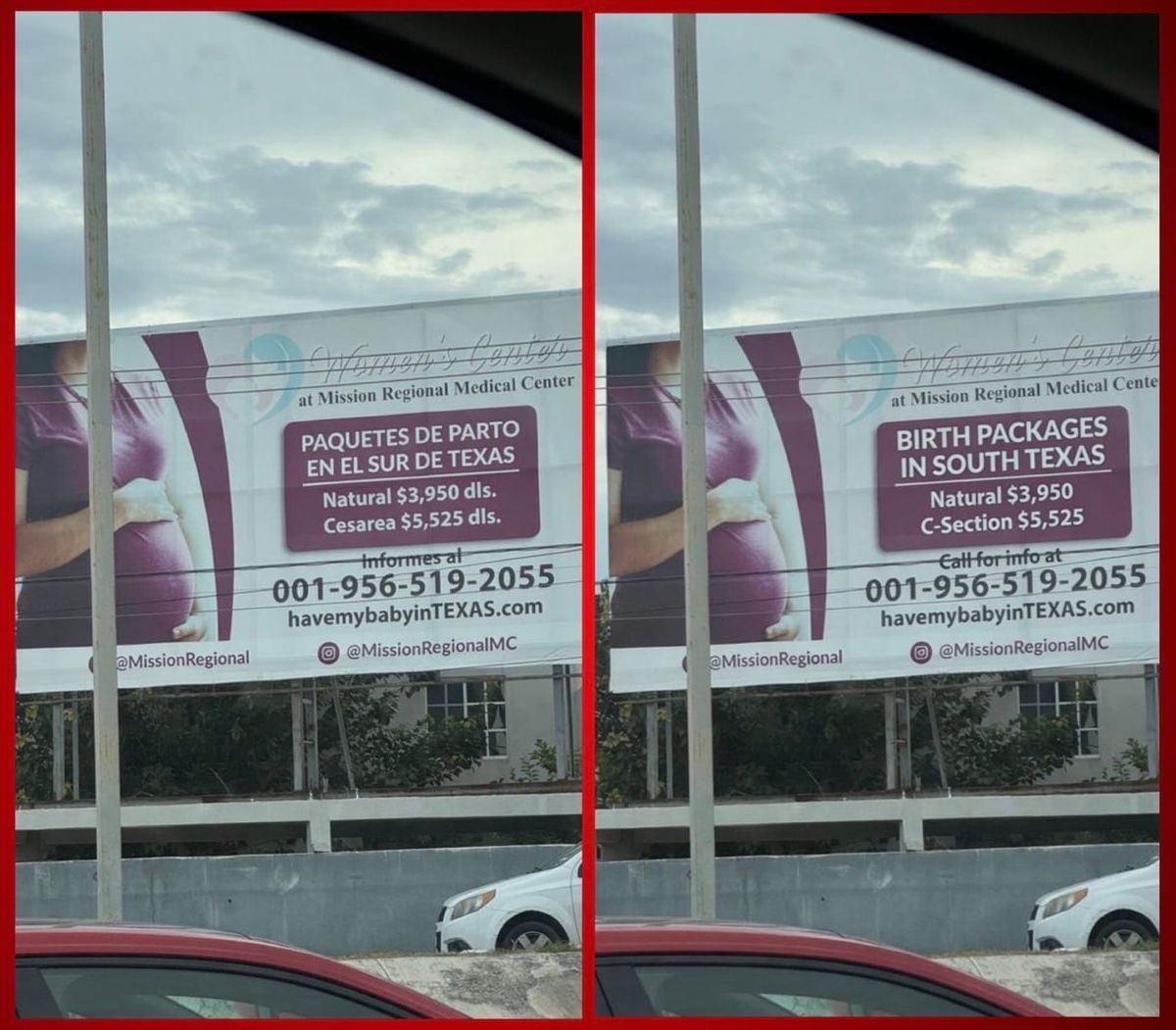
Mission Regional Medical Center in South Texas marketed childbirth packages to international patients through Spanish-language advertising and a website called “Have My Baby in Texas.”
A billboard reportedly placed in Reynosa, Mexico, promoted births across the border in Mission, Texas. The hospital offered packages starting at $3,950 for a vaginal delivery and $5,525 for a cesarean delivery. Its marketing asked pregnant women living abroad whether they wanted to “welcome your baby in South Texas.”
The hospital has since removed the campaign, saying its materials were retired because of an “unintended misunderstanding.” It denied supporting unlawful conduct and said it would cooperate with state officials.
Texas Gov. Greg Abbott ordered an investigation.
“American citizenship is not for sale and Texas will not permit our healthcare system to be used as a magnet for birth tourism,” Abbott said.
The ads do not state in the wording quoted by news reports that citizenship was formally included in the hospital package. Still, their target audience, location and timing raise an obvious question: Why market Texas delivery rooms to pregnant women in foreign nations when a child born a few miles north of the border receives U.S. citizenship for life?
Trump’s answer was blunt.
“AMERICAN CITIZENSHIP IS NOT FOR SALE!” he posted on Truth Social.
Birth tourism is hard to track because the government does not maintain a complete count of women whose chief purpose for entering the country is to give birth.
Estimates also vary depending on whether researchers count only women traveling on tourist visas or include other temporary visitors.
The Migration Policy Institute reported that available estimates range from about 5,000 to 26,000 birth-tourism births per year. An older Center for Immigration Studies estimate placed the number at roughly 33,000 annually.
A May 2026 letter from the House Oversight Committee cited an estimate of nearly 26,000 annual births to women on tourist visas. It also cited a broader estimate of about 70,000 births to temporary visitors in 2023, though that larger figure should not be treated as a count of women proven to have entered solely for birth tourism.
The same congressional inquiry examined a company offering childbirth services “exclusively for international patients.” Its listed 2026 packages totaled $6,652 for a vaginal birth and $8,177 for a cesarean birth, along with help involving housing, travel and legal advice.
The State Department has barred the issuance of visitor visas when officials have reason to believe an applicant’s main purpose is to give birth in the United States and obtain citizenship for the child. Giving birth here is not itself unlawful, but lying about the purpose of a visit can amount to visa fraud.
The Court’s decision does not erase those visa rules. It does, however, preserve the reward that drives the trade. Anyone who succeeds in entering the country and giving birth can obtain citizenship for the child, even when neither parent is an American, neither intends to remain here and both owe allegiance to another nation.
No reliable study has yet measured how much the new ruling will increase birth tourism. But the ruling removes any doubt about the prize being offered. Hospitals and private firms now know that, unless immigration officials stop the mother before she enters, the child’s citizenship is secure.
That is not merely a side effect of Roberts’ opinion. It is the legal rule the majority chose to constitutionalize.
The broader scale of the issue extends well beyond organized birth tourism. According to a 2026 analysis by the Pew Research Center, roughly 320,000 babies—about 9% of all U.S. births in 2023—were born to mothers who were either in the country illegally or present on temporary visas. Of those, approximately 245,000 births were to parents who were both in the United States illegally, while another 75,000 involved at least one parent with temporary legal status or lawful permanent residence.
Separately, the Center for Immigration Studies estimates that between 225,000 and 250,000 children were born to illegal immigrant parents in 2023, representing nearly 7% of all U.S. births. While the precise figures vary because illegal immigration is inherently difficult to measure, both analyses indicate that hundreds of thousands of children acquire U.S. citizenship each year under the current interpretation of the Fourteenth Amendment. Opponents of the Supreme Court's ruling argue that preserving automatic citizenship will further encourage both illegal immigration and birth tourism by removing any remaining uncertainty about a child's citizenship once he or she is born on American soil.
Despite significant pushback against the Barbara ruling, Trump’s rehearing request faces long odds. Supreme Court reversals through Rule 44 are exceptional, and the administration needs a justice from the majority to reconsider the case.
Yet the Texas billboards provide Trump with potent new evidence of what the dissenters warned: When citizenship is tied to the location of a delivery room rather than allegiance to the nation, a priceless national bond becomes a product that can be advertised, packaged and sold.
The Court may refuse to hear the case again. If so, it should not pretend the consequences were unforeseeable.