Trump Opens Highways to Tax-Free Red Diesel
Trump follows Alabama’s lead, easing dyed-diesel rules nationwide as record fuel costs threaten a “Dieselpocalypse”
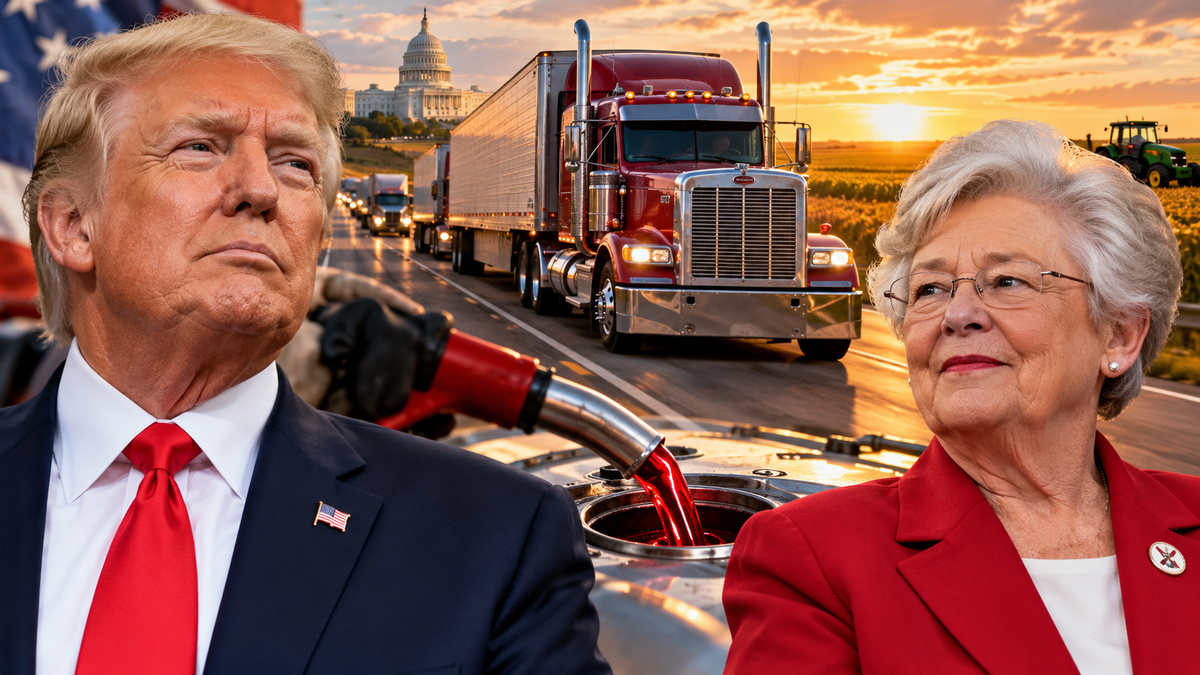
TL;DR: President Donald Trump signed an Executive Order Sunday opening the nation’s highways to dyed diesel through the end of 2026 while directing Treasury to defer the 24.4-cent federal highway tax and waive penalties. The move comes as diesel averages $6.32 nationwide and the nation faces thin inventories, tight refinery capacity and war-driven supply shocks. Trump’s action follows a similar move by Alabama Gov. Kay Ivey, who Ordered State police Sept. 24 to stop checking commercial trucks for dyed fuel for 120 days.
President Donald Trump is taking a page from Alabama Governor Kay Ivey’s playbook, opening the nation’s highways to dyed diesel fuel as his administration scrambles to head off what ALPolitics.com has dubbed the “Dieselpocalypse.”
Trump signed an Executive Order Sunday temporarily easing federal restrictions on dyed, or “red,” diesel and directing the Treasury Department to defer federal highway taxes on the fuel through the end of the year.
The move could immediately cut fuel costs for truckers, farmers and other diesel users if fully put into effect — and even more if States follow Trump’s lead.
“Today, I am announcing another unprecedented step to bring down costs. For many years, farm vehicles, construction equipment, and other off-road vehicles have used what is known as ‘red dye’ diesel… which is exactly the same as normal diesel, but is sold tax-free for off-road vehicles and big trucks… Tonight, I am going to sign a historic Executive Order to officially waive the off-road requirement and allow anyone to purchase tax-free red dye diesel for any reason,” Trump said Sunday in Nebraska, according to a White House Statement.
The move comes at a critical time.
According to AAA, the national average for highway diesel stood at $6.32 per gallon Sunday, up from $3.69 one year ago. That is an increase of more than 71 percent in 12 months.
Alabama diesel averaged about $5.95 per gallon, compared with $3.43 a year ago. The State set an all-time record of $6.1596 on Sept. 20.
Dyed diesel is not a different type of fuel. It is regular diesel marked with red dye because it is normally sold for tax-exempt off-road uses, including tractors, construction equipment and logging machinery. Using it in highway vehicles can normally trigger federal taxes and stiff penalties.
Trump’s Executive Order directs Treasury Secretary Scott Bessent to determine within five days whether he can defer the federal excise tax on dyed diesel used on highways between Oct. 5 and Dec. 31.
The Order also directs the IRS not to impose the normal penalties for selling or using dyed diesel on highways during that period. Any deferred tax would carry no interest or penalties. Trump further Ordered Treasury to explore ways, including legislation, to eliminate the deferred tax bill altogether.
The federal tax on highway diesel is 24.4 cents per gallon. That works out to about $61 on a 250-gallon fill-up. The White House fact sheet says savings could top $100 per fill when States provide similar tax relief.
The Order also directs the Agriculture Department to work with farm co-ops, rural fuel suppliers and other groups to make sure dyed diesel reaches high-demand areas. The Transportation Department is directed to coordinate with States, industry groups and labor.
Perhaps most important for Alabama and other States, Trump Ordered the White House Office of Intergovernmental Affairs to urge Governors to take similar action.
That part should sound familiar to Alabamians, because Kay Ivey acted nearly two weeks before Trump.
On Sept. 24, the Governor directed the Alabama Law Enforcement Agency to stop focusing commercial vehicle inspections on dyed diesel use for 120 days and instead concentrate on safety threats.
As ALPolitics.com reported, Ivey said the spike in diesel prices was causing “significant economic hardships for all Alabamians,” with farmers and timber crews taking a particularly hard hit during harvest season.
“Many Alabama farmers and timber operators maintain on-site supplies of dyed diesel fuel for nontaxable, off-road use,” Ivey wrote. “Temporarily refocusing enforcement activity related to the use of dyed diesel fuel will provide meaningful relief to Alabama’s agricultural and timber industries.”
Ivey also directed Alabama Revenue Commissioner Mary Martin Mitchell to seek federal penalty relief from the IRS.
At the time, that was the catch.
Alabama could tell ALEA not to check fuel tanks, but Montgomery could not erase federal taxes or tell the IRS to stand down.
An ALPolitics.com analysis of Ivey’s move noted that the unresolved federal issue stood between Alabama fuel users and the full benefit of combining the State’s 31-cent highway diesel tax with the 24.4-cent federal tax — roughly 55 cents per gallon in potential relief.
Trump has now moved to address the federal half of that problem.
Alabama was hardly alone in preempting the President. Reuters reported that Louisiana, Oklahoma, Nebraska and North Carolina were among States that had also eased dyed-diesel restrictions as fuel prices soared.
The White House action comes amid a diesel crunch that is about far more than the price displayed on gas station signs.
ALPolitics.com warned last week that record prices, low stocks, limited spare refining capacity, war and the arrival of harvest and holiday shipping seasons were converging into a “Dieselpocalypse.”
Diesel powers the trucks that haul groceries and Christmas merchandise. It runs tractors, combines, bulldozers and logging equipment. Higher diesel prices eventually work their way into the price of nearly everything Americans buy.
The problem is increasingly one of refined fuel rather than simply crude oil.
Reuters reported in September that U.S. diesel inventories had fallen to their lowest level for that time of year in more than four decades and were about 13 percent below year-earlier levels. American diesel exports, meanwhile, had risen more than 20 percent from 2025 to about 1.3 million barrels per day as the U.S. helped fill gaps left by disruptions in Russia and the Middle East.
That pressure has only grown.
Russia has restricted diesel exports after Ukrainian attacks damaged refineries, while the Iran war has disrupted Middle East refining and shipping. China also suspended fuel exports in October, adding another strain to an already tight global market.
As ALPolitics.com reported in August, America’s broader energy cushion had already been shrinking as the Iran war drained reserves and drove up diesel and farm costs.
Trump has tried several ways to relieve that pressure. His administration pushed European allies to release emergency diesel stocks, while the U.S. offered another 40 million barrels of crude from the Strategic Petroleum Reserve late last month.
But crude oil is not diesel. It still has to pass through a refinery before it can fuel a semi.
Opening the highway market to dyed diesel does something much more direct: It makes an existing pool of finished diesel easier and cheaper to use.
For Alabama, the federal Order also closes much of the gap left by Ivey’s earlier move. The Governor effectively told State officers to quit worrying about red dye for 120 days and asked Washington to follow suit.
Less than two weeks later, Trump did — and he is now asking the rest of the country to follow Alabama’s lead.