Trump Signs Orders to Aid Ranchers, Meat Access
New orders target wolves, beef labels, meatpacking competition and interstate meat sales after ranchers pushed back on imports
TL;DR: President Donald Trump signed two executive orders aimed at helping U.S. ranchers and expanding consumers’ access to American meat. The first directs federal agencies to review rules affecting ranchers, reconsider protections for wolves that prey on livestock, explore mandatory country-of-origin labeling for beef, and look for ways to strengthen the cattle industry. The second targets concentration in meatpacking, calls for stronger enforcement of the Packers and Stockyards Act, expands paths for eligible state-inspected meat to be sold across state lines, and seeks more processing options for small and mid-sized producers. The orders follow sharp backlash from cattle producers over Trump’s recent plan to increase lower-tariff beef imports. Ranchers have welcomed many of the new measures but remain wary of import policies they say could undercut cattle prices just as producers are being asked to rebuild the nation’s historically small herd.
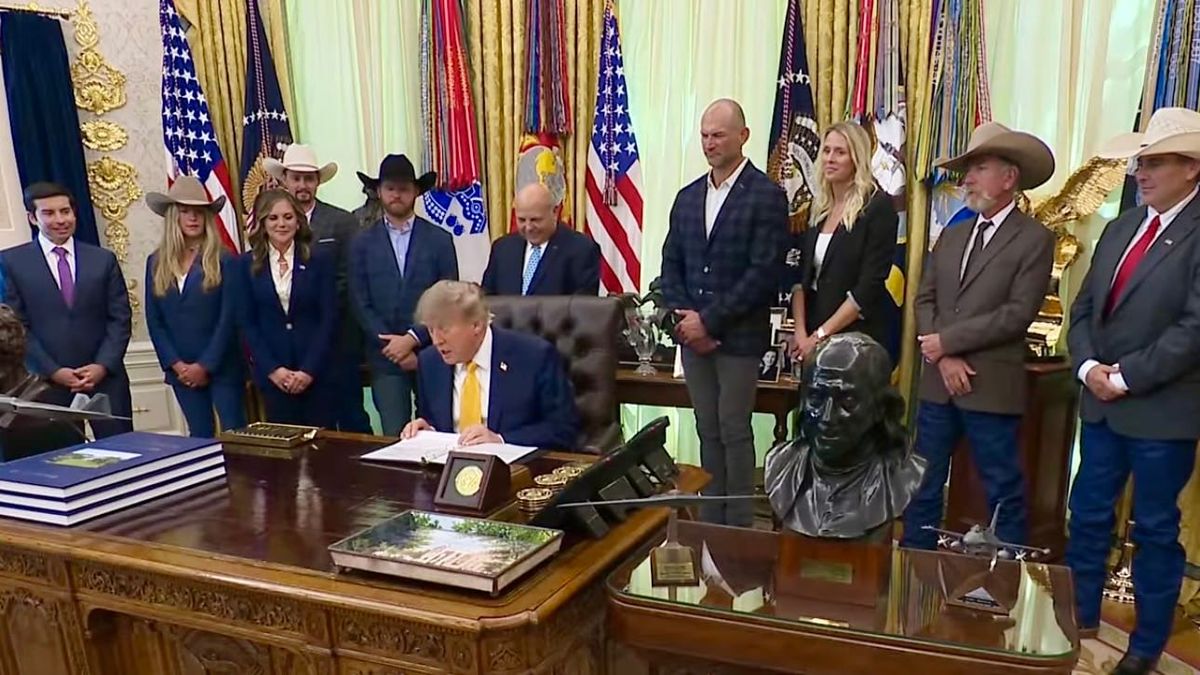
President Donald Trump signed two Executive Orders (EOs) Friday aimed at rebuilding the nation’s cattle industry, giving ranchers more options to market their meat and addressing several long-running complaints from beef producers.
The Sept. 4 orders take aim at everything from gray wolves and country-of-origin labels to meatpacking concentration and rules that limit where some small processors can sell their products. The White House says the goal is to strengthen American ranchers while expanding beef supplies and lowering costs for consumers.
The Orders come at a tense moment between Trump and cattle producers.
Just days earlier, the administration moved to temporarily allow up to 300,000 metric tons of lower-tariff foreign lean beef into the country in an effort to ease high ground-beef prices. Ranchers warned that the move could push cattle prices lower just as producers need an incentive to rebuild a national herd that has fallen to its lowest level in roughly 75 years.
The backlash was particularly strong in Alabama.
Alabama Cattlemen’s Association CEO Erin Beasley said the import announcement caused an immediate drop in cattle markets at a critical time for Alabama producers.
“Today’s announcement by President Trump to import 300,000 metric tons of government-subsidized beef is extremely disappointing,” Beasley said. “This decision has consequences for our industry starting with the immediate reactions we have seen today in the live cattle market. Since the announcement, the market has taken a sharp decline, which affects the bottom line for cattlemen in Alabama.”
Beasley called for policies that encourage herd growth and lower ranchers’ costs instead.
“This Administration needs to focus on policies that will encourage herd expansion and lower the input costs that have burdened the industry for some time,” she said. “Market manipulation will never be the answer, and today’s announcement is another slap in the face for cattlemen everywhere, especially the more than 10,000 members in our organization.”
Friday’s EOs move much more directly in that direction.
Trump’s first Order, “Supporting America’s Ranchers,” launches a broad review of federal policies affecting cattle producers.
The White House notes that the national cattle herd is at a 75-year low while demand for beef has risen nearly 10 percent over the past decade. Drought, wildfires, high production costs and years of herd reductions have all contributed to the supply squeeze.
Among the order’s main provisions:
- Review federal rules affecting ranchers. Agriculture, Interior, the U.S. Trade Representative, Food and Drug Administration and Small Business Administration must review federal rules and policies affecting ranchers and recommend changes aimed at improving financial stability and market access. The report is due within 90 days.
- Reconsider federal protection of wolves. The Interior Department must determine whether gray wolves and Mexican wolves have met the standards needed to be removed or moved to a lower level of protection under the Endangered Species Act. If so, the department is directed to begin the process.
- Give ranchers more tools against predators. Federal agencies are directed to review rules governing compensation for livestock killed by wolves and consider changes that could make it easier to remove wolves that threaten cattle or people.
- Revisit mandatory country-of-origin labeling. USDA and the U.S. Trade Representative must examine whether current law gives the administration authority to require country-of-origin labels on beef. USDA may pursue new rules where allowed by law or recommend legislation to Congress.
- Keep consumer prices in mind. Federal agencies implementing the order are directed to take steps to ensure the measures benefit consumers through lower prices “to the maximum extent possible.”
The labeling provision could prove especially important to cattle groups that have long argued consumers should be able to tell whether beef comes from American cattle.
Current federal rules allow meat to carry the voluntary “Product of USA” label only when the animal was born, raised, slaughtered and processed in the United States. The new order directs USDA to study whether mandatory labeling can legally go further.
Not everyone in the meat industry supports that idea.
The Meat Institute has warned that bringing back mandatory country-of-origin labeling could add major compliance costs and eventually increase beef prices. Congress repealed the previous mandatory beef labeling system in 2015 after trade disputes.
Trump’s second Order, “Promoting Fair Competition in Livestock Markets and Expanding Market Access for American Meat Producers,” focuses on another problem ranchers have complained about for years: the power of large meatpackers and the limited number of places where cattle can be processed.
The EO directs USDA to step up enforcement of the Packers and Stockyards Act while making it easier for smaller processors to enter the market and, in some cases, sell meat across state lines.
Its main provisions include:
- More Packers and Stockyards Act investigations. USDA must put greater focus on possible unfair, deceptive or anti-competitive conduct by meatpackers and other firms covered by the law.
- More federal enforcement resources. USDA is directed to increase staffing and investigative capacity and work with the Justice Department on cases that may also involve federal antitrust law.
- Expand interstate meat sales. USDA must streamline programs that allow eligible state-inspected meat processors to participate in interstate commerce, including the Cooperative Interstate Shipment and Talmadge-Aiken programs.
- Help small processors navigate federal rules. USDA is directed to provide added technical aid and training for small and very small processors and create an easy-to-use resource showing slaughter and processing options around the country.
- Modernize meat inspection. The order calls for cutting reporting rules that do not advance food safety while expanding the use of technology and modern inspection methods.
- Create a USDA coordinator. A new coordinator will serve as a point of contact for ranchers and small and mid-sized meat processors seeking access to federal inspection and interstate markets.
- Support regional processors with loans. USDA is directed to establish a “Strengthening Processing for U.S. Ranchers” guaranteed loan program to help small and regional meat processors stay open and expand capacity.
Trump described the goal at the White House as giving producers more ways to bypass the largest meatpackers.
“For the first-time ever, we’re going to give farmers and ranchers the right to process their own food,” Trump said. “We’re creating a program where small and medium-sized and large ranchers can sell their products directly to consumers so that they don’t have to go through the big four processes and middlemen.”
The Order itself is more limited than that broad description. Federal food-safety law still applies, and interstate sales will remain tied to federal inspection or approved state-federal inspection programs. What changes is USDA’s direction: the Department is being told to expand those paths and remove barriers where current law permits.
The administration says concentration in meatpacking is part of the problem. According to the White House, the four largest beef packers now account for about 85 percent of purchases of steers and heifers, compared with 36 percent roughly four decades ago.
Some industry analysts dispute whether concentration alone proves anti-competitive conduct. Drovers reported that Sterling Marketing estimates the four largest firms’ actual slaughter share at about 75.8 percent, down from 81.7 percent in 2015, while packers themselves have recently faced losses because of high cattle costs.
The two Orders address several issues cattle groups have sought for years. But they do not erase concern over the administration’s recent import policy.
The National Cattlemen’s Beef Association said Friday that it appreciated several parts of the new plan but remained frustrated over the administration’s push to lower beef prices after recent losses in cattle markets.
“It was disappointing to see the President celebrate the idea of beef prices declining while cow-calf producers have lost tens of millions of dollars in the past few weeks due to the administration’s actions,” NCBA said.
That tension reflects the difficult economics behind today’s beef market.
Consumers want cheaper beef. Ranchers need cattle prices high enough to justify retaining heifers and rebuilding herds. Yet keeping more heifers for breeding means fewer cattle enter the beef supply today, which can tighten supply before more calves eventually reach market.
And rebuilding a cattle herd takes years, not months.
Trump’s temporary import plan may add roughly 661 million pounds of beef to the U.S. market. That sounds substantial, but it represents only about 2 to 3 percent of annual American beef consumption. Economists have questioned how much such a temporary increase can ultimately reduce prices at the grocery store.
Friday’s orders take a longer view.
Rather than relying solely on imported beef to increase supply, they seek to increase domestic processing capacity, strengthen competition, protect cattle from predators, revisit beef labeling and give smaller ranchers more ways to reach consumers.
How much ultimately changes will depend heavily on USDA, the Interior Department and, in several areas, Congress.
As U.S. Cattlemen’s Association President Justin Tupper put it, “The lasting impact will be decided by the agencies as they do their review and Congress, who can take legislative action to support these moves.”
“Our markets have been shaken by imports, and many producers are cautious on what comes next,” Tupper added. “We will keep pushing to ensure these initiatives become long-term solutions — not short-term promises — for U.S. cattle producers and American consumers.”
As of this writing, the Alabama Cattleman’s Association had not commented on Friday’s EOs on social media.
Friday’s EO signing, with the President’s remarks, may be seen on YouTube and below: