Trump Beef Import Plan Draws Cattlemen Backlash
Alabama and national cattle groups say Trump's 300,000-ton beef import plan could hurt ranchers while offering shoppers little relief

President Donald Trump’s plan to bring up to 300,000 metric tons of tariff-free foreign beef into the United States is drawing sharp opposition from cattle producers, including the National Cattlemen’s Beef Association, the United States Cattleman’s Association and the Alabama Cattlemen’s Association.
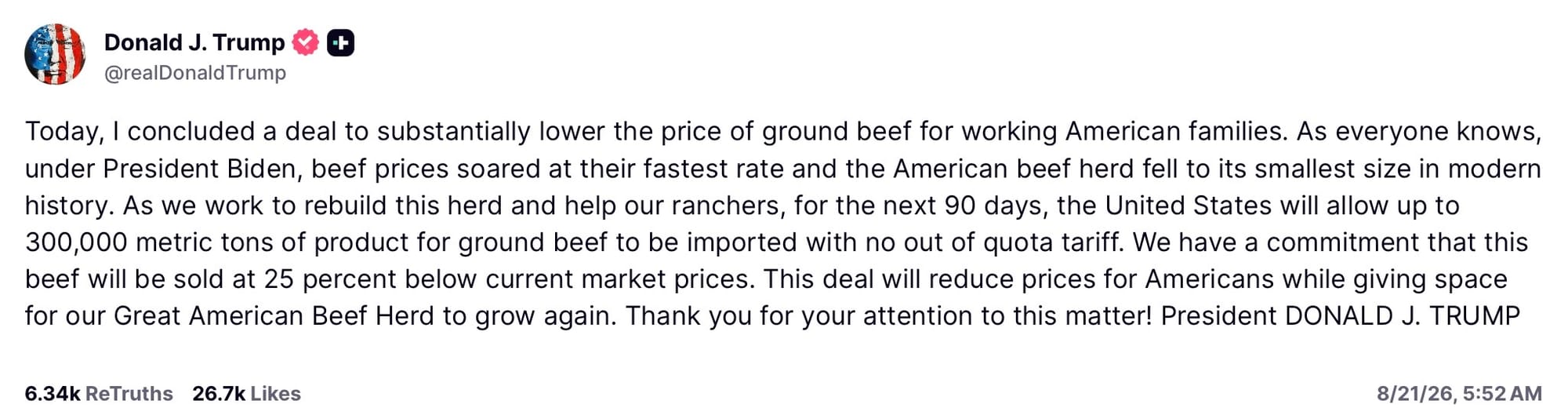
Trump announced the plan Friday as a short-term bid to bring down record-high ground beef prices. For the next 90 days, the United States will allow up to 300,000 metric tons of product intended for ground beef to enter without the normal out-of-quota tariff.
The President also said foreign suppliers have agreed to sell the beef at 25 percent below current market prices.
“Today, I concluded a deal to substantially lower the price of ground beef for working American families,” Trump wrote on Truth Social. He said the temporary imports would give the domestic cattle herd time to grow while cutting costs for consumers.
But cattle producers argue the plan treats the symptom while making the underlying problem worse.
The National Cattlemen's Beef Association (NCBA), the nation’s largest cattle industry group, quickly pushed back.
“No cow-calf producer in America is asking for increased imports,” NCBA said. “Undercutting American farmers and ranchers with inferior product from foreign competitors does nothing to create market confidence or encourage rebuilding the herd.”
NCBA argued that ranchers make herd decisions years in advance and need stable prices before taking on the cost and risk of expansion. The group also accused the White House of creating “whiplash” through sudden changes in trade and beef policy.
Justin Tupper, President of the United States Cattlemen’s Association (USCA), said bluntly, “You don’t put America first by putting U.S. cattle producers last. This move will weaken our markets and gamble with food safety in the process.”
The reaction was just as strong in Alabama, where cattle production remains a major part of the State’s farm economy.
Alabama Cattlemen’s Association Chief Executive Officer Erin Beasley said Trump’s announcement had an almost instant effect on cattle markets.
“Today’s announcement by President Trump to import 300,000 metric tons of government-subsidized beef is extremely disappointing. This decision has consequences for our industry starting with the immediate reactions we have seen today in the live cattle market. Since the announcement, the market has taken a sharp decline, which affects the bottom line for cattlemen in Alabama.”
She continued, “It’s no secret that August is a heavy marketing month for Alabama feeder calves, and volatility in the market greatly impacts the bottom line for our producers. Flooding the market with subsidized foreign beef only discourages cattlemen from making investments in their operations, ultimately slowing down herd rebuilding. We've already seen deals struck with poor trading partners, and now we will see an increase in the products we import from these countries. This Administration needs to focus on policies that will encourage herd expansion and lower the input costs that have burdened the industry for some time. Market manipulation will never be the answer, and today’s announcement is another slap in the face for cattlemen everywhere, especially the more than 10,000 members in our organization.”
The timing of Trump’s deal is key for Alabama producers. Late summer is a major marketing period for feeder calves. A sharp fall in futures or cash cattle prices can translate into real losses when those calves reach auction — and cattle futures on the Chicago Mercantile Exchange tumbled to eight-month lows on Friday after the announcement.
Trump’s move comes as Alabama cattlemen are already dealing with costs that remain far above levels seen before the pandemic.
Fertilizer is needed to maintain pasture and produce hay. Diesel powers tractors, hay equipment and trucks. Ranchers also have to pay for feed, fencing, equipment, repairs, veterinary care, labor, land and interest. Many of those costs rose sharply during the inflation surge and have not returned to their old levels.
Feed alone is typically one of the largest expenses in a cow-calf operation. High fertilizer costs also make producing hay and maintaining productive pasture more expensive. That means today's higher cattle prices do not translate dollar-for-dollar into higher profits for the rancher.
Those costs help explain why cattlemen bristle at the idea that today's high cattle prices amount to a windfall.
There is also a basic supply problem that no 90-day trade policy can quickly fix: America simply does not have many cattle.
The U.S. cattle herd is hovering around levels not seen in roughly 75 years. Years of drought forced ranchers in some of the nation's largest cattle states to reduce their herds. High feed, fuel, fertilizer, land and financing costs have made rebuilding more difficult — and this 75-year-low cattle inventory is one of the main forces behind today's high beef prices.
Even when conditions improve, a cattle herd cannot be rebuilt in months.
A producer has to retain heifers instead of selling them. Those animals must reach breeding age, become pregnant, carry a calf for roughly nine months and then raise that calf. The resulting animals still need time to reach slaughter weight.
That process takes years.
And rebuilding carries a short-term paradox: When ranchers keep more heifers to rebuild the breeding herd, those animals do not enter the beef supply. That can tighten beef supplies even further before herd expansion eventually produces more beef.
This is a principal downside of Trump's plan. High cattle prices are one of the economic signals that would normally encourage ranchers to retain breeding stock and expand.
Cattle groups fear that deliberately pushing cattle prices lower through subsidized foreign imports could weaken that signal.
There is also another factor to consider. The headline number sounds huge, and taken in isolation, it is.
Three hundred thousand metric tons works out to roughly 661 million pounds of beef.
But Americans consume roughly 29 billion pounds of beef in a year.
At that pace, Trump's entire 300,000-metric-ton quota amounts to only about eight days of U.S. beef consumption.
Measured against roughly 25 billion pounds of annual domestic beef production, the imports are equal to about 9.7 days of U.S. production.
In other words, the entire new quota amounts to roughly eight to 10 days of America's normal beef supply.
The Associated Press has similarly put the additional imports at roughly 3 percent of annual U.S. beef consumption, while estimates based on total annual consumption put the figure closer to 2 percent. The difference depends on the measure being used and what products are included.
That raises a basic question: How much can such a small addition to annual supply really change what shoppers pay?
Trump says the imported product will be sold at 25 percent below current market prices.
That does not mean the price of ground beef at Publix, Walmart or Piggly Wiggly will fall 25 percent.
Foreign exporters do not set the final retail price. Packers, distributors and grocery chains stand between imported beef and the consumer. How much of that 25 percent discount ultimately reaches the supermarket shopper is another question.
Agricultural economists expressed skepticism that the price effect consumers see will be that great. The 300,000 metric tons represents only a small fraction of the American beef market, raising doubts that it will be enough to cause a major or lasting reduction in retail beef prices.
The mathematics is brutal: 661 million pounds amount to only about 2 to 3 percent of estimated annual U.S. beef consumption. Even if every pound entered the market at a full 25 percent discount and every cent of that savings passed straight to consumers — highly generous assumptions — the effect spread across an entire year's beef market would be well under 1 percent.
Since the beef will enter during a 90-day window, the effect could be more visible during those three months. The quota is equal to roughly 9 percent of the beef Americans normally consume over a 90-day period. A perfect 25 percent discount across that slice of supply would produce a theoretical blended effect of only about 2 percent during the period.
At today's prices, that suggests an impact closer to cents per pound than dollars per pound when averaged across the broader market.
The actual result will depend on where the beef comes from, what processors pay for it, what type of beef is imported, how quickly it reaches stores and how much of the savings retailers pass along.
And lest anyone forget, the midterm elections are only two and a half months away — and affordability, including food affordability, has already become a major issue for Democrats seeking to take back the House and Senate.
Still, there is no question consumers could use some relief, regardless of the motivation behind it.
The average U.S. retail price for 100% ground beef reached $6.885 per pound in July, according to data from the U.S. Bureau of Labor Statistics. That was up 10.1 percent from a year earlier.
Beef prices more broadly have also risen sharply. BLS reported beef and veal prices were 9.4 percent higher than a year earlier. Uncooked beef roasts were up 13.5 percent, while uncooked beef steaks were up 9.6 percent.
The problem is not limited to beef.
The latest Bureau of Labor Statistics Consumer Price Index report shows that overall consumer prices were 3.4 percent higher in July than a year earlier. Food prices were up 3.0 percent, while food purchased for use at home was up 2.7 percent.
Energy presents an even sharper affordability problem. BLS reported energy prices were 14.7 percent higher than in July 2025, while gasoline prices were up 24.6 percent. Electricity was up 4.2 percent.
That matters for the cattleman and the consumer.
Higher energy prices raise the cost of running tractors, transporting cattle, producing hay, hauling feed and moving beef through processing and distribution. Eventually, many of those costs work their way through the supply chain.
At the same time, consumers are paying more for groceries, utilities, housing and other basic needs.
A lower inflation rate does not mean prices have returned to what they were before the inflation surge. It means already-high prices are increasing at a slower pace.
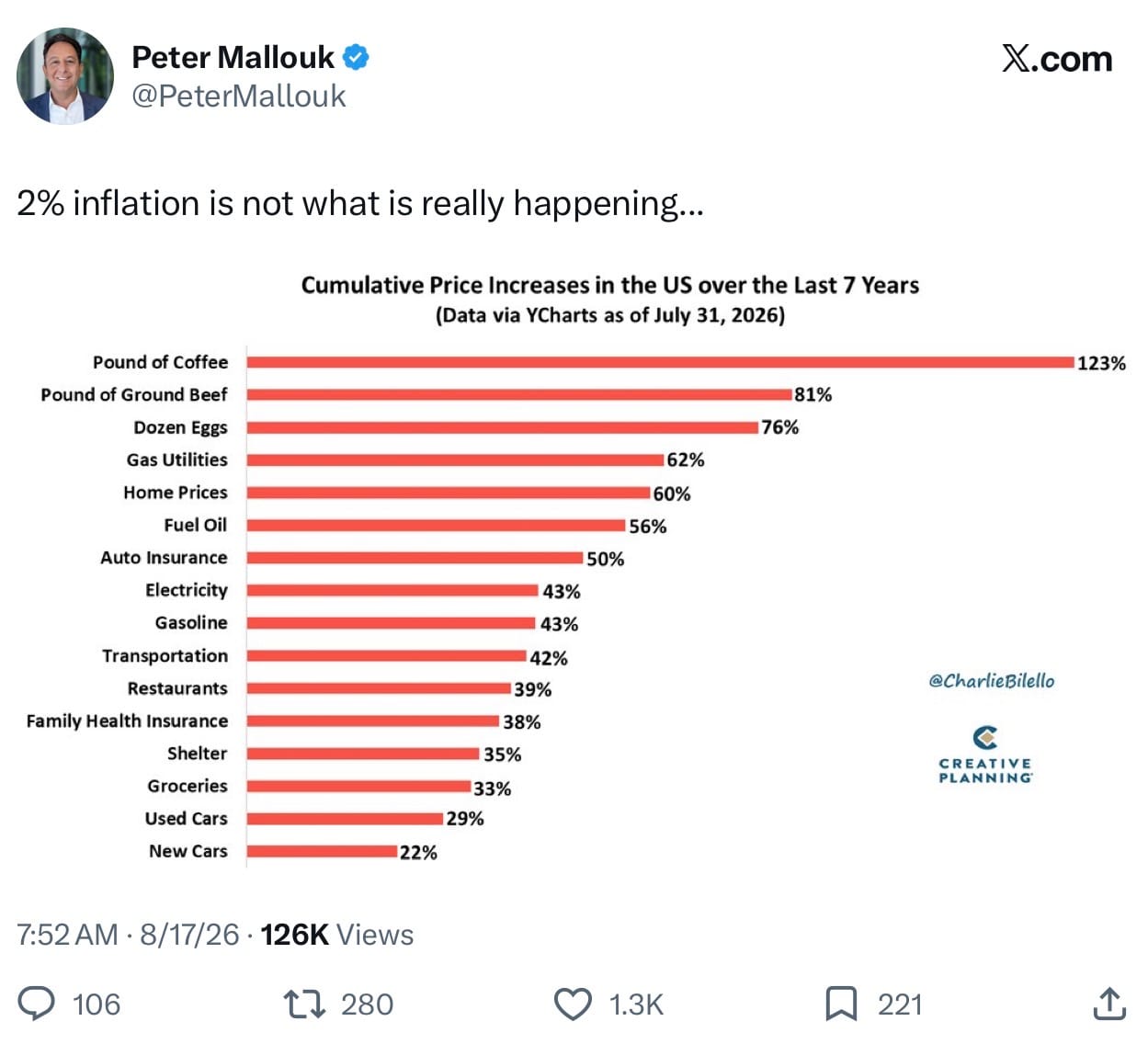
That is the core of the affordability problem confronting American families.
For consumers, it shows up at the supermarket checkout. For cattle producers, it shows up on both sides of the ledger.
Ranchers pay more for fuel, fertilizer, equipment, feed, labor, repairs and financing. Consumers pay more for the beef that eventually reaches the meat counter.
That leaves policymakers with an uncomfortable problem: cutting the price paid to farmers is not necessarily the same thing as cutting the price paid by consumers.
Trump's announcement also highlights the tensions within his broader trade policy.
The administration has relied heavily on tariffs to protect domestic industries and change foreign trade practices. Now, faced with high beef prices, Trump is temporarily removing one of those barriers in hopes that cheaper imports will bring grocery prices down.
The White House says the policy is meant to fill a short-term gap while American ranchers rebuild.
Cattlemen see the contradiction, and they are less than happy about it.
Rebuilding the herd requires producers to keep replacement heifers, expand pasture, buy breeding stock and accept years of costs before seeing a return. Those investments become harder to justify if Washington responds to high cattle prices by suddenly opening the market to large volumes of government-subsidized foreign beef.
That is why the argument is about more than what hamburger costs next week.
The United States has spent years shrinking its cattle herd. Ranchers now have the strong cattle prices that would normally encourage them to rebuild it. Yet they are also facing high production costs and a federal government that is attempting to push beef prices lower through imports.
The administration's answer is to import roughly eight days' worth of America's annual beef consumption and hope the added supply takes some pressure off supermarket prices — temporarily, right before a critical election.
For shoppers paying nearly $7 a pound for hamburger, any relief will be welcome.
For cattlemen being asked to invest the money and years needed to rebuild America's herds, the concern is that a short-term answer to an affordability crisis could make the long-term supply problem harder to solve.
As the NCBA said, “Today's announcement and other market interventions throw cold water on the prospect of herd expansion and sacrifices long-term stability for short term messaging.”
“U.S. ranchers have endured years of low cattle prices and trade uncertainty, and now they are being used as pawns in a 90–day political timeline,” USCA President Tupper said. “The recent recall of beef from Argentina showed clearly that our current system is already strained. Imposing a blanket halt on tariffs and guaranteeing cheaper pricing on imports only adds risk for consumers and undermines confidence in our food system.
And Trump himself appeared to acknowledge Friday that consumers should not expect a dramatic drop at the meat counter.
When asked about cattle producers' criticism of the deal, Trump said the imported beef would bring prices down “a little bit.” That, he said, is “what people want.”