Who Is Building This, and What It Takes
Part 3 of a four-part series — Guest Opinion by Alicia Boothe Haggermaker
Guest Opinion by Alicia Boothe Haggermaker
Part 3 of a four-part series
Assembled With Dependency — Part 3
Part 3 of a four-part series. Part 2 traced what the buildout's supply chain is actually made of. This part follows the money into who is financing it — and what it draws out of the communities that host it. The complete version appears at unprecedentedtimes.org.
Who Is Building This and For Whom
Understanding who benefits from this infrastructure requires looking at the documented financial interests of the people shaping the policy environment around it.
Jared Kushner's firm Affinity Partners had $6.16 billion in assets under management as of 2025 — $1.2 billion more than the prior year. Of that total, 99% comes from non-U.S. persons: specifically sovereign wealth funds operated by Saudi Arabia, Qatar, and the United Arab Emirates. Senator Ron Wyden concluded after a Senate investigation that the fund "may not be motivated by commercial considerations, but rather by the opportunity for foreign governments to pay members of the Trump family." In February 2026, Kushner was appointed Special Envoy for Peace — simultaneously soliciting investments from the same governments he was negotiating with. Representative Jamie Raskin opened a sweeping congressional investigation in April 2026. Affinity's portfolio includes Israeli AI startups and UAE logistics plays, with joint ventures in sovereign AI platforms under evaluation.
Elon Musk's DOGE team expanded use of his Grok AI chatbot across federal agencies, feeding sensitive government data into a system owned by his private company xAI. Five technology and government ethics specialists told Reuters the arrangement could violate security and privacy laws and potentially grants Musk access to federal contracting information from agencies where Tesla and SpaceX conduct business. Musk's companies have received an estimated $15.4 billion in government contracts over the past decade. He did not file ethics forms. The White House said he would identify his own conflicts.
Peter Thiel's Palantir collected over $1.3 billion in federal contracts since Trump's inauguration across twelve federal departments and agencies. The Department of Health and Human Services — where a former Palantir engineer serves as CIO — has $405 million in Palantir contracts. Anduril, part of the Thiel network, signed a 10-year Army deal worth up to $20 billion in March 2026. Palantir was originally seeded by In-Q-Tel, the CIA's venture capital arm. In the first quarter of 2026, Palantir took in $687 million from government contracts. Thiel left California in late 2025 ahead of a proposed billionaire tax residency deadline.
Section 224 of the House Armed Services Committee's 2027 NDAA draft — titled the United States-Israel Defense Technology Cooperation Initiative — would permanently embed Israeli defense technology into American military supply chains across AI, quantum, autonomous systems, directed energy, and cyber domains. It would shield the arrangement from the annual appropriations process. Critics note it would give a foreign government unprecedented leverage over American defense priorities. The bill envisions joint-venture factories on U.S. soil — citing existing projects in Alabama and Mississippi as prototypes.
None of this requires coordination. Compatible financial interests operating through the same access points produce predictable outcomes without anyone needing to be in the same room. That is how a cartel ecosystem functions. Different organizations. Overlapping interests. No conspiracy required.
The America First voter got the rhetoric. The documented record shows who got the policy.
The Water Nobody Priced In
The data center boom has a resource problem that is not about chips or supply chains. It is about water.
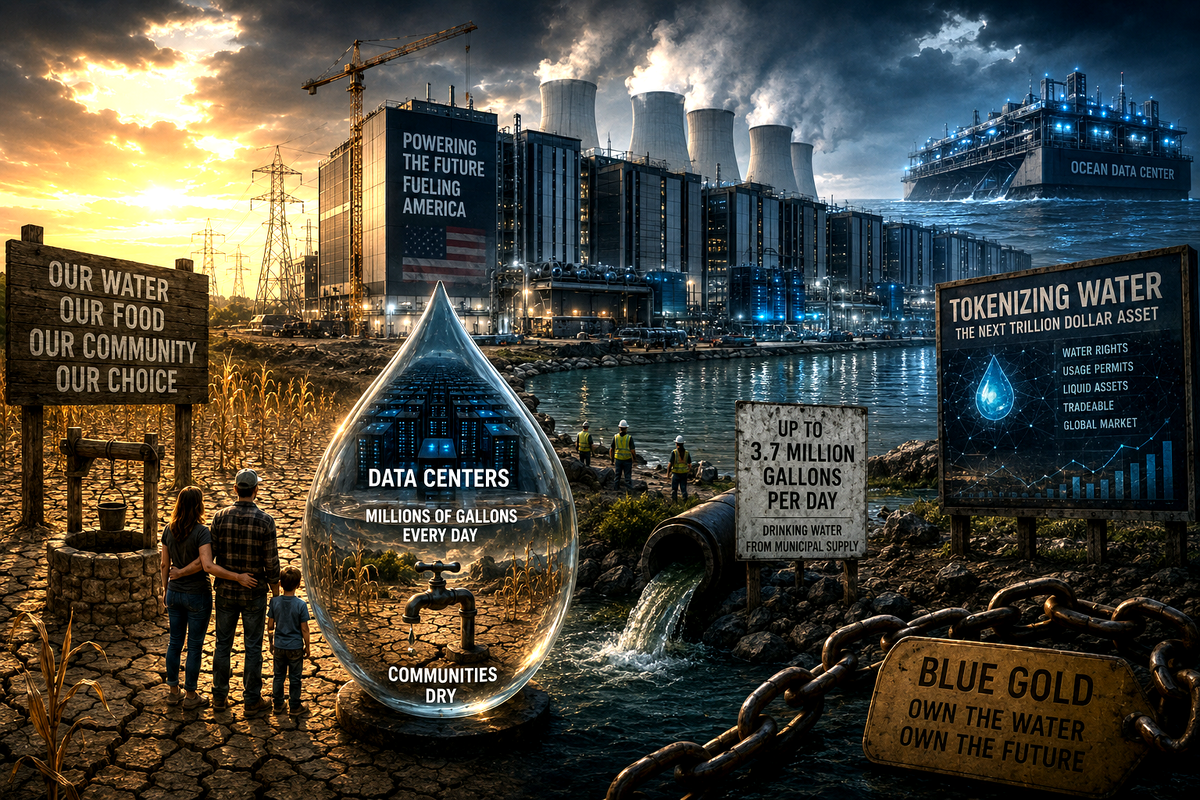
Elon Musk's xAI data center in Memphis — known as Colossus — promised local residents a water recycling facility to offset its drain on the municipal water supply. Construction on that facility stopped. The city acknowledged it has no legal authority to mandate construction because there are no public incentives attached to the deal. Meanwhile xAI is completing a second Memphis data center and planning a third across the state line in Mississippi. The company has requested to use up to 3.7 million gallons of drinking water per day.
Tesla's Giga Texas increased its annual treated water use nearly 60% between 2023 and 2025, consuming 556 million gallons and becoming Austin Water's third largest customer — while residents are urged to conserve. Musk announced Terafab, a proposed $20-25 billion semiconductor fabrication plant adjacent to the same site. Environmentalists warn it could further strain a drought-prone region.
SpaceX's IPO filing added new language warning investors that access to water — required to cool its data centers — is now listed alongside chips and power as a core business risk.
The Browns Ferry Nuclear Plant in Alabama has operated on the Tennessee River for decades. On July 8, 2010, when the river hit 90°F, the plant was forced to run at half capacity for eight consecutive weeks — at the precise moment air conditioning demand was at its peak. A Nature Climate Change study projects that the likelihood of extreme power generation drops from thermoelectric plants will almost triple between 2031 and 2060 due to warming water temperatures.
Every data center dependent on water cooling carries the same vulnerability. The water gets warm. The cooling fails. The infrastructure goes offline at peak demand. Browns Ferry demonstrated this in a documented, measurable, public way. The lesson was not applied to the infrastructure being built now.
Google's data centers withdrew 7.8 billion gallons of water in 2024. Of that, 78% was consumed through evaporation and not returned to the water system. The water footprint of AI systems could reach 764.6 billion liters in 2025 according to published research. That water does not evaporate and return to the local watershed at the pace and distribution the hydrological cycle evolved around. The sun distributes evaporation across 139 million square miles of ocean surface over variable seasonal cycles. Data centers concentrate it at point sources, continuously, at industrial scale. The atmospheric effect of that concentration at the scale the AI buildout requires has not been studied.
And consider the forethought. Legionnaires' disease — caused by bacteria that thrive in the warm-water systems cooling towers create — rose roughly 900% in the United States between 2000 and 2018. The causes are multifactorial, and the rise predates the AI buildout; no honest accounting pins the historical increase on data centers. But cooling towers are a documented transmission vector, the disease is already climbing, and the plan in front of us is to add the largest wave of new cooling-tower infrastructure in history on top of a problem that is already getting worse — without anyone studying what that addition does. We have a spike, and the response is to scale up a known vector for it. That is not a claim about what caused the past. It is a question no one asked before pouring the concrete.
Peter Thiel is now investing in ocean data centers — autonomous floating platforms that use cold seawater for cooling. The regulatory framework governing their environmental impact in international waters is, by documented assessment, nascent at best. Who governs a data center twelve miles offshore is simultaneously a legal question and, for some operators, a feature rather than a bug.
Whoever Owns the Water
I have spent a lot of time telling people to watch the water — its quality, the infrastructure that moves it, the plants that depend on it, the fragility nobody was tracking. Watch it now for a different reason. The water is being turned into something to own.
In 2026, "tokenizing water" stopped being a fringe idea and became a pitch with serious infrastructure behind it. The concept is simple: convert water rights and usage permits into digital tokens — tradeable, liquid financial assets — so the right to use water can be bought, sold, and speculated on like a share of stock. The industry's own nickname for it is "blue gold." The framing is always transparency and efficiency and "modernizing water management," set against the World Bank's projection that global water demand will outstrip supply by forty percent by 2030. Scarcity, in other words, is the business case.
The rails are still being laid; this is not yet a built-out global market. But the trajectory is the point. Because here is what "liquid, tradeable asset" means for a thing you cannot live without: efficient markets allocate to the highest bidder, and the highest bidder for water is not the family that drinks it or the farm that grows food with it. It is the data center that needs millions of gallons a day to cool its servers, or the fund betting on the scarcity itself. "The market will allocate it efficiently" and "everyone gets the water they need to live" are not the same sentence. Most of the time they are opposite sentences.
And it removes the one thing that ever protected the commons: friction. Right now it is slow and local and jurisdictionally messy to buy a community's water out from under it — slow enough that sometimes the community notices and fights. Tokenization is designed to sand that friction off, to make the water rights of a small town as easy to acquire from the other side of the planet as a share of stock. It detaches ownership from the place entirely. Your watershed could be owned by someone who will never see it, drink it, or answer to a single person downstream of it.
So let me say the part plainly, because it is the oldest rule of power and it needs no blockchain to be true:
Whoever owns a community's water and food owns the community.
Not as a metaphor. Literally. Control of the necessities is control of the people, because people will comply with almost anything before they will watch their children go thirsty or hungry. Every system of control in history has understood this — you do not need to govern people you can simply make dependent. Rome did it with grain. The company town did it with the company store. The most sophisticated version yet is the one that turns the necessity into a financial instrument and calls it innovation, so the leash looks like a portfolio.
This is why the distributed argument in this series is not abstract idealism. A community that owns its own water, grows a meaningful share of its own food, and controls the infrastructure those depend on cannot be starved into compliance, because no one else holds the tap. Sovereignty is not a slogan. It is the practical difference between a community that can refuse and one that cannot afford to. And it begins with the most basic things there are: the water, the food, the ground under your feet.
Watch the water. And then ask who is about to own it.
Next, in Part 4 — The Right to Refuse, and the Bill: what happens when communities try to say no, what the boom costs at the level of one household, and who is ultimately left holding the tab.
Alicia Haggermaker is an investigative journalist, systems analyst, and community organizer based in Huntsville, Alabama. She publishes at Unprecedented Times and is the founder of the Mycelium Network. The complete version of this series appears at unprecedentedtimes.org.
Sources (Part 3):
Affinity Partners SEC Form ADV, March 2026; Senate investigation and Wyden conclusion, 2024; Raskin congressional investigation, April 2026; Reuters on the xAI/Grok federal arrangement; USAspending.gov, Palantir federal contracts; Revolving Door Project analysis of Palantir and Thiel; House Armed Services Committee 2027 NDAA draft (Section 224); E&E News on xAI Memphis water reuse; Austin Current on Tesla water use, April 2026; TechCrunch on the SpaceX IPO water-risk filing, June 2026; TVA and NRC Browns Ferry thermal documentation; Nature Climate Change thermoelectric projection study; CDC Legionella surveillance data; Fortune on Thiel's Panthalassa investment, May 2026; Chainlink and Kenson Investments reporting on water-rights tokenization, 2026; World Bank water-demand projection for 2030.
Opinions do not reflect the views and opinions of ALPolitics.com. ALPolitics.com makes no claims nor assumes any responsibility for the information and opinions expressed above.