Alabama Bans Sports Betting — Why is FanDuel Already Here?
FanDuel Predicts and Kalshi test whether federal rules can bypass Alabama's ban on online sports betting
TL;DR: Alabama has repeatedly rejected efforts to legalize and regulate online sports betting, yet Alabamians can now put money on sporting events through prediction markets such as FanDuel Predicts and Kalshi. The companies argue their sports contracts are federally regulated financial products, not sports bets subject to State gambling laws. Federal courts have split on that argument, and a new Alabama lawsuit against Kalshi could help decide whether the State can enforce its gambling laws against these markets — or whether federal regulation has opened a back door into Alabama that lawmakers never approved.
Alabama lawmakers have repeatedly declined to legalize online sports betting. That has not stopped Alabamians from putting money on sports through a growing class of prediction markets.
Now, a court fight involving Kalshi could help decide whether Alabama — or any other State — can do anything about it.
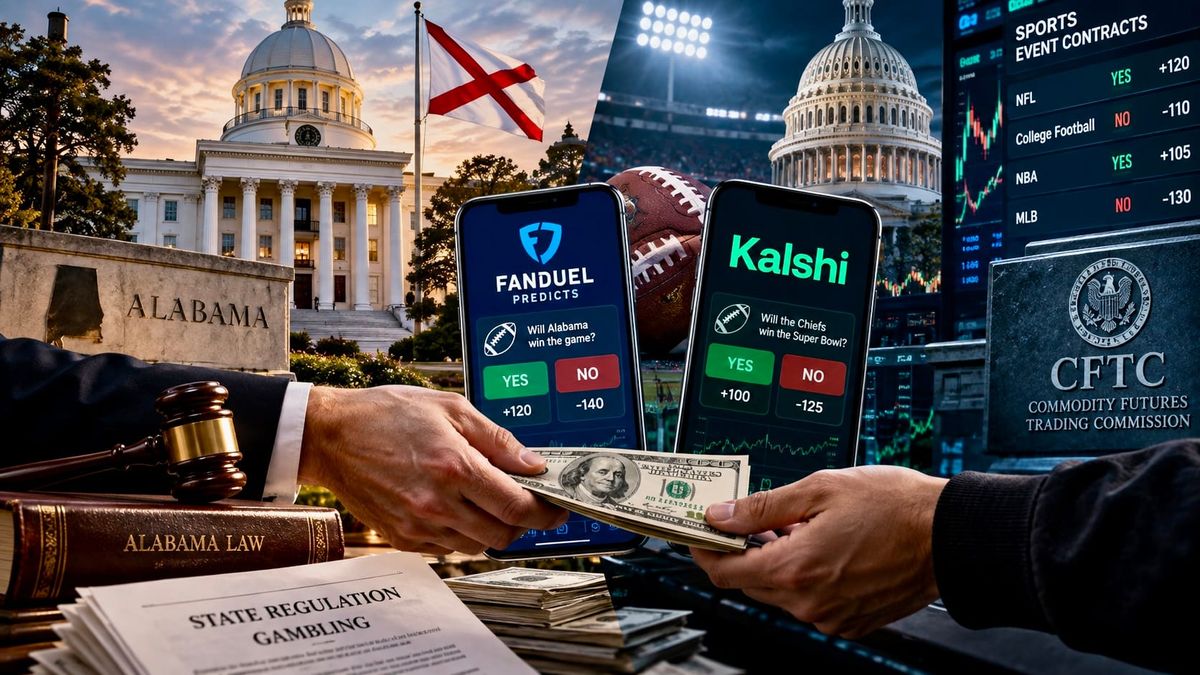
FanDuel launched FanDuel Predicts in Alabama in December of last year. The service allows customers to buy and sell contracts based on whether an event will happen — and that includes sports. Specifically, it includes the outcome of sporting events.
FanDuel and its partner, CME Group, specifically chose Alabama as one of the first five States for the product. Sports contracts are offered in States where online sports betting is not legal. If a State later legalizes online sports betting, FanDuel says it will stop offering sports contracts there through Predicts.
The distinction between sports contracts and sports betting is a fine one to make, which is why it’s important.
A customer cannot legally open the FanDuel Sportsbook app in Alabama and place a conventional bet on a football game. But FanDuel Predicts can let that same customer buy a contract based on the outcome of a sporting event.
The transaction may look a lot like a bet. It may behave a lot like a bet. However, the legal theory behind it is very different.
Prediction-market firms argue these are federally regulated financial contracts, not sports bets regulated by the States. That puts them under the Commodity Futures Trading Commission (CFTC) and the federal Commodity Exchange Act. And, the CFTC agrees with these companies.
The federal agency has gone so far as to sue States attempting to enforce their gambling laws against CFTC-regulated prediction markets. In June, the CFTC sued New Mexico after that State sought to stop Kalshi from offering sports contracts.
The CFTC maintains federal law gives it exclusive jurisdiction over these markets and preempts conflicting State gambling laws.
“New Mexico is the latest state seeking to nullify black letter law and decades of judicial precedent by imposing state gaming laws on federally regulated derivatives exchanges subject to the CFTC’s exclusive jurisdiction,” CFTC Chairman Michael S. Selig said in a statement. “As I’ve said repeatedly, the CFTC has the expertise and responsibility to protect its exclusive jurisdiction over commodity derivatives, and that’s exactly what we’ll continue to do.”
Several States disagree with this position. And, Alabama may soon get its own answer, as an Alabama case puts Kalski to the test, under Alabama law.
Nick Willis filed suit against Kalshi in Franklin County Circuit Court in March. His complaint alleges Alabama residents use Kalshi to buy contracts tied to game winners, point spreads, total scores and player propositions.
Kalshi, like FanDuel Predicts, operates as a CFTC-designated derivatives exchange, and offers products based on the federally regulated prediction-market structure.
Willis argues those transactions are wagers prohibited by Alabama law, regardless of what Kalshi calls them.
The case also invokes an unusual Alabama statute.
Under Ala. Code §8-1-150, gambling contracts are void. The law provides ways to recover money paid or lost through gambling. Willis is relying on subsection (b), which allows another person to bring an action to recover gambling losses for certain relatives of the person who lost the money:
(b) Any other person may also recover the amount of such money, thing, or its value by an action commenced within 12 months after the payment or delivery thereof for the use of the wife or, if no wife, the children or, if no children, the next of kin of the loser.
Kalshi moved the case to federal court. It argued, among other things, that its contracts fall under the Commodity Exchange Act and that federal law prevents Alabama gambling law from being applied to them.
On Sept. 8, U.S. District Judge Harold Mooty sent the case back to State court.
That was not a ruling that Kalshi is illegal in Alabama. Mooty specifically declined to decide whether the contracts are gambling or whether federal law ultimately preempts Alabama law.
Instead, he ruled that Kalshi's federal argument is a defense to a State-law claim and did not give the federal court jurisdiction over Willis' lawsuit.
That leaves the underlying fight alive, and in an Alabama court, under Alabama law.
Ultimately, the question comes down to this: is a sports contract really different from a sports bet?
Kalshi recently suffered another setback on that distinction. On Aug. 28, the Ninth Circuit Court of Appeals upheld the dissolution of an injunction that had protected Kalshi from Nevada gaming regulators.
The court said Kalshi had failed to show that federal commodities law preempts Nevada gaming laws as applied to its sports contracts. The opinion also drew a direct comparison between buying a sports event contract and placing a conventional sports bet.
However, Kalshi has also won a major ruling on the other side of the issue. In April, the U.S. Court of Appeals for the Third Circuit upheld an injunction blocking New Jersey from enforcing its gambling laws against Kalshi's sports contracts. The court found that Kalshi had shown a reasonable likelihood of proving that the federal Commodity Exchange Act preempts State law when the contracts are traded on a CFTC-licensed market. The court concluded that Kalshi's sports-event contracts qualify as federally regulated “swaps” and that the CFTC has exclusive jurisdiction over them.
The ruling directly conflicts with the direction taken by the Ninth Circuit in the Nevada case, underscoring a growing split over how much power States retain to police sports prediction markets.
While neither ruling directly affects Alabama courts — Alabama, along with Florida and Georgia, sits in the Eleventh Circuit — they will likely be invoked by both sides in the Alabama case. The dueling opinions also make an ultimate review by the U.S. Supreme Court very likely.
Meanwhile, Alabama has repeatedly considered sports betting — but never legalized it.
Alabama law already broadly prohibits gambling. Ala. Code §13A-12-20 defines gambling to include risking something of value on a “future contingent event” and expressly covers bookmaking. Section 13A-12-21 also makes knowingly participating in unlawful gambling a Class C misdemeanor. There are limited exceptions, including certain pari-mutuel wagering, but Alabama has never created a legal market for online sports betting.
Lawmakers have tried several times.
Sen. Greg Albritton (R-Atmore) sponsored SB293 and SB294 in 2022, a broad gambling package that included a lottery, casino gaming and sports betting. The bills also proposed a State Commission to license and regulate gambling. Both were indefinitely postponed and died before passage.
The biggest recent push came in 2024, when the House passed HB151 and HB152. The original package proposed a constitutional amendment allowing a lottery, casinos and sports wagering, along with an Alabama Gaming Commission to regulate the industry. The House approved both bills, but the Senate stripped sports betting and casino gaming from its version. A later compromise still failed in the Senate by a single vote needed to send the constitutional amendment to voters.
Albritton made another push in 2025, but the proposal never became a formally introduced bill. He spent the first part of the session drafting and circulating a scaled-down gambling package while trying to secure the 21 Senate votes needed for a constitutional amendment. His proposal would have authorized a State lottery, sports betting — including online and mobile wagering — and Class II electronic gambling at six existing facilities, while creating a state gaming commission and enforcement division.
By early April, Albritton said he was still one or two votes short. Senate President Pro Tem Garlan Gudger (R-Cullman) then declared the proposal “too little, too late” and said it had too few votes to pass. Albritton abandoned the effort rather than formally introducing it, saying, “We’re not going to drop a bill this year.”
The issue returned in 2026 with Sen. Merika Coleman's (D-Birmingham) SB257. Her proposed constitutional amendment would have authorized a lottery, casino gaming and both in-person and online sports wagering under a State Gaming Commission. It never made it out of the Senate Tourism Committee before the Legislature adjourned April 9.
The bottom line has not changed: Alabama lawmakers have repeatedly considered legal sports betting, but have never authorized a regulated online sportsbook market. There is no Alabama sportsbook license, State sportsbook regulator or tax system for DraftKings- or FanDuel-style mobile sports betting.
Yet Alabamians can now access sports-event contracts through federally regulated platforms such as Kalshi and FanDuel Predicts.
That is the heart of the legal fight. Alabama has not legalized online sports betting. Prediction-market operators argue they do not need the State's permission because their products are federally regulated financial contracts under the Commodity Exchange Act.
The courts are now being asked to decide whether federal law has effectively opened a path into States that their own lawmakers chose not to open.
Once again, Alabama finds itself squarely in the middle of a highly-contentious national argument.
The Legislature has not authorized FanDuel or Kalshi to run a sportsbook in the State. Alabama does not license online sportsbooks or collect taxes from a legal sports betting market. But, FanDuel can offer sports-related contracts through Predicts under a federal regulatory structure. Kalshi is doing the same, under the same federal structure.
Operating as prediction markets allows these companies to claim they are different, and this raises a genuine conflict between State gambling authority and federal commodities regulation.
That fight is now playing out in courts across the country.
Thanks to the Willis lawsuit, Alabama has joined the battle.
The filing in Willis v. Kalshi Inc et al may be found at THIS LINK.