America’s Oil Cushion Shrinks as Diesel Crisis Hits
The Iran war has drained U.S. oil stocks, sent diesel and fertilizer costs soaring and raised the risk of a new food-price shock
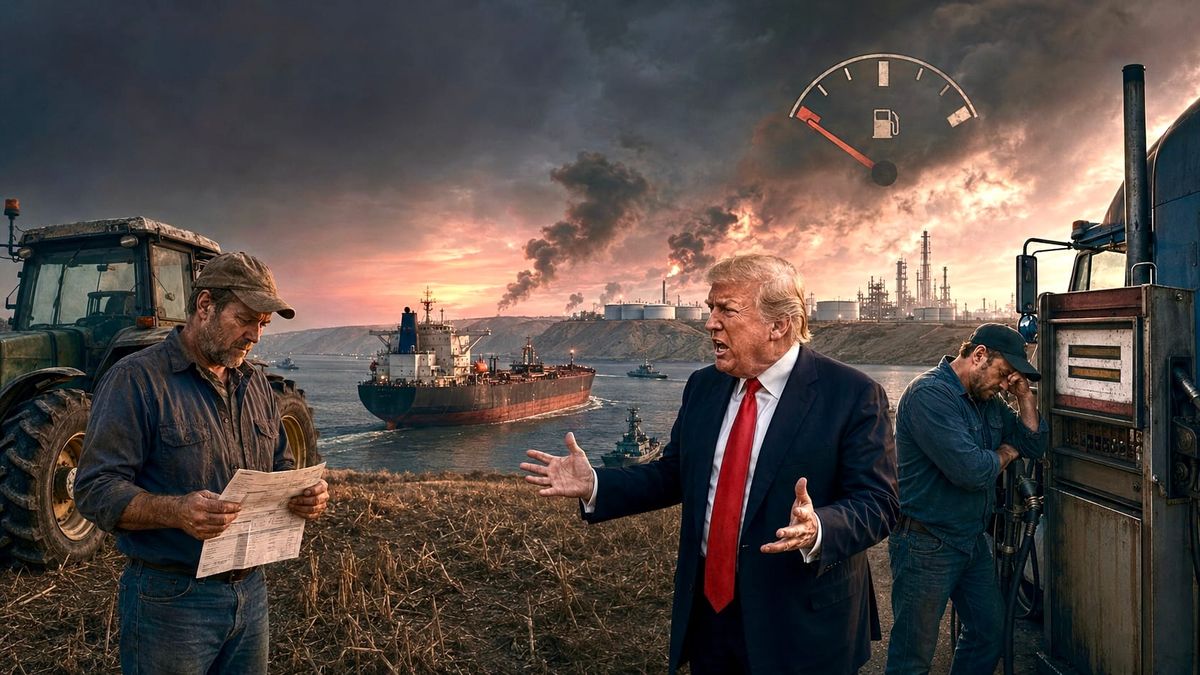
TL;DR: America is not about to run out of oil, but its emergency cushion has fallen to about 41 days of refinery use—far below the historic norm. The Iran war has drained the Strategic Petroleum Reserve, disrupted global fuel shipments and pushed U.S. diesel stocks to their lowest August level since 1996. Record diesel prices and soaring fertilizer costs are crushing already-strained farmers, raising the risk of smaller crops, higher grocery bills and spot food shortages. Meanwhile, just 31% of Americans now support the war.
America’s emergency oil cushion is wearing dangerously thin as the war with Iran enters its seventh month.
The United States held 722.2 million barrels of crude oil in commercial storage and the Strategic Petroleum Reserve during the week ending Aug. 14. That was down nearly 102 million barrels, or 12.4%, from the same week last year, according to the U.S. Energy Information Administration.
Those stocks would cover roughly 41 days of refinery use if all new supplies stopped, according to an analysis by Defence Security Asia. That is far below the historic norm of about 65 days.
The figure does not mean the United States will run out of oil in 41 days. America remains the world’s largest oil producer, and imports have not stopped. Rather, it shows how little room the nation has left if another large supply shock hits.
That is no small risk while a war rages around the Strait of Hormuz, the narrow waterway that carried about one-fifth of the world’s oil and liquefied natural gas before the conflict.
The greater concern is the Strategic Petroleum Reserve itself.
The Energy Department reported that the reserve held 294.1 million barrels as of Aug. 20. That was less than half of its 714 million-barrel storage limit and about 60% below its record high of 726.6 million barrels in 2009, according to the department’s SPR inventory report.
President Donald Trump ordered the release of 172 million barrels in March as part of a joint move by members of the International Energy Agency. The White House hoped the release would ease prices after U.S. and Israeli attacks on Iran began Feb. 28.
Instead, the conflict dragged on. Iran kept a de facto block on much of the region’s oil trade, while attacks damaged refineries and cargo routes.
The reserve fell below 300 million barrels in August. That put it near levels last seen in the early 1980s, when the reserve was still being filled.
Commercial stocks have offered only a limited offset. U.S. commercial crude inventories rose to 428.8 million barrels during the week ending Aug. 14, but the gain came after months of tight supply. In July, commercial crude was running about 6% below the prior five-year average.
Crude oil, however, is only part of the threat. The shortage of fuel made from that oil may be worse.
U.S. stocks of distillate fuel — a category that includes diesel and heating oil — stood at 107.1 million barrels on Aug. 7. That was the lowest level for that time of year since 1996.
At the same time, the U.S. diesel “crack spread” — the gap between the price of crude and the value of diesel made from it — reached a record $102.20 per barrel.
That does not mean diesel itself cost $102 per barrel. The crack spread is a measure of the profit available to refiners. Its record rise shows how scarce finished diesel has become when compared with crude oil.
“The U.S. is producing more diesel, not less, and yet the crack is still above $100. That tells you this is not a refinery incentive problem anymore — it is a refinery capacity and global replacement-barrel problem,” NitrolOil CEO Shohruh Zukhritdinov told Reuters.
The Iran war has cut shipments of refined fuel from the Middle East. The war in Ukraine has made the crisis worse by damaging Russian refineries and halting Russian diesel exports.
Global refinery runs fell to 80.9 million barrels per day in July, down about 5 million barrels per day from one year earlier. Global diesel and jet fuel stocks are now near the bottom of their five-year range.
The diesel shortage reaches far beyond gas stations. Trucks, trains, ships and much of the nation’s heavy equipment rely on it. So do American farms.
Farmers entered 2026 after years of weak crop prices and shrinking margins. The Iran war then sent two of their largest costs — diesel and fertilizer — sharply higher.
Diesel powers tractors, combines, irrigation pumps and the trucks that haul crops to market. Most farm equipment cannot switch to another fuel when prices rise.
The national diesel price rose more than 40% after the war began. Prices reached record highs in several farm States during the spring, including $6.167 per gallon in Indiana and $6.14 in Illinois.
“It’s a huge cost,” Kansas farmer Glenn Brunkow said.. “There’s just not much we can do about it, and we weren’t budgeting for it. It came out of nowhere and surprised us.”
The Financial Times reported this week that some Corn Belt farmers now describe their plight as the worst farm crisis in 40 years.
Fertilizer has added another blow.
The Gulf region is one of the world’s main sources of ammonia and urea, two key products used to make nitrogen fertilizer. Natural gas is also a major part of the cost of making fertilizer. The war disrupted both Gulf gas supplies and the sea routes used to ship the finished product.
About 30% of the world’s traded fertilizer once passed through the Strait of Hormuz. Bank of America estimated early in the war that some fertilizer prices had already risen 30% to 40%.
Urea, which is vital for corn, wheat, rice and cotton, has climbed from about $450 to roughly $580 per ton.
Farmers cannot fully escape that cost. They can apply less fertilizer, but that often means lower yields. They can plant crops that require less nitrogen, but a broad move away from corn or wheat could reduce the food and animal-feed supply.
Either way, consumers will ultimately pay.
The United Nations Food and Agriculture Organization warned this month that the world may be on the edge of another surge in food prices.
Higher oil costs, lost fertilizer shipments, tight diesel supplies and poor weather have formed a “perfect storm” for farm production.
“I expect that commodity prices will start to increase more now ... and food prices will start increasing by the end of the year, and next year for sure they will increase more,” FAO Chief Economist Maximo Torero told Reuters.
“The transmission from the commodity to the final food price is around three to six months,” he said.
That delay matters. Much of the pain now hitting farms has not yet reached supermarket shelves.
A warning cited by ZeroHedge said food buffers are being drawn down fast. The danger is no longer limited to high fertilizer prices. If farmers use less fertilizer, plant fewer acres or cut other costs, crop yields may fall just as existing stocks are shrinking.
There is no proof that a nationwide food shortage is certain. Good weather, restored shipping through Hormuz or an end to the war could ease the pressure. Yet the risk of higher prices and spot shortages is no longer remote.
The chain is clear: restricted oil and gas shipments raise diesel and fertilizer costs. Those costs squeeze farmers and cut output. Lower output then raises food prices.
Trump argued that the war was needed to keep Iran from obtaining a nuclear weapon. Six months later, his case has failed to win broad public support.
Just 31% of Americans supported U.S. military action against Iran in an Aug. 21–24 Reuters/Ipsos poll. Support was down from 37% in March and 34% earlier in August. Sixty-three percent opposed the military strikes.
Trump’s job approval stood at 33%, matching the lowest level Reuters/Ipsos recorded during either of his terms. Even Republican support for the war fell from 77% in March to 69% in August. Some 83% of Americans said they expected the conflict to last for an extended period.
The war has already pushed gasoline prices more than $1 per gallon above their prewar level. Its next political shock could come through the diesel pump, the farm supply store and the grocery aisle.
America is not about to run out of oil. But its margin for error is vanishing — and the cost of Trump’s unpopular war is moving steadily closer to the dinner table.