Britt Calls for Flock Safeguards at Senate Hearing
Alabama senator backs the crime-fighting value of license plate readers but says misuse demands stronger safeguards and oversight
TL;DR: Sen. Katie Britt told a Senate Judiciary subcommittee Wednesday that Flock license plate cameras can save lives and solve crimes, but their power also creates serious risks when police misuse them. Britt and Sen. Raphael Warnock are asking the Justice Department for federal guardrails, while a sheriff testifying before the panel called for tough limits and felony penalties for abuse.
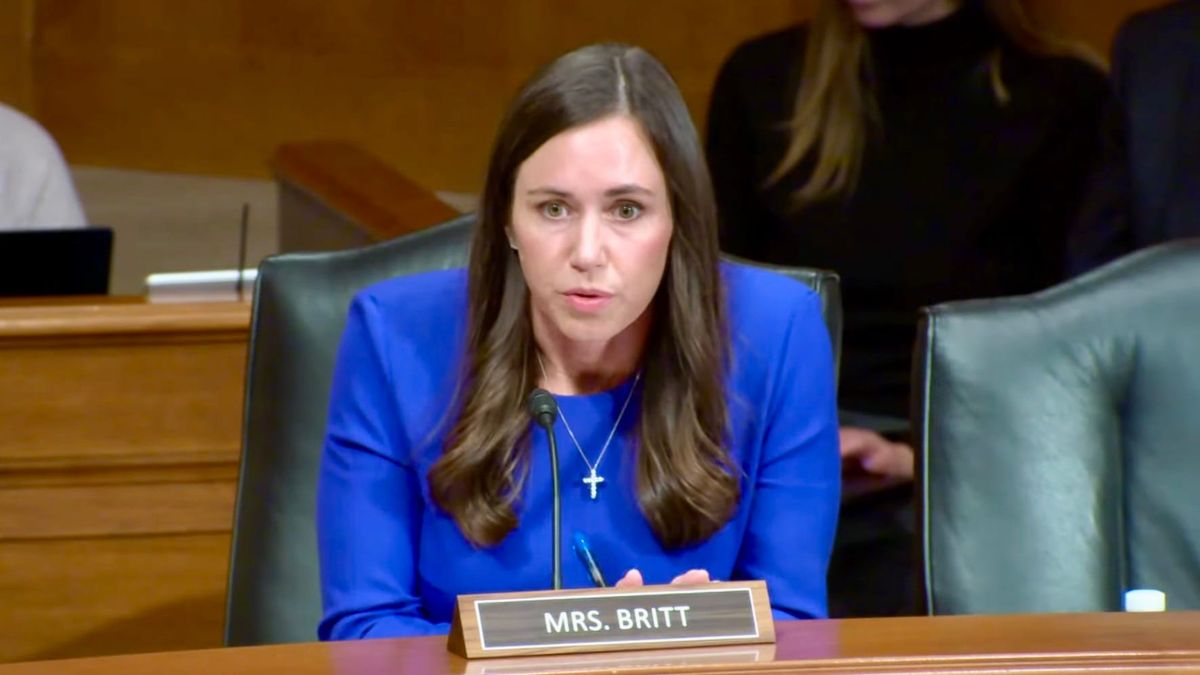
U.S. Senator Katie Britt (R-AL) called for stronger safeguards on Flock Safety cameras Wednesday, telling a Senate panel that the crime-fighting value of automated license plate readers must be weighed against Americans’ Fourth Amendment rights.
Britt made the remarks during the Senate Judiciary Subcommittee on Crime and Counterterrorism hearing, “Always Watching: Flock’s Nationwide AI Surveillance Network.” The Sept. 23 hearing examined the rapid spread of Automated License Plate Readers (ALPRs) and growing reports of misuse.
Sen. Britt did not call for abandoning the technology. Instead, she argued that its real public-safety benefits make strong limits on its use even more important.
“We’ve seen this technology be incredibly helpful in locating missing children, endangered persons, kidnapping suspects,” Britt said during her questioning.
But she also pointed to reports of improper searches and abuse by people with access to the systems.
That concern has increasingly become part of a bipartisan debate in Washington. Flock operates a network of roughly 120,000 cameras across 49 States, generating billions of scans each month. The cameras can record a passing vehicle's plate, make, model, color, location and time, creating records that can later be searched.
The day before the hearing, Britt joined Sen. Raphael Warnock (D-GA) in asking Attorney General Todd Blanche and the Department of Justice to provide State and local police with guidance aimed at preventing abuse of ALPR systems.
“We are deeply concerned about the misuse of ALPR systems and believe that appropriate safeguards are necessary to protect against unauthorized access and abuse, including by individuals who might misuse the technology to stalk and harass their victims,” the Senators wrote. “We also want to ensure that funding of these technologies is paired with appropriate oversight to ensure that the funding is not used to facilitate such abuse.”
Britt said Wednesday that the letter had been submitted for the hearing record.
Her questions also highlighted an increasingly difficult issue for law enforcement: how to keep the benefits of license plate readers without building a system that can be turned against innocent Americans.
Pinal County, Arizona, Sheriff Ross Teeple offered one possible approach.
Teeple told Britt that his department had seen firsthand how ALPR technology can help solve serious crimes. In one recent fatal hit-and-run investigation, license plate readers played a key role in confirming that the suspect vehicle was still in the area. Police later arrested a suspect.
Yet Teeple's department has decided not to renew its Flock contract, citing concerns about the Fourth Amendment and the growing capabilities of the technology.
During Britt's questioning, Teeple said any future system should be narrowly limited. He supported restricting ALPRs to still photographs instead of allowing the technology to evolve into live-streaming surveillance.
He also called for serious criminal penalties when authorized users abuse their access, telling the panel that improper access should carry felony-level consequences.
Britt and Warnock's letter cited reports of officers using ALPR systems to stalk current or former romantic partners, track Americans without warrants and monitor personal contacts. Their offices said at least 50 law enforcement officers nationwide have been charged with or accused of unauthorized use of the systems.
The Institute for Justice maintains a searchable database of improper use of Flock cameras by law enforcement that, to date, has nearly 250 instances on file.
The hearing also heard from Lindsey Isaacs, a Florida woman who was wrongfully arrested after license plate reader data became part of a fatal hit-and-run investigation. Isaacs said authorities relied on an image of her vehicle captured far from the crash scene.
Britt closed her questioning by thanking Isaacs for sharing her experience and helping lawmakers understand how surveillance tools can harm innocent people when safeguards fail.
The issue of Flock and other ALPRs is of particular concern to Britt’s constituents in Alabama.
More than 2,800 Flock cameras reportedly operate across the State, with systems deployed from Birmingham and Huntsville to Montgomery, Mobile and smaller cities. Alabama Power has also played a major role in deploying the technology through agreements with local governments.
Britt herself has supported federal funding used for public-safety surveillance in Birmingham. She is an original cosponsor of the Combating Organized Retail Crime Act (CORCA), which would create a new federal center for sharing information on organized retail and supply-chain crime. Supporters say the measure is needed to fight interstate theft rings. Civil-liberties groups have raised concerns that its broad information-sharing structure could give the federal government greater access to data collected by public and private surveillance networks.
Wednesday's hearing showed that Britt is now publicly backing additional guardrails for the technology.
“Flock cameras have proven to be a valuable tool for law enforcement in keeping our communities safe,” Britt said in a statement released with the Warnock letter. “While I support the technology’s aim, I also believe commonsense safeguards can prevent misuse by a small number of bad actors.”
The larger question is not whether abuse of these systems is possible — it clearly is, and has been occurring — to what Congress and the Justice Department will do about it.
Subcommittee Chairman Josh Hawley (R-MO) has launched an investigation into Flock and other AI surveillance systems. He invited the CEOs of Flock Safety, Axon Enterprise, Motorola Solutions and Verkada to testify Wednesday.
None appeared.
Hawley said the constitutional issue should remain at the center of the debate.
“We’ve got to find a way to protect and enforce the Bill of Rights and the basic personal liberties of every law-abiding citizen in this country no matter what the technology is,” Hawley said.
For Alabama, where thousands of cameras are already watching the roads — and parking lots, and who knows where else — the debate is hardly academic. It is real, and it is happening now.
Earlier this month, the Walker County Commission voted to ban Flock cameras and other automated license plate readers from county roads, rights-of-way and property, ordering them removed within 30 days. Commissioners cited concerns about privacy, data collection and uncertainty over who ultimately has access to the information. Red Bay has also taken its two Flock cameras offline while city leaders decide whether and under what rules they should be used. Springville officials, meanwhile, have explored ending the city's Flock contract after an officer was found to have misused the system and a city review questioned whether the cameras were worth their cost.
The fight over ALPR surveillance has moved well beyond Washington. In Alabama, citizen involvement is causing some local governments to ask whether safeguards are enough — or whether the cameras should be there at all.
And while the Senate holds hearings, Alabamians are not content to sit idly by as their rights are compromised.
Our State motto sums it up nicely: “Audemus jura nostra defendere.”
“We dare defend our rights”
Sen. Britt’s remarks at Wednesday’s hearing may be seen on YouTube and below:
The full hearing may be seen at THIS LINK.