Broader jobless measure puts unemployment at 24.9%
Official unemployment fell to 4.1% in July, but a wider measure finds nearly one in four workers lacks a full-time, living-wage job
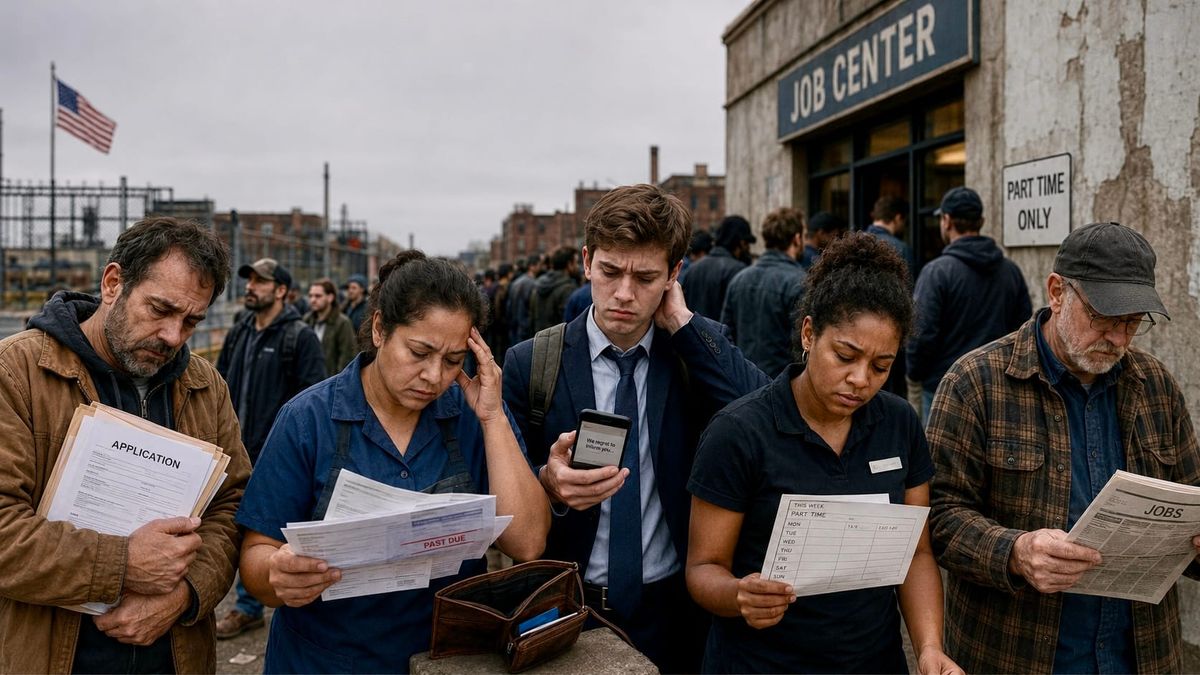
America’s unemployment rate is far worse than the number reported by the federal government.
The official unemployment rate fell to 4.1% in July. Yet a broader measure of the job market found that 24.9% of American workers were “functionally unemployed.”
That means nearly one in four people in the labor force was jobless, unable to find full-time work or earning less than a basic living wage.
The figure comes from the Ludwig Institute for Shared Economic Prosperity (LISEP). Its “True Rate of Unemployment” rose for the fourth straight month in July, climbing from 24.7% to 24.9%.
The rate has risen 1.3 points since March. It remains just below the recent peak of 25.2%, recorded in December.
The official rate and LISEP’s figure measure different things. The 24.9% figure is not the federal unemployment rate, nor is it an alternative estimate of how many Americans have no job at all.
Rather, it counts the share of the labor force that LISEP considers unable to find adequate work. That includes people who:
- Have no job but are seeking work.
- Want a full-time job but are stuck working fewer than 35 hours a week.
- Earn less than $26,000 a year before taxes, measured in 2025 dollars.
The official unemployment rate, known as U-3, is much narrower. It counts people who do not have a job, are available to work and have actively sought work during the prior four weeks.
Under federal rules, a person who worked as little as one hour during the survey week may be counted as employed. People who want a job but have stopped looking are generally not counted as unemployed.
That helps explain how the government can report low unemployment while many families still feel trapped in a weak economy.
“Washington can call these people employed, but try paying rent, food, insurance, utilities, transportation, and medical expenses on barely $2,000 per month before the government takes its share,” Armstrong Economics wrote.
The Bureau of Labor Statistics reported that the nation had 6.9 million unemployed people in July. The labor force participation rate stood at 61.4%, down 0.7 points since January.
Employers also cut 23,000 nonfarm jobs during the month. Local public schools and retail stores shed jobs, while health care continued to add workers.
Another 4.8 million Americans were working part time for economic reasons. They wanted full-time work but could not find it or had seen their hours cut.
The government also found 5.9 million people outside the labor force who said they wanted a job. Because they had not recently looked for work or were not immediately available, they were excluded from the official unemployment count.
Even the federal government’s broadest labor measure was far below LISEP’s figure. The BLS U-6 rate, which includes discouraged workers, other workers with a limited tie to the labor force and people forced into part-time jobs, stood at 7.9% in July.
The gap exists mainly because LISEP also counts millions of people who work full time but earn less than its $26,000 living-wage line. BLS does not treat low-paid workers as unemployed.
The LISEP report also found a sharp divide among workers.
Functional unemployment among women rose 1.6 points to 31%, its highest level since March 2021. The rate for men fell 0.9 points to 19.5%.
The rate stood at 27.3% for Black workers, 26.7% for Hispanic workers and 23.8% for White workers.
Education made an even larger difference. LISEP placed functional unemployment at 50.3% among workers without a high school diploma. It was 28.5% for high school graduates, 16.8% for workers with bachelor’s degrees and 12.8% among those with advanced degrees.
LISEP Chairman Gene Ludwig, who served as U.S. Comptroller of the Currency under President Bill Clinton, said four straight monthly increases should not be dismissed.
“We shouldn’t read too much into a single month, but four months begin to tell a story,” Ludwig said. “Functional unemployment is moving higher while workforce participation is moving lower. If this continues, it would suggest the labor market is losing strength despite what we may see in the headline unemployment numbers.”
Not every economist accepts LISEP’s framework as a better unemployment measure.
Gregory Daco, Chief Economist at EY-Parthenon, told CBS News that an unemployment rate in the 20% range does not match other signs in the economy.
That criticism is fair insofar as LISEP combines joblessness, a lack of full-time work and low pay into one figure. Those are related problems, but they are not the same problem.
Still, the 24.9% rate helps explain the stark gap between upbeat government reports and the daily lives of working Americans. A person can be counted as employed and still lack enough work — or earn too little — to pay the bills.
The official rate answers whether Americans have jobs. LISEP asks a harder question: Are those jobs enough to live on?
According to LISEP’s recent data, the answer for 1 out of 4 Americans is “no.”