Central Alabama Water Backs Higher Bills for Most
A billing overhaul would raise costs for 90% of households and cut bills for heavy users. A separate rate hike remains possible
TL;DR: Central Alabama Water’s board backed a uniform water charge that would raise bills for about 90% of residential customers. Final approval is pending, and another rate increase could follow for 2027.
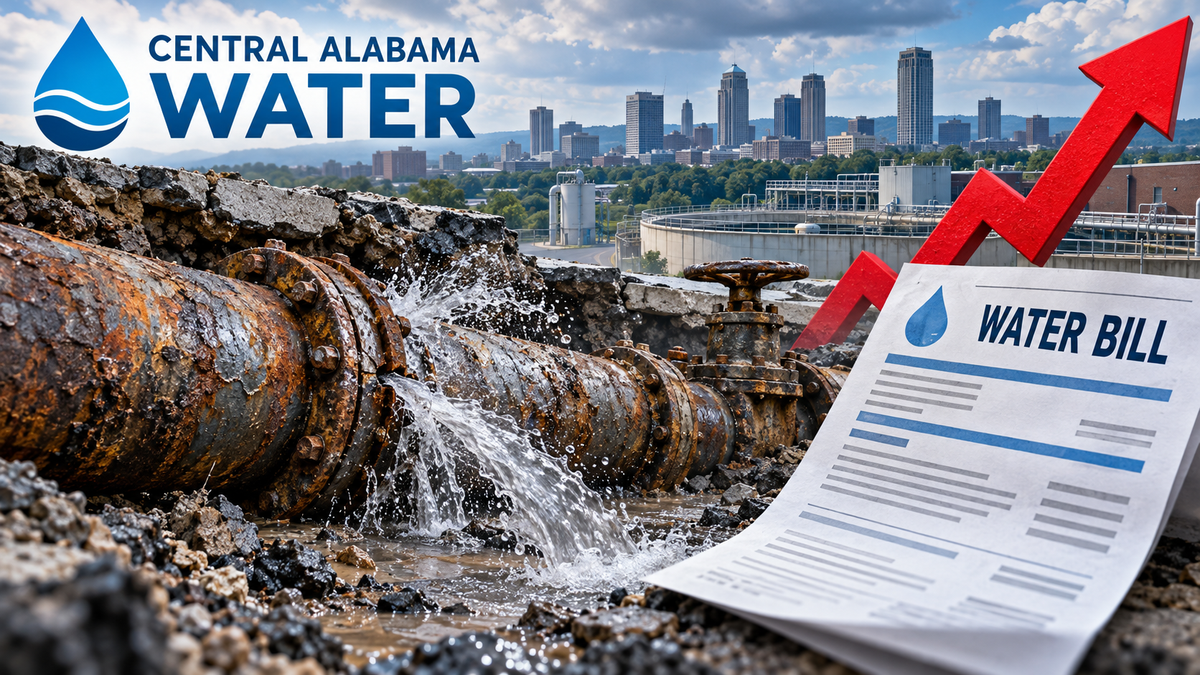
Central Alabama Water’s board has backed a billing change that would make roughly nine out of 10 residential customers pay more, while giving the heaviest water users a break.
The board voted Friday, Oct. 9, to recommend replacing its three-tier pricing system with a uniform charge per gallon. Final rates have not been approved. The change could take effect Jan. 1, 2027, according to ABC 33/40.
Under the current system, the price per gallon rises as households use more water. The proposed structure would charge $4.72 for each 748 gallons, using 2026 revenue estimates.
A household using about 3,740 gallons monthly would see its water bill rise from $47.19 to $52.09. That is another $4.90 a month, or nearly $59 a year. A household using about 14,960 gallons would see its bill fall from $150.20 to $122.89.
Those examples do not include any separate rate increase for 2027.
The utility’s financial adviser, Raftelis Financial Consultants, described the proposal as revenue neutral. It would shift who pays without bringing in much more money overall. About 90% of residential customers would pay more, while the highest-use 10% would see lower bills, WBHM reported.
Board member Jeff Brumlow supported the approach.
“We don't penalize large families,” he said. “It does hurt smaller families some that use less water.”
Raftelis said a uniform charge would make revenue more stable. The current system relies more heavily on high-volume use, including lawn watering, which can drop during wet weather.
CEO Jeffrey Thompson also argued that the utility has ample water and treatment capacity. Higher charges for heavy use discourage sales of a resource the system has available, he said.
Two directors opposed the recommendation. Jarvis Patton Sr. wanted a workshop on both the billing structure and a possible rate increase before the board chose an approach.
The proposal follows a sweeping change in who controls the utility.
Governor Kay Ivey signed SB330 in May 2025, replacing the nine-member Birmingham Water Works Board with a seven-member regional board. Birmingham’s appointment power fell from six seats to two. The other five appointments went to the Governor, Lieutenant Governor and three surrounding County Commission Presidents.
The law stripped Birmingham of its governing majority. Supporters cited repeated rate hikes, aging pipes and management failures. Opponents called it a political takeover that weakened the voice of Birmingham’s largely Black population.
The new board voted 5-2 on June 24, 2025, to operate as Central Alabama Water. The board also hired lawyers to defend against Birmingham’s federal challenge to the overhaul.
The financial problems run deep. A disclosure covering 2001 through 2024 showed a 53% gap between water treated and water billed to customers. The filing cited leaks and underbilling as possible causes. Administrative expenses rose nearly 70% from 2021 to 2024, according to WBRC’s review.
The new leadership has also faced scrutiny over its own decisions. BirminghamWatch reported in March on disputes over the CEO hiring process and private discussions about the Lake Purdy Dam project.
For customers, the next decision could carry a second cost. The board plans to consider a separate rate increase for January. Most households could face both a higher bill from the new pricing structure and another increase on top of it.