COVID Shot Analysis Finds Autism, ADHD Associations
An independent study of federal survey data reports higher adjusted odds, but cannot show whether vaccination came before diagnosis
TL;DR: A new preprint using 2022–2024 federal health survey data reports higher adjusted odds of autism, ADHD and anxiety among children who received COVID shots. The findings call for closer study, but do not establish that the shots caused those conditions.
A new analysis of federal health survey data reports higher adjusted odds of autism, ADHD and several other outcomes among children who received COVID-19 vaccines. Its authors want a long-term study to test whether the links reflect vaccine effects or other differences between families.
The paper, posted Oct. 5 on Zenodo, is a preprint, not a peer-reviewed journal article. Nicolas Hulscher and Peter McCullough of the McCullough Foundation are among its six authors. They analyzed data collected by the National Health Interview Survey from 2022 through 2024. This is an outside analysis of federal data, not a finding issued by the CDC. As such is not an official position of the CDC.
The sample included 21,990 children ages 0–17 with reported COVID vaccination status. The autism, ADHD and learning-disability questions covered 19,882 children ages 2–17.
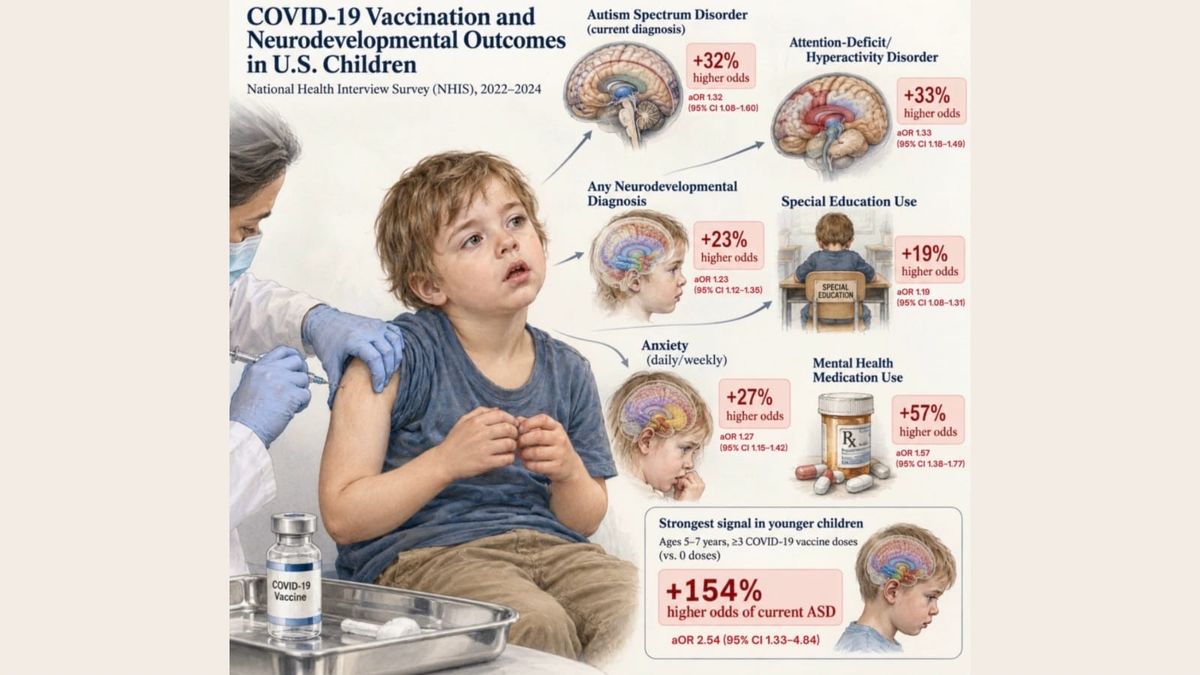
After adjusting for age, sex, income, insurance, parental education and other factors, the researchers reported 32% higher odds of current autism and 33% higher odds of ADHD among children who had received COVID shots. They also found 27% higher odds of frequent anxiety and 19% higher odds of special-education use.
Notably, those figures describe relative odds. They do not mean that 32% of vaccinated children had autism, or that autism rates rose by 32 percentage points.
The raw autism figures were nearly identical. A lifetime autism diagnosis was reported for 4.19% of COVID-vaccinated children and 4.28% of children who had not received those shots. Current autism was reported for 3.93% and 3.88%, respectively. The higher autism odds emerged after statistical adjustments.
Such adjustments can reveal links obscured by differences between groups. They also make the result depend on which factors the model captures and how it handles them.
The authors reported rising adjusted autism odds with dose count. A subgroup analysis found children ages 5–7 who received three or more doses had 2.54 times the odds of current autism compared with those who received none. Its confidence interval was wide, from 1.33 to 4.84. Another early-vaccination subgroup estimate rested on just nine exposed autism cases.
The researchers also used a balancing method to reduce measured differences between vaccinated and unvaccinated children. The autism association remained. They argue that this strengthens the case for further study.
But the survey cannot resolve the central question: Did vaccination come before the diagnosis?
The paper acknowledges that it lacks diagnosis dates. Children already diagnosed with autism or ADHD could have been vaccinated later. Statistical adjustments cannot recover that missing timeline.
“Unvaccinated” also has a narrow meaning here: no COVID-19 vaccine. Children in that group may have received other routine shots. The study does not compare the full childhood vaccine schedule with receiving no vaccines.
The authors list other limits, including parent reports, unmeasured differences in healthcare use and family health views, and multiple subgroup tests without a correction for chance findings. Their secondary analyses were developed as the work progressed rather than registered in advance.
Nor were all developmental outcomes elevated. The main adjusted analysis found no statistically significant links with learning disability, intellectual disability or developmental delay. These findings and limits appear in the supplied paper, Neurodevelopmental Outcomes in COVID-19-Vaccinated Children.pdf (attached below).
Modernity’s Oct. 5 report highlighted the higher odds and calls to stop childhood COVID vaccination. The paper itself proposes a study linking vaccine records with later, clinically confirmed diagnoses. While its data cannot establish that a halt is warranted, Modernity’s call to action mirrors the concerns of many who follow this topic.
The new analysis raises concerns and suggests new questions for researchers to test. Answering those questions will require verified vaccine dates, diagnoses made after exposure and careful checks for other causes. Parents and children deserve that work — and clear, unbiased reporting about what the current evidence can and cannot show.
Neurodevelopmental Outcomes in COVID-19-Vaccinated Children.pdf is attached: