Flock’s ‘Million Crimes Solved’ Claim Doesn’t Hold Up
Flock says its cameras help solve huge numbers of crimes. Independent research suggests the real benefit is far more modest — and the risks are very real

TL;DR: Flock Safety has repeatedly claimed its cameras help solve more than one million crimes a year. A new CBS News investigation found the company's own data does not support that claim. Independent studies also find mixed or modest results, while innocent motorists have been jailed, held at gunpoint or wrongly targeted because of bad Flock hits and police errors.
Flock Safety has sold thousands of police departments on a simple pitch: Put its cameras on the roads and cops will catch more criminals.
The company has backed that pitch with an eye-popping number: more than one million crimes solved in a year.
There is just one problem.
A new CBS News investigation found Flock's own data does not support that claim.
Flock CEO Garrett Langley said in March that the company had helped “clear just over a million crimes in America” during 2025. In another interview, he went even further.
“Over a million cases were solved last year with this technology,” Langley said.
But when CBS started digging into the number, Flock offered a much different explanation.
“The most precise way to describe our 2025 national estimate is that Flock technology supported approximately 1 million investigations and incidents,” company spokesman Paris Lewbel told CBS.
That is not the same thing as solving one million crimes.
Flock's estimate came from its 2025 Impact Census, which surveyed about 700 law enforcement agencies that use its system.
Some agencies provided raw numbers. Others supplied estimates. For one of Flock's key findings — that its technology assisted in 20% of cleared cases in customer jurisdictions — only 307 agencies supplied percentage estimates. Those figures were then combined with FBI crime and clearance data.
More importantly, the million figure was not limited to crimes that Flock actually helped police solve.
According to Flock, it included direct case clearances, investigative leads, searches made during active investigations, help provided to other agencies and other uses of the system.
In other words, a detective searching Flock during an investigation can become part of the company's impact estimate even when other evidence ultimately solves the crime.
Yes, even that level of incidental association gets rolled into Flock’s numbers.
Flock itself calls the results “directional estimates rather than audited totals” and acknowledges that its methodology is “not a finished product.”
Criminologist Andrew Wheeler identified an even more basic flaw.
A solved case in which police used Flock does not prove the case would have gone unsolved without it.
“The ‘a million crimes solved’ is probably a gross over-estimate based on that particular work,” Wheeler told CBS.
Even Charles Fain Lehman, a Manhattan Institute senior fellow who supports use of the technology, was unimpressed with Flock's methodology.
“It's worth about the paper it's printed on,” Lehman told CBS, while adding that other research suggests ALPRs do have some effect.
Unfortunately for the company, Flock's numbers don't even agree with Flock's numbers
CBS also found wildly different crime-solving claims in Flock's own public materials.
One Flock fact sheet claimed its technology helped solve more than 2,000 crimes per day.
Another page in the same document said more than 2,800 crimes per week.
Those numbers aren't close.
Two thousand crimes per day would equal more than 700,000 per year. But 2,800 per week works out to about 146,000.
Flock's FAQ created still more confusion, at different points claiming more than 1,000 crimes solved per day and more than 2,200 per week.
CBS reported that some of those materials disappeared or changed after reporters began asking questions.
Flock said the figures reflected different time periods, datasets and methods.
The gap between Flock's sales pitch and the research becomes clearer when looking at independent analysis — and the reality seems to be much less impressive than the claims.
A recent working paper published through CrimRxiv studied Flock deployment at 216 law enforcement agencies and compared them with more than 3,000 agencies that did not deploy the cameras.
On its face, the results looked good for Flock.
Researchers found an 11% decline in motor vehicle theft and a 15.9% increase in motor vehicle theft arrests after deployment.
But there was a catch, and it’s a big one.
The increase in arrests began during the three months before the cameras were deployed.
The authors themselves acknowledged that this weakens any claim that Flock caused the improvement.
The cameras also shaved only about 0.28 days — roughly seven hours — from the median recovery time among vehicles that were recovered. When researchers looked at all stolen vehicles, they found no overall improvement in recovery.
The Institute for Justice's analysis of the study found another problem. Vehicle theft was already declining before Flock deployment.
IJ researcher Matthew West also found that the headline 11% reduction was statistically significant only when researchers weighted the data toward agencies that already had larger auto-theft problems.
When agencies were weighted by population, or simply averaged, there was no statistically significant decline in vehicle theft.
“Because there were already differences in arrests and thefts trends before ALPR deployment, we don't know if the differences in ALPR deployment were caused by ALPR deployment,” West told Reason.
That doesn't prove Flock has no effect. It means the research cannot support some of the sweeping claims being made for it.
Other studies tell much the same story.
A separate academic evaluation of a major ALPR expansion in Atlantic City reached similarly mixed results.
The study, published in Justice Evaluation Journal, found no reduction in violent crime following the expansion. It did find declines in shootings, property crime and motor vehicle theft.
But when researchers looked specifically at shooting cases, the clearance rate moved from 77.1% before the expansion to 80.8% afterward.
That small increase was not statistically significant.
The researchers noted that there remains “little evidence” that ALPRs reduce crime and even less research showing that they improve clearance rates.
Atlanta offers another real-world test.
The city's Connect Atlanta surveillance system has grown to integrate more than 28,000 cameras. Yet an Atlanta Community Press Collective analysis of FBI data found that the Atlanta Police Department's clearance rates did not markedly improve between 2021 and 2025.
Atlanta's homicide clearance rate was 53.4% in 2021. It was 48% in 2025.
Motor vehicle theft clearance was 9.9% in 2021 and 10.2% in 2025.
The cameras may help officers in individual cases. The broader data simply does not show the dramatic crime-solving revolution suggested by Flock's marketing.
The cost side of the cost/benefit equation is not a hypothetical risk, either, because when Flock gets it wrong, innocent people pay.
The Institute for Justice has documented at least 27 cases since 2018 in which ALPR errors led innocent motorists to be stopped, detained or arrested. Most occurred since 2023.
In nearly two-thirds of those cases, according to IJ, police pointed guns at innocent people before discovering the mistake.
One of the starkest recent examples involved Hugo Parra in San Diego.
According to Times of San Diego and Ars Technica, police investigating an attempted armed carjacking were looking for a red Alfa Romeo. A Flock search turned up a similar car carrying Parra.
But the timestamp was a problem. The Flock image allegedly showed Parra's vehicle roughly five miles away from the crime scene at essentially the same time as the crime.
“This Flock hit was obviously the wrong car, as it could not have been in both places simultaneously,” attorney Alex Coolman said.
Parra nevertheless spent nearly a month in jail before the case against him fell apart. He and the vehicle's owner have since filed a federal civil-rights lawsuit against San Diego and several officers.
Another troubling case comes from Flock's own backyard.
Atlanta Army veteran and doctoral student Ladavious McNair spent about 30 days in the Fulton County Jail after police accused him of taking part in a November 2023 road-rage shooting.
According to 11Alive's investigation, investigators used Flock license-plate data while trying to identify the suspect's vehicle. The system placed McNair's Infiniti SUV in the area.
But a vehicle appearing near a crime scene does not prove who was behind the wheel — or that the vehicle was involved in the crime.
McNair maintained that he was at Clark Atlanta University when the shooting occurred. His attorneys also argued that police focused on his SUV despite differences between it and the vehicle described in the shooting.
Police eventually arrested McNair on Oct. 2, 2024. He remained jailed for roughly a month.
Then the case collapsed. A judge dismissed the charges with prejudice, preventing prosecutors from simply refiling the same case.
McNair has since filed a federal civil-rights lawsuit against the City of Atlanta, Police Chief Darin Schierbaum and a detective involved in the investigation. The lawsuit remains pending, and its allegations have not been finally decided by a court.
Then there is Lindsey Brooke Isaacs.
A Flock camera captured her Dodge Durango near the scene of a deadly Florida crash. Investigators concluded it was the vehicle involved.
It wasn't.
Isaacs spent 13 days in jail, facing eight felony charges, before prosecutors dropped the case. Another driver was later arrested. The Institute for Justice's review of the case lists it among a growing number of ALPR-related errors.
In Sherwood, Arkansas, the consequences were immediate.
A Flock camera misread one digit on an SUV's plate in February. Police then stopped an innocent couple and ordered them out at gunpoint while their six-week-old baby remained strapped into a car seat.
And in South Carolina, Iraq War veteran Steven Melvin says a bad Flock hit led deputies to hold him at gunpoint.
According to the Rock Hill Herald's reporting on the lawsuit, the camera incorrectly read Melvin's plate while deputies were looking for a similar stolen BMW. Melvin alleges he was ordered onto his knees at gunpoint and kept there for about five minutes.
These are not examples of Flock cameras independently deciding to arrest someone. Human mistakes, bad database entries, poor police judgment and failures to verify alerts often play a major role.
That distinction offers little comfort to the innocent person looking down the barrel of a police officer's gun.
Unfortunately, errors aren't the only concern. There are also numerous documented cases of Flock data misuse.
The Institute for Justice's ALPR abuse database now contains nearly 250 reported incidents involving ALPR systems, including wrongful stops, stalking, non-law-enforcement searches and other misconduct.
Alabama has already seen several cases of alleged or confirmed Flock misuse by law enforcement. In July, WBRC reported that a Springville police officer resigned after an audit found multiple searches involving a family member, while a Moody police employee was fired after a separate audit uncovered a violation of the department's license-plate-reader policy; both cases were referred to ALEA. In August, a Lee County sheriff's deputy was fired after an internal audit found violations involving information obtained through Flock, according to the Lee County Sheriff's Office. And in Decatur, WAFF reported that an officer was placed on administrative duty while the department and ALEA investigate alleged misuse of its Flock system. Taken together, the cases show that concerns about unauthorized access to ALPR data are not merely hypothetical in Alabama.
Flock argues that abuse represents only a tiny fraction of legitimate searches and notes that its audit logs can help expose misuse. The company has also announced tighter safeguards, including more standardized reasons for searches and plans to require case numbers for most law-enforcement searches.
That brings the debate back to the basic question: just what, exactly, are we getting in return from all these cameras watching us?
Flock cameras can help recover stolen cars. They can generate useful leads. They can help police locate wanted vehicles, missing people and suspects. The research provides evidence of some genuine benefits.
But “useful police tool” is a very different claim from “one million crimes solved.”
Flock has built a vast system capable of recording where ordinary Americans' vehicles travel and making those records searchable by thousands of law enforcement users. That system has generated serious Fourth Amendment challenges, although courts have not uniformly accepted the argument that warrantless use of fixed ALPR networks violates the Constitution.
So the constitutional issue remains part of a larger fight over how old Fourth Amendment rules apply to a new kind of mass location database.
The practical issue may be simpler.
Flock has a documented record of police misuse. Its data and alerts have contributed to innocent motorists being stopped at gunpoint and, in some cases, jailed. Independent research suggests its effect on crime and clearance rates is much more modest and uncertain than its marketing implies.
And now CBS has shown that perhaps Flock's biggest selling point — a million crimes solved — wasn't really a million solved crimes at all.
If Americans are being asked to accept a nationwide surveillance network as the price of public safety, they deserve solid proof of what they are getting in return.
So far, that proof looks considerably thinner than the sales pitch.
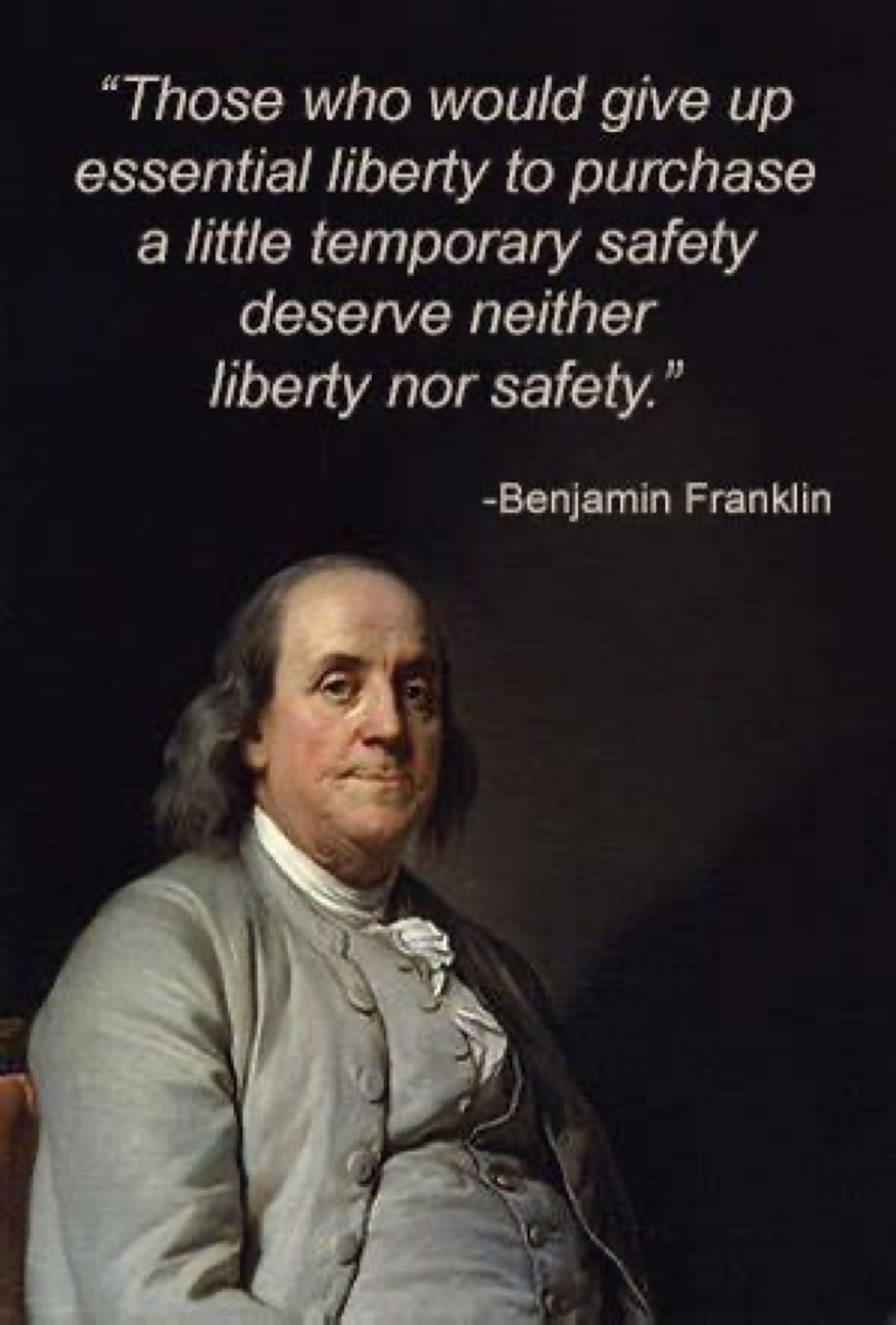
Or, we could just remember what Ben Franklin had to say about Liberty and Safety.