Gambling Opponents Ask Supreme Court to Revisit 2018 Ruling
Three groups seek to restore a federal sports wagering ban as Alabama fights prediction markets operating under federal rules
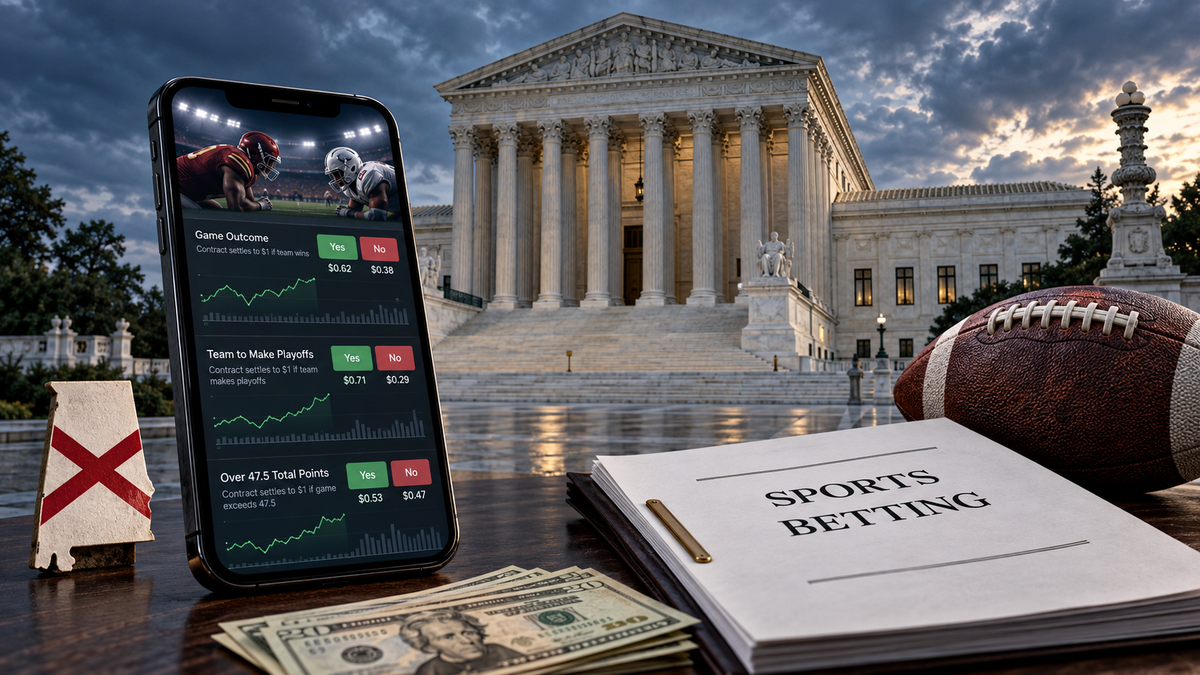
TL;DR: Three gambling opponents want the Supreme Court to revisit part of the ruling that opened the door to legal sports betting. Their brief targets prediction markets, which offer sports contracts in Alabama despite its ban on online sports wagering.
Texans Against Gambling has joined Stop Predatory Gambling and the Association of American Physicians and Surgeons in asking the U.S. Supreme Court to revisit part of its landmark 2018 sports betting ruling. The move could carry stakes well beyond prediction markets — including in Alabama, where online sports betting remains banned.
The groups filed their friend-of-the-court brief Oct. 7 in Flaherty v. KalshiEX. They support New Jersey officials seeking review of a ruling that shields Kalshi’s sports-event contracts from State gambling laws. They also want the justices to consider restoring a federal restriction on private sports wagering businesses.
That request reaches back to Murphy v. NCAA, decided May 14, 2018. The Court held that Congress could not order States to keep sports betting bans in place. Such commands violate the Constitution’s rule against forcing States to carry out federal policy.
But the Court made a second choice: It struck down the rest of the Professional and Amateur Sports Protection Act (PASPA) rather than leave parts standing. That included a provision aimed at private parties operating sports wagering schemes under government authority.
The constitutional ruling was by a 7–2 vote. The decision to strike down the remaining provisions split the Court 6–3. That narrower divide is central to the new challenge.
The three groups argue the private-party restriction could stand on its own. They want the Court to revisit its severability analysis — the test for deciding whether valid parts of a law can survive when another part falls. Their brief also cites gambling harms and challenges the use of federal financial law to override State gambling limits. Those are arguments for the justices to consider, rather than findings by the Court.
As The Baptist Paper reported, the groups’ effort could reach beyond Kalshi to the wider legal sports betting market. Their request seeks to reopen a key part of the ruling that allowed that market to grow.
The immediate dispute concerns who sets the rules for sports prediction contracts. Customers buy and sell contracts tied to outcomes such as game winners or player performance. Kalshi argues that federal commodities law governs those trades and overrides conflicting State gambling laws.
New Jersey’s petition for Supreme Court review challenges that position. The Third Circuit sided with Kalshi, while other federal appeals courts have backed State enforcement in related disputes.
Alabama is already involved in this legal debate.
As ALPolitics.com previously reported, residents can buy sports-event contracts through prediction platforms even though lawmakers have not approved online sports betting. FanDuel and CME Group launched FanDuel Predicts in Alabama and four other States in December 2025. Their launch announcement expressly targeted sports contracts to States without legal online sports betting.
Alabama Attorney General Steve Marshall joined an Ohio-led brief from 39 States and the District of Columbia urging the Court to preserve State authority. That effort supports State control over gambling; the separate request to revisit Murphy would reach further by restoring a federal restriction.
The NFL has also entered the fight. The league filed its own brief seeking review. It warns about contracts that one player or official could influence, along with risks from inside information. The league also wants stronger safeguards for those trading on games.
Meanwhile, an Alabama lawsuit against Kalshi remains a separate front in the war against online sports betting. Nick Willis sued to recover alleged gambling losses under State law. U.S. District Judge Harold Mooty III returned that case to State court Sept. 8. His ruling settled where the case belonged — in State court. It did not decide whether Kalshi’s contracts violate Alabama law. This case is currently active and ongoing.
The amicus brief filed by Texans Against Gambling, Stop Predatory Gambling and the Association of American Physicians and Surgeons may be found at THIS LINK.