House Rejects GOP Bid to Keep Supreme Court at Nine
Alabama's five Republicans backed the amendment, while the State's two Democrats joined most of their party in voting against it
TL;DR: House Republicans failed Wednesday to pass a constitutional amendment that would have permanently fixed the U.S. Supreme Court at nine justices. The measure won a 212-206 majority, but fell short of the two-thirds vote needed for a constitutional amendment. All 211 Republicans voting backed it, joined by just one Democrat. Alabama’s delegation split 5-2 along party lines, with Republicans Robert Aderholt, Barry Moore, Mike Rogers, Gary Palmer and Dale Strong voting yes, while Democrats Shomari Figures and Terri Sewell voted no. Republicans said the amendment would prevent future “court packing,” while Democrats argued it would strip Congress of its historic power to set the size of the Supreme Court.
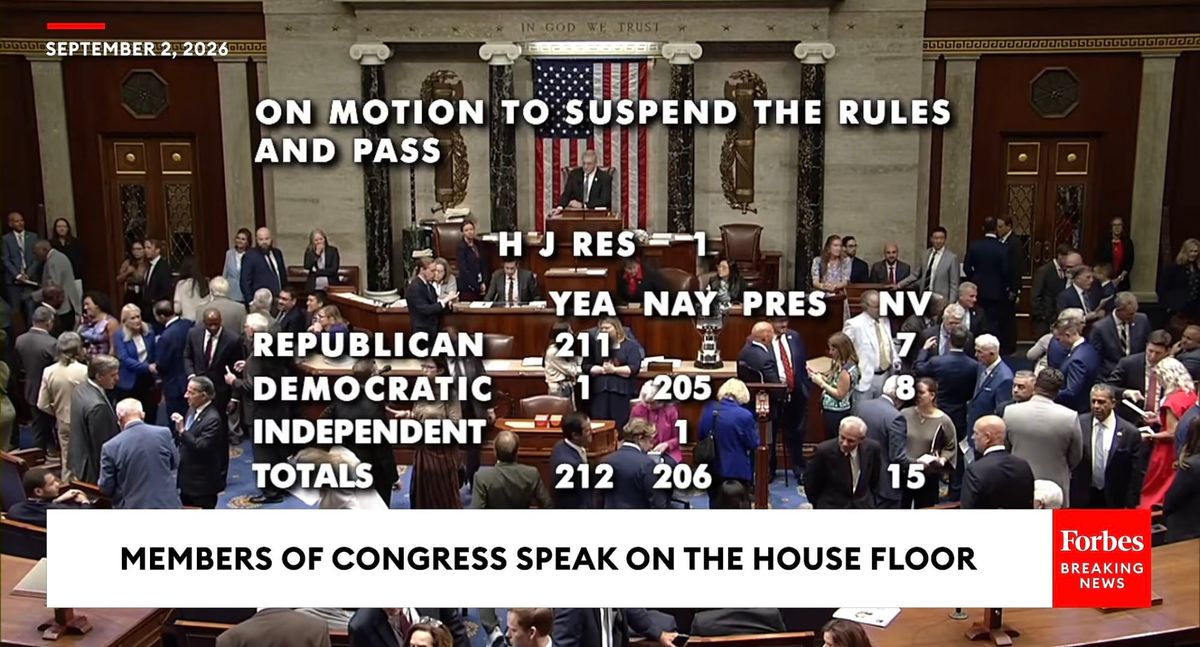
House Republicans failed in their bid to lock the U.S. Supreme Court at nine justices on Wednesday, as nearly every Democrat voted against a proposed constitutional amendment that would have barred future efforts to expand the court.
The House voted 212-206 in favor of H.J. Res. 1, but because the measure proposed an amendment to the U.S. Constitution, it needed support from two-thirds of the House to advance. The official House roll call lists the measure as failed.
The vote broke almost entirely along party lines.
All 211 Republicans who voted supported the amendment. North Carolina Rep. Don Davis was the lone Democrat to vote yes. Another 205 Democrats voted no, as did the House's lone independent, Kevin Kiley of California. Fifteen members did not vote.
The proposal, sponsored by Rep. Andy Biggs (R-AZ) was simple. It would have amended the Constitution to require that the Supreme Court consist of nine justices. The proposed amendment itself states: "The Supreme Court of the United States shall be composed of nine justices."
Had the House approved it, the proposed amendment still would have faced a long road to passage.
A constitutional amendment must receive a two-thirds vote in both the House and Senate. It must then be ratified by three-fourths of the States before becoming part of the Constitution.
Alabama's congressional delegation divided cleanly along party lines.
Republican Reps. Robert Aderholt, Barry Moore, Mike Rogers, Gary Palmer and Dale Strong all voted yes.
Democratic Reps. Shomari Figures and Terri Sewell voted no.
The official House roll call confirms that all seven members of Alabama's delegation participated in the vote.
That Alabama split mirrored the national partisan divide over what Republicans have called "court packing."
The Constitution creates "one supreme Court," but it does not set the number of justices. Congress has historically held the power to determine the court's size.
The first Supreme Court had six justices. Congress changed the number several times during the 19th century before settling on nine in 1869. The number has remained unchanged for more than 150 years.
H.J. Res. 1 would have fundamentally changed that arrangement. Instead of allowing a future Congress to alter the size of the court by passing a law, nine seats would have been written into the Constitution.
Republicans argued that such a change is needed to protect the judiciary from a cycle in which whichever party controls Washington could add seats to gain an ideological advantage.
Republicans made little secret of the fact that Wednesday's vote was also meant to put Democrats on record ahead of the November midterm elections.
House Speaker Mike Johnson described the idea of adding justices as "crazy" and said Republicans were "going to make sure that doesn't happen." Johnson also said the vote would make Democrats "put their money where their mouth is" on whether they support expanding the court.
The issue has gained new life because of the Supreme Court's current conservative majority and calls from some Democrats to expand or restructure the court.
House Minority Leader Hakeem Jeffries has said "dramatic" Supreme Court reform is "necessary." He has also indicated that Democrats would consider several options if they regain control of the House.
"There's a variety of different options that are on the table," Jeffries said. "And I think that we can't foreclose any single one of them."
Democrats countered Wednesday that the Republican amendment would surrender a power Congress has held since the nation's founding.
Maryland Democratic Rep. Jamie Raskin argued that Republicans were seeking to lock in the court's current conservative majority. He described past Republican actions surrounding Supreme Court nominations as "court packing on steroids."
Pennsylvania Democratic Rep. Mary Gay Scanlon also opposed the amendment.
"This proposed constitutional amendment would undermine our system of checks and balances," Scanlon said, arguing it would be a "grave mistake" to adopt a "misguided Constitutional amendment that would permanently tie Congress' hands."
Another criticism came from Gabe Roth, Executive Director of judicial reform group Fix the Court. Roth told Forbes that permanently limiting the Supreme Court to nine seats could complicate some plans to impose 18-year term limits on justices because those proposals could temporarily require more than nine justices while current lifetime-appointed members remained on the bench.
Voting for the amendment would therefore amount to "a vote against Supreme Court term limits," Roth argued.
Republicans, meanwhile, portrayed Wednesday's vote as a straightforward test of whether Democrats were willing to rule out adding Supreme Court seats when political control changes hands.
The proposal won a majority of those voting — 212 to 206 — but constitutional amendments face a deliberately higher bar. The House considered H.J. Res. 1 under suspension of the rules, requiring a two-thirds vote. The measure therefore failed despite receiving six more yes votes than no votes.
The defeat of H.J. Res. 1 means Congress retains the same authority it has long exercised: lawmakers can change the number of Supreme Court seats through legislation — an action that is already being strongly pushed by Democrats.
For now, however, SCOTUS remains at nine justices — and Wednesday's vote showed a sharp partisan divide over whether Congress should ever be allowed to change it again, despite the Democrat’s plans to do just that.