
Ivey Orders New Primaries After Senate Map Ruling
Court restores Alabama's 2021 Senate map, voiding earlier primary results in Districts 25 and 26
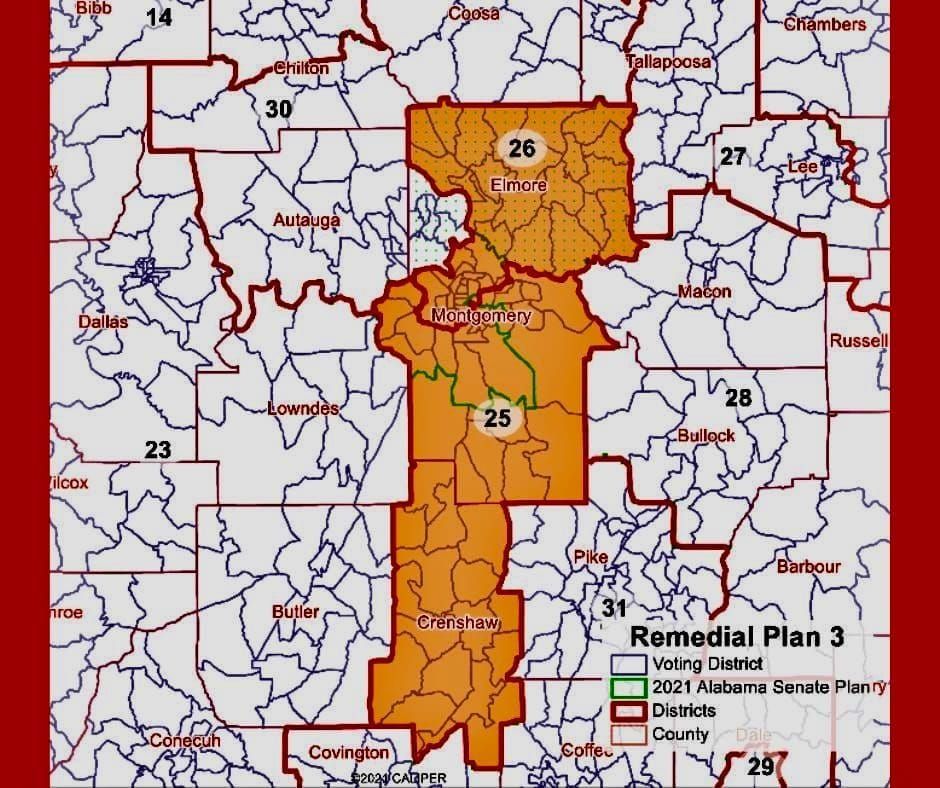
Alabama voters in two Montgomery-area Senate districts will head back to the polls this summer after a federal appeals court revived the State's original 2021 legislative map, prompting Governor Kay Ivey to call new special primary elections for Senate Districts 25 and 26.
The special primaries will be held Aug. 11, with no runoff election. Winners will advance to the Nov. 3 general election. The move comes just days after the 11th U.S. Circuit Court of Appeals stayed a lower court order that had required Alabama to use a court-drawn map for the two districts.
As a result, the primary elections already conducted under the court-ordered map have been invalidated, and candidates must now run again under district lines established by the Alabama Legislature following the 2020 Census.
“Alabama continues winning fair and square in our redistricting battle, and I am proud to celebrate yet another victory for Alabamians and our elections. In this case, we are talking about Alabamians in State Senate Districts 25 and 26,” Ivey said in a statement announcing the special election.
The Governor's action marks the latest turn in a legal battle that has stretched on for more than two years and focused almost entirely on Senate Districts 25 and 26, which cover portions of Montgomery, Elmore and Crenshaw Counties.
The dispute began when a group of voters challenged the Legislature's 2021 Senate map, arguing that the configuration of the two districts diluted Black voting strength in the Montgomery area. Plaintiffs contended that Alabama's population growth and demographic changes warranted a different district arrangement that would provide Black voters a greater opportunity to elect candidates of their choice.
In November 2025, U.S. District Judge Anna Manasco agreed with those arguments and ordered Alabama to use a court-selected replacement map for the 2026 and 2030 election cycles. The map was drawn by a special master and significantly altered the boundaries of both districts.
The court-selected plan moved thousands of voters between Districts 25 and 26 and reshaped the districts to create a different racial and political balance. The ruling immediately triggered appeals from State officials, who argued that the court had improperly substituted its judgment for that of the Legislature.

The controversy intensified earlier this year when election qualifying and campaign activities began under the court-ordered map. Candidates entered races, voters were assigned to new districts, and primary elections proceeded while the appeals process continued.
Meanwhile, Alabama officials sought emergency relief from higher courts. State attorneys moved to fast-track their appeals following a series of favorable developments in federal redistricting litigation, including a U.S. Supreme Court decision that reopened challenges to court-imposed maps in Alabama and other States.
Expecting that courts might eventually restore the Legislature's districts, Ivey called lawmakers into special session this spring. The Legislature approved measures allowing the Governor to quickly schedule replacement elections if ongoing appeals changed district boundaries after primary voting had already begun.
Those preparations proved significant when the 11th Circuit ruled that Alabama could return to the 2021 Senate map while the litigation continues. The appeals court found that State officials had met the requirements for a stay, allowing the Legislature's districts to remain in effect pending further review.
The ruling effectively erased the results of the May primary elections in Districts 25 and 26 and required a fresh election under the restored map.
According to the Governor's office, major-party candidates must qualify by 8 a.m. June 2. Independent and minor-party candidates have until Aug. 11 at 5 p.m. to qualify.
Ivey framed the decision as part of a broader legal victory for the State.
“I can tell you this: Alabama is not tired of winning,” the Governor said.
State Senate President Pro Tem Garlan Gudger (R-Cullman) responded to the court’s decision by saying, “From day one, we have stood by the constitutionality of the State Senate maps that were drawn and passed by the Legislature in 2021, and the 11th Circuit Court of Appeals should be commended for finally seeing the light.
“The upcoming elections in Senate District 25 and 26 can now be held using fairly drawn maps that are firmly rooted in common sense and prioritize reason over race.“
While the immediate effect is limited to two State Senate districts, the case has drawn Statewide attention because it mirrors larger redistricting battles involving Alabama's congressional districts. State officials continue to pursue appeals in those cases as well, arguing that courts have exceeded their authority by replacing maps enacted by elected lawmakers.
For now, however, the most immediate impact will be felt by voters in Districts 25 and 26, who will once again choose party nominees this summer under district lines that many believed had already been settled.