Redistricting Bills Advance Through Alabama Legislature
Special session bills tied to Alabama voting maps clear both chambers as lawmakers press ahead amid court fights
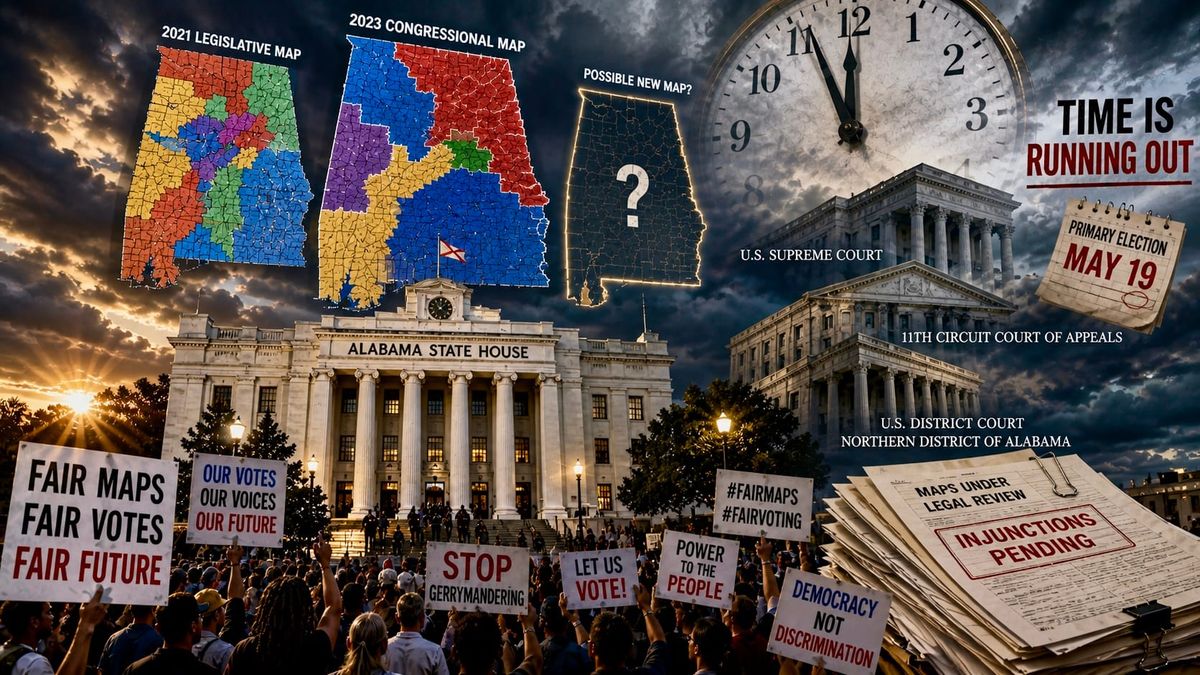
Alabama lawmakers are moving quickly this week on a pair of Special Session bills tied to the State’s ongoing redistricting fight, advancing both measures through their original chambers as court battles continue ahead of the May 19 primary deadline.
The legislation outlines how Alabama would conduct special primary elections if federal courts allow the State to use previously approved congressional and legislative maps now blocked under injunctions.
House Bill 1 (HB1), dealing with Congressional Districts, passed the Alabama House by a vote of 75 yeas, 29 nays, and 1 abstention. The bill has now moved to the Senate County and Municipal Government Committee for further consideration.
HB1 authorizes special primary elections in affected Congressional Districts if a federal court lifts the injunction blocking Alabama’s 2023 Congressional map and if the ruling comes too late to fit within the current election schedule.
Speaking during committee debate earlier in the process, bill sponsor House Pro Tem Chris Pringle (R-Mobile) defended the proposal while avoiding speculation about pending court action.
“This is pending before the court and I don’t want to answer that question because the court’s going to determine that,” he said. “I clearly said if the court changes and lifts the injunction against us, this provides the venue for a special election.”

Senate Bill 1 (SB1), which addresses State Senate Districts, also advanced. The bill passed the Alabama Senate by a vote of 26 yeas to 7 nays and has now been referred to the House Ways and Means General Fund Committee.
The legislation focuses on Senate Districts 25 and 26 in the Montgomery area. Like the House proposal, it would trigger special primary elections if courts lift injunctions on maps approved by lawmakers in 2021 and if the election calendar can no longer accommodate standard qualifying deadlines.
Senator Chris Elliott (R-Josephine) the sponsor of SB1, said the legislation was crafted to prepare for possible court action.
“If the federal courts issue an order to vacate an injunction allowing the legislature to use maps that we previously enacted for our own Senate Districts,” Elliott said.
Both bills are expected to clear committee and receive approval in their second chambers as Republican lawmakers continue preparing for multiple possible court outcomes.
The legislative push intensified after the U.S. Supreme Court issued a 6-3 ruling in Louisiana v. Callais, a decision that reshaped how race may be considered in drawing electoral districts and sparked renewed legal action across the South.
Following that decision, Alabama Attorney General Steve Marshall filed emergency motions in both federal district court and the Eleventh Circuit Court of Appeals seeking to lift injunctions currently blocking the State’s congressional and legislative maps, as well as emergency motions to the U.S. Supreme Court related to active cases pending there.
Outside the Alabama State House, protesters have gathered to voice concerns about voting rights, representation, and the future of Alabama’s electoral districts. Members of the public joined Democratic lawmakers in criticizing efforts to revive previously blocked maps.
For now, both measures remain tied to future federal court rulings. If judges decline to lift the injunctions, the special elections outlined in the bills would never take effect.