Jones hits Tuberville, Flock and AI in Birmingham
Doug Jones called for a debate with Tommy Tuberville while taking on Flock cameras, AI, crime and Alabama’s direction
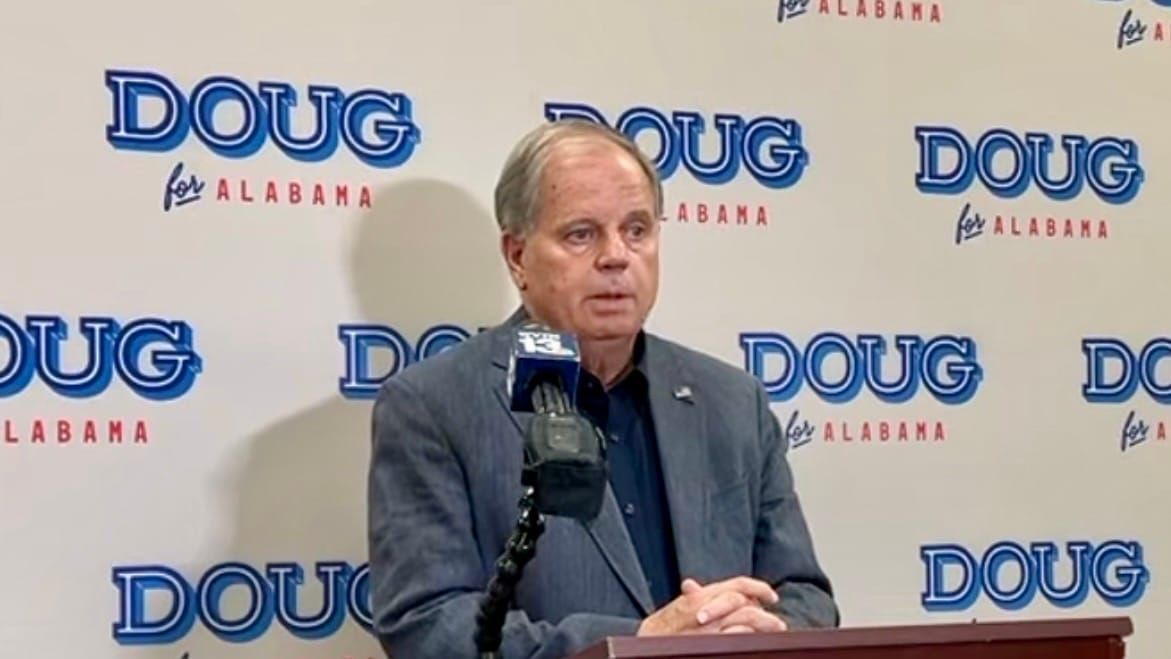
Democratic gubernatorial nominee Doug Jones used a Tuesday evening press conference in Birmingham to take aim at Republican opponent Tommy Tuberville, warn about Flock surveillance cameras and artificial intelligence, and lay out his approach to crime and public safety.
Jones spoke to reporters shortly before a campaign Town Hall at A.H. Parker High School, part of a series of open events his campaign is holding across Alabama. His next stop is scheduled for Wednesday in Mobile.
The former U.S. Senator opened by challenging Tuberville to debate him before the Nov. 3 election.
“I think the people of Alabama deserve a debate,” Jones said. “We have seven weeks. We will start a countdown clock of 49 days today.”
Jones has made the challenge a recurring part of his campaign. Tuberville has so far declined. Asked by Axios last month whether he would debate or hold a town hall, Tuberville said “probably not,” arguing the differences between the candidates were already clear. His campaign later told Axios there was “nothing new to learn in a debate.”
Jones was less restrained Tuesday.
“I’ve never believed he had the guts enough to debate,” Jones said. “He talks tough, tries to pretend, but at the end of the day, you call him for a debate, and he takes a knee.”
Asked about Flock cameras and other automated license plate readers, Jones said his views have shifted as more details have emerged about how the systems work and how police agencies use their data.
“My opinion has moved considerably,” Jones said.
Jones said the cameras can help law enforcement, but cited cases in which police officers have allegedly misused license plate databases to track people for personal reasons. He called for stronger privacy safeguards and said Florida’s move to restrict the technology at the state level deserved consideration.
“There are real privacy concerns that are coming out now that a lot of people believe outweigh the law enforcement concerns,” Jones said.
The issue has become especially heated in Alabama because of Alabama Power’s role as a reseller and installer of Flock and similar systems. A recent Alabama Reflector and Inside Climate News investigation reported that Alabama Power has partnered with more than 80 Alabama municipalities on surveillance systems.
Jones raised concerns about the utility’s role and suggested it could obtain camera data. Alabama Power disputes that point. The company told reporters that it installs and maintains the equipment but “does not operate the system or have access to data,” saying participating customers control the information.
Jones stopped short of calling for a Statewide ban, saying local police chiefs and sheriffs should retain some control over public-safety decisions. But he argued the State should establish privacy guardrails.
Jones sounded an even stronger warning about artificial intelligence in public schools.
“I am very concerned about the use of AI in classrooms, especially in the younger days,” he said. “I want kids to learn to think. I want them to read. I want them to learn to have critical thinking as early as they can.”
Jones drew a distinction between teaching computer science and letting students rely heavily on AI.
“I would love every kid to learn how to code right now,” he said. “If you learn computer science, [they] are going to be able to control AI.”
But Jones warned against allowing AI to become a “crutch” for students or teachers and said Congress has moved too slowly to address the risks.
On violent crime, Jones rejected the “defund the police” approach and called for more officers, better training and stronger cooperation among federal, state and local agencies.
“I am just the opposite of defund the police,” Jones said. “I want to give them more resources. I want to get more training.”
He praised Birmingham Mayor Randall Woodfin and Birmingham police for recent declines in violent crime. City figures released earlier this year reported homicides down 75 percent, robberies down 26.7 percent and total violent crime down 31.8 percent compared with the same period a year earlier.
Jones also proposed closer coordination between the Alabama Law Enforcement Agency, local police and sheriffs, along with community programs modeled on initiatives he worked with as U.S. attorney.
The Birmingham stop carried added meaning for Jones. Tuesday marked the anniversary of the 1963 bombing of 16th Street Baptist Church. Jones, who prosecuted two former Ku Klux Klan members in the bombing decades later, said Parker High School was chosen in part to honor the four girls killed in the attack and two Black boys killed elsewhere in Birmingham later that day.
“We’ve made considerable progress,” Jones said, but added that he believes racial division and threats to voting rights remain.
He closed with a pitch aimed directly at Republican voters: judge the candidates by their records rather than the letters beside their names.
“I want people to not just look at an initial by a name, an R or a D,” Jones said. “I want people to compare the records.”
Jones’ press conference may be seen in its entirety on the ALPolitics.com Facebook page at https://www.facebook.com/reel/1062369746706365.