MapQuest Puts Flock Cameras on the Map
A new app feature reveals nearby surveillance cameras as Flock fights efforts to map its network, including Alabama-born DeFlock
TL;DR: MapQuest now lets users see known Flock cameras and other license plate readers. DeFlock offers a similar map with Huntsville roots, but Flock has challenged its name and sought removal of a separate researcher’s map through trademark claims.
MapQuest is giving drivers a clearer view of who may be watching their daily travels.
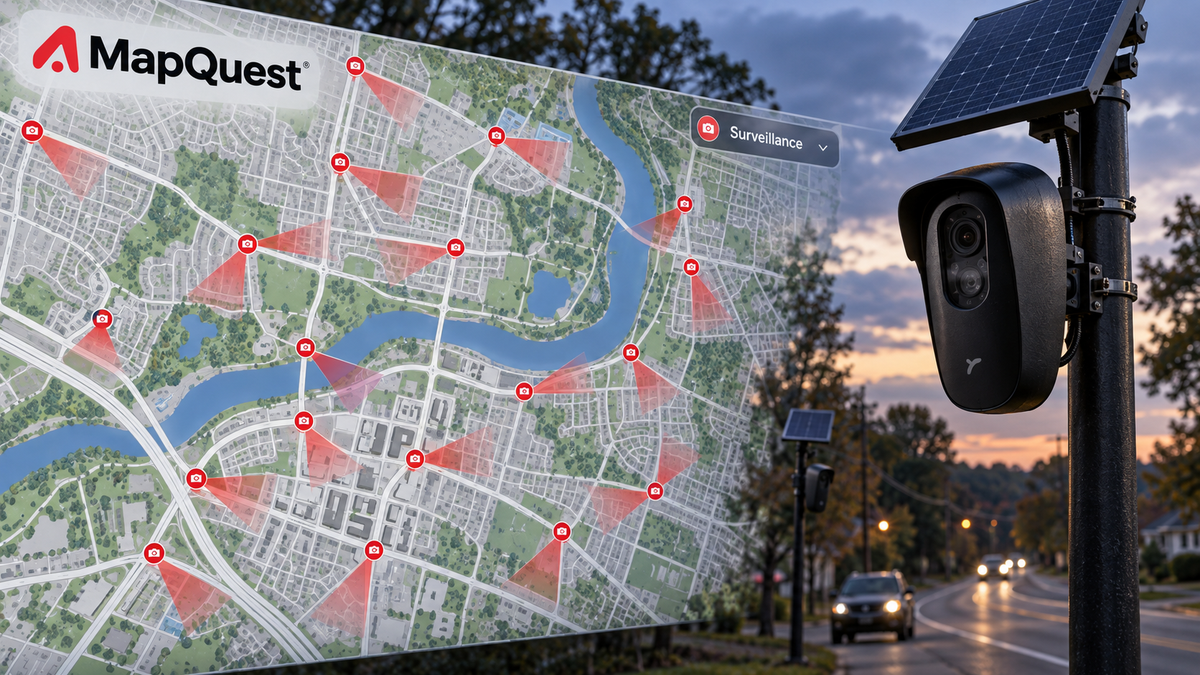
The mapping service has added a “Surveillance Layer” to its mobile app, showing known license plate readers and other outdoor cameras. It offers another way to find the devices near their homes, schools and workplaces.
“The Roads Have Eyes!” MapQuest declared in its announcement. Users can turn on the feature under Map Options. It covers cameras from Flock Safety, Motorola Solutions, Axon, Rekor, Verkada and several other firms.
The feature brings camera mapping into a familiar navigation app. But, a grassroots project with Alabama roots has been doing similar work for nearly two years.
Software engineer Will Freeman launched DeFlock after noticing license plate cameras while moving to Huntsville. As 404 Media reported in November 2024, he began plotting the devices through OpenStreetMap and invited others to contribute. The effort grew into a worldwide map of readers from Flock and other vendors.
DeFlock’s map shows reported camera locations. It does not provide access to footage, reveal who searched a driver’s plate or prove that every listed device remains active. Its volunteer reports also should not be treated as a complete count of all cameras, as State of Surveillance explains.
The Alabama debate was already underway before MapQuest’s update. WAFF covered a December 2025 gathering in Huntsville where Freeman urged more public scrutiny of the cameras and the data they collect. Huntsville police and Flock defended the devices as tools that help reduce crime and give officers faster leads.
Flock has also pushed back against those mapping its equipment. The company has filed a cease-and-desist demand against DeFlock.
In January 2025, Flock’s lawyers demanded that Freeman stop using the DeFlock name. The company claimed the branding diluted its trademarks and harmed its reputation.
The Electronic Frontier Foundation took Freeman’s side and rejected the demand. Its lawyers argued that federal trademark law protects noncommercial use of a mark to criticize the company or its products. DeFlock continued operating.
A second dispute arose in September over cybersecurity researcher Joshua Michael’s Flock Surveillance Map, a separate project built from location records reportedly obtained through exposed access to Flock-related systems.
Gadget Review reported that Michael’s map listed more than 170,000 cameras and about 130,000 supporting devices. Notably, the roughly 300,000 total includes hardware other than cameras.
According to Cybernews, brand-protection vendor Doppel submitted a trademark complaint on Flock’s behalf Sept. 24 of this year seeking removal of Michael’s site. The complaint alleged that its use of the Flock Safety mark could confuse customers. Michael’s site carried a disclaimer stating that it was not affiliated with or endorsed by Flock.
The maps expose the central dispute over license plate readers: useful evidence for police can also become a searchable record of ordinary travel.
Flock says its technology captures plates and vehicle details to help solve crimes. Privacy advocates counter that the collection reaches everyone who passes a camera, whether or not they are suspected of wrongdoing. Additionally, there is considerable data to suggest that Flock’s crime-fighting claims may be overblown, leading to ongoing, serious discussion about their cost/benefit ratio.
Recently, U.S. District Judge Sara Hill ruled that Flock cameras and the database they create was an unconstitutional act of “indiscriminate, mass surveillance“ that was predicted in 1983’s United States v. Knotts case.
“More than 40 years have passed since the Supreme Court’s decision in Knotts, and this Court is now faced with technology that appears to be approaching the dragnet type law enforcement practice Mr. Knotts warned of,” she wrote.
The constitutionality of Flock and other license plate reading cameras will almost certainly be decided by the U.S. Supreme Court. Until then, MapQuest’s update gives residents another tool to examine that network. For Alabama communities weighing camera contracts, it also provides a starting point for public questions: who can search the records, how long they are kept and what safeguards protect drivers from misuse.