
Oklahoma Judge: Flock Search Was Unconstitutional
Federal ruling calls ALPR tracking “indiscriminate mass surveillance,” pushing the Flock Fourth Amendment fight closer to SCOTUS
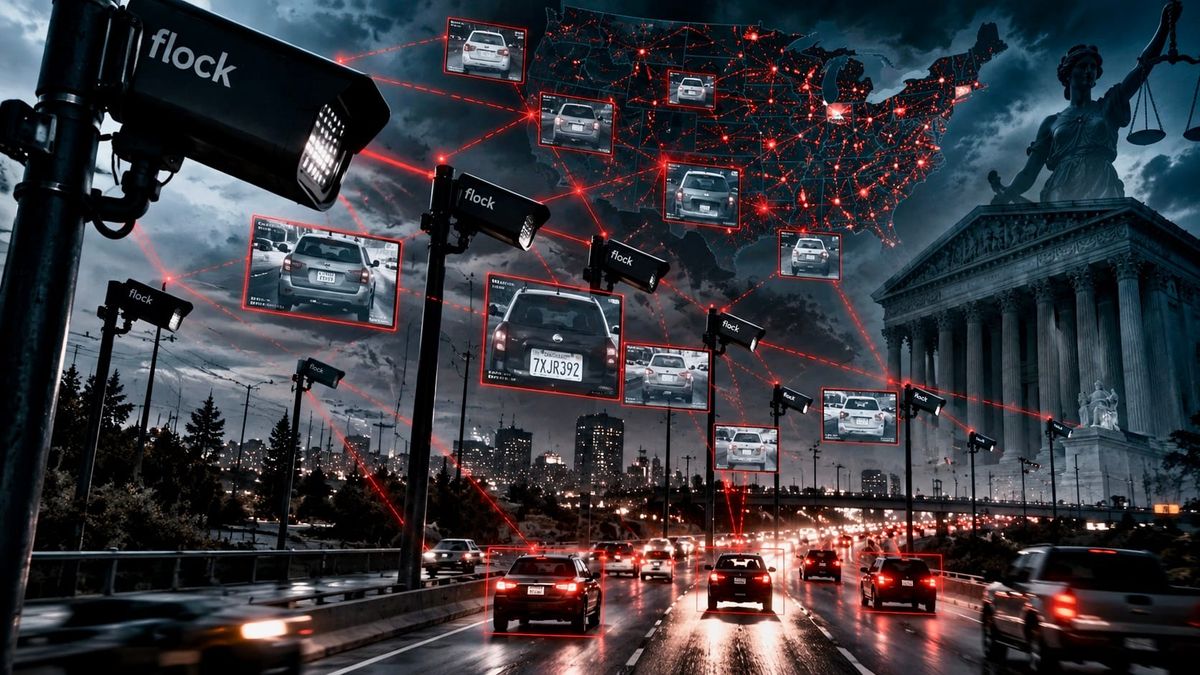
TL;DR: A federal judge in Oklahoma has ruled that a warrantless search of a driver’s travel history through Flock and other automated license plate reader systems violated the Fourth Amendment. Judge Sara Hill called the technology a form of “indiscriminate mass surveillance” and warned that modern ALPR networks are approaching the kind of police dragnet the Supreme Court warned about more than 40 years ago. The ruling is not binding nationwide, but it creates a direct split in the reasoning of lower courts and brings the constitutional fight over Flock one step closer to the U.S. Supreme Court.
A federal judge in Oklahoma has ruled that police violated the Fourth Amendment when an officer searched a driver's travel history through Flock and other automated license plate reader systems without a warrant.
The decision may prove to be one of the most important court rulings yet involving Flock Safety and the fast-growing network of automated license plate readers, or ALPRs.
In an Oct. 1 38-page opinion and order, U.S. District Judge Sara Hill found that a Tulsa County deputy conducted an unconstitutional search when he used ALPR databases to pull a month of location records on a woman he had seen driving with a California license plate.
Hill did not mince words about what the technology has become.
“This is a type of indiscriminate mass surveillance,” Hill wrote. “It is not targeted on a single individual, as in Carpenter. It is a tool that collects information about all vehicles that pass by any network-connected camera at all times, and it serves up the information to law enforcement on demand.”
As 404 Media reported, the ruling is among the first federal decisions to find that a police search of historical Flock data can itself violate the Fourth Amendment. It also moves the country another step toward what increasingly seems inevitable: the U.S. Supreme Court will eventually have to decide whether police may search vast privately run ALPR networks without first getting a warrant.
The facts in the Oklahoma case, United States v. Kyle, show just how easily that surveillance can begin.
Tulsa County Deputy Sheriff Freddie Alaniz was parked along a highway when he saw Melisa Susan Kyle drive past in a Mazda SUV with California plates. According to Hill, Alaniz began following the Mazda “for no apparent reason other than the fact that it had a California license plate.” He then searched the tag through Flock. At that point, all he knew was that the vehicle carried a California plate.
The search gave Alaniz access to Kyle's past movements. The systems available to him held at least 30 days of vehicle-location data from many States. The records showed more than 50 sightings of Kyle's vehicle across several States during the prior month.
Alaniz later stopped Kyle for traffic violations and questioned her about her trip. He compared her answers with the location history he was reviewing through the ALPR systems. After Kyle refused consent to search the Mazda, Alaniz detained her for a dog sniff. Police ultimately searched the vehicle and arrested her.
Hill ordered the resulting evidence suppressed.
However, the importance of the ruling goes far beyond one traffic stop.
The government's main argument was familiar: license plates and cars travel on public roads, where drivers normally have no reasonable expectation that their movements will remain unseen.
That argument rests heavily on the Supreme Court's 1983 decision in United States v. Knotts. There, police used a primitive electronic “beeper” to help follow a suspect's vehicle. The Court held that a person traveling on public roads generally has no reasonable expectation of privacy in movements visible to anyone watching.
But Knotts contained an important warning.
The defendant argued that the government's position could eventually permit “twenty-four hour surveillance of any citizen of this country” without judicial oversight. The Supreme Court responded that if “dragnet type law enforcement practices” ever became reality, courts could then consider whether different constitutional rules should apply.
Hill concluded that day — the Day of the Dragnet — may have arrived.
“More than 40 years have passed since the Supreme Court’s decision in Knotts, and this Court is now faced with technology that appears to be approaching the dragnet type law enforcement practice Mr. Knotts warned of,” she wrote.
That distinction is crucial, and in keeping with Knotts.
A police officer seeing a car drive past is one thing. A nationwide computer network photographing millions of cars, storing those sightings, linking them by tag number and allowing an officer to reconstruct weeks of someone's travel with a few keystrokes is something else entirely.
Hill offered a simple analogy in her ruling.
People may expect a friend to say they saw their car outside a store last week. They do not expect police to produce “a detailed log of every place your vehicle has been with supporting photographic evidence” covering the last 30 days and then share that information with police across the country.
The judge concluded that freedom from “persistent, dragnet-style surveillance” in public is a reasonable expectation of privacy.
“It is not too much to draw the line at indiscriminate mass surveillance,” Hill wrote.
The legal path leading to this ruling has been building for years.
In Carpenter v. United States in 2018, the Supreme Court held that police generally need a warrant to obtain historical cell-site location records. The Court recognized that technology had made it possible for the government to reconstruct a person's movements on a scale that would once have required an enormous police surveillance operation.
Then came this year's Chatrie v. United States.
As ALPolitics.com previously reported, the Supreme Court held that police conducted a Fourth Amendment search when they obtained Google Location History data through a geofence warrant. The Court rejected the idea that location data loses constitutional protection merely because it is stored by a private tech company.
Hill relied heavily on both cases.
“The underlying principle to take away from Carpenter and Chatrie is that people ‘have a reasonable expectation of privacy in the whole of their physical movements,’” she wrote.
That principle is difficult to reconcile with a nationwide ALPR network built specifically to record, store and later search a vehicle's past movements.
Hill acknowledged that Flock-type systems are not as precise as cell phones. But that did not settle the issue.
ALPR records could reveal visits to a fertility clinic, liquor store, casino, doctor's office or lawyer, she noted. The same logic plainly extends to churches, political meetings, gun stores and shooting ranges.
The question Hill eventually posed was much simpler: “Why is it the government’s business where everyone goes all the time?”
This does not mean Flock cameras have now been ruled unconstitutional nationwide. They have not.
Hill's district court ruling does not bind other federal courts, and she acknowledged that nearly every court to previously consider ALPR searches had reached the opposite result. Several federal courts in Oklahoma alone had found no Fourth Amendment search because vehicles travel in public.
A federal district court in Virginia also ruled in January against plaintiffs challenging Norfolk's network of 176 Flock cameras. That case, Schmidt v. City of Norfolk, is now on appeal in the Fourth Circuit.
That makes the developing conflict increasingly important — and one that is almost certainly headed to SCOTUS.
One line of cases treats ALPRs largely like a police officer standing beside a highway watching cars pass.
Hill's ruling treats modern networked ALPRs as something fundamentally different: a database that first watches everyone and stores everyone's movements, allowing police to decide later whom they want to investigate.
That is the core Fourth Amendment problem.
The Founders prohibited general warrants precisely because government agents were not supposed to search broadly first and decide who looked suspicious afterward. Modern ALPR networks risk recreating the same principle digitally: collect the movements of millions of innocent people first, then search the database later — often without probable cause, a warrant or a judge.
The Supreme Court has already moved toward limiting such digital dragnets in Carpenter and Chatrie. The Oklahoma ruling now applies that reasoning directly to ALPR location data.
The question also has direct implications for Alabama.
As ALPolitics.com has previously reported, Flock operates roughly 120,000 cameras nationwide, while Alabama Power has served as Flock's “longest-standing reseller“ in the State. An Alabama Power representative said last year that the utility had surveillance partnerships with more than 80 Alabama towns and cities.
The cameras also collect far more information than many drivers may realize.
A recent hardware and software analysis found that one Flock camera photographed roughly 50,200 vehicles and produced about 1.6 million images during about three weeks of recovered logs. The system detected vehicles, license plates, bicycles and people, though the researchers found no evidence that Flock itself was using facial recognition.
Concerns have also been raised about using ALPR systems to track gun owners. A recent ALPolitics guest opinion from BamaCarry's Taylor Rhodes argued that searchable vehicle features, travel histories and visits to gun stores or ranges could effectively allow government agencies to identify and track lawful gun owners.
And Congress has noticed.
At a Sept. 23 Senate Judiciary subcommittee hearing, lawmakers examined Flock's nationwide surveillance network and the privacy risks created when thousands of agencies can search data collected far beyond their own borders. Records obtained by the Electronic Frontier Foundation covered more than 12 million Flock searches by more than 3,900 agencies between December 2024 and October 2025.
The constitutional line is becoming clearer.
A camera photographing a tag in public is probably not, by itself, the issue. The harder question is what happens when tens of thousands of those cameras are linked together, recording innocent drivers around the clock and building a historical database that police can search later without a warrant.
That is no longer ordinary observation. It is a dragnet.
And after Carpenter, Chatrie and now United States v. Kyle, the Supreme Court may soon have to decide whether the Fourth Amendment permits government to build a record of where everyone goes, keep it on a server, and search it whenever an officer becomes curious.
Judge Hill's answer was no.
“The government cannot go snooping through our personal lives and business without an adequate basis to do so,” she wrote.
For Flock and the nation's rapidly growing ALPR network, that may be the beginning of a much bigger constitutional reckoning.
Judge Hill’s full decision is attached below: