Marshall Strikes TikTok Deal Amid Speech, Privacy Concerns
Alabama’s potential $300 million TikTok deal promises child safeguards and a huge payout, but critics warn it could threaten speech and privacy
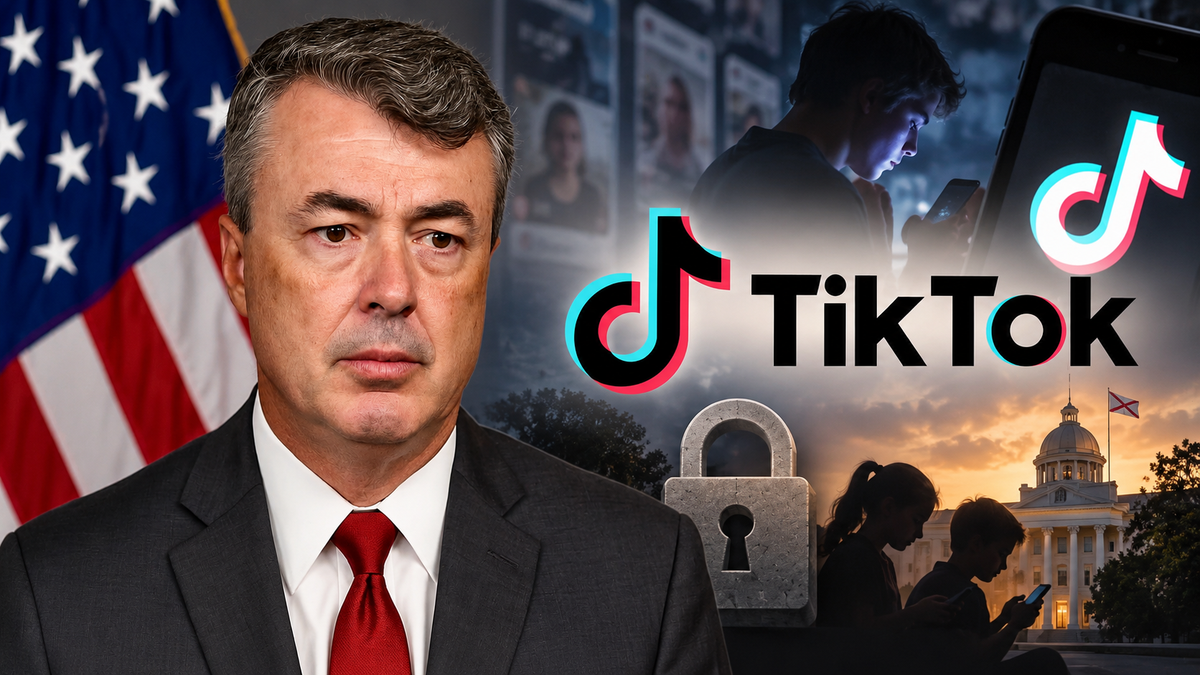
TL;DR: Alabama’s TikTok settlement guarantees a $116.2 million base payment — including $100 million for consumer restitution and remediation — and could grow to $300 million if other States reach similar deals. TikTok must impose teen time limits, overnight restrictions, stronger parental controls, age-assurance systems and other safeguards. Marshall calls the deal a major victory for child safety. Free-speech and privacy advocates warn that the broader settlement model being used against TikTok and Meta can also expand age verification, user monitoring and government-backed controls over access to lawful online speech.
Alabama Attorney General Steve Marshall announced Friday that the State has reached a sweeping settlement with TikTok that could eventually bring Alabama $300 million while forcing major changes in how the social media platform treats young users.
The agreement ends Alabama’s lawsuit against TikTok Inc. and its parent company, ByteDance, just days before a trial was set to begin Monday in Montgomery.
Marshall’s office billed the agreement as a major victory for parents and children. But a closer look at the 41-page settlement agreement shows it reaches well beyond simple parental controls. It requires age-assurance systems, more monitoring of users and changes to how TikTok delivers lawful content. Those provisions mirror parts of a recent Meta settlement that have drawn sharp criticism from free-speech and privacy advocates.
According to the Attorney General’s Office, the settlement resolves State claims that TikTok used addictive design features, exposed young people to mental-health risks and misled consumers about the safety of the platform.
“This is a great day for Alabama parents. Tonight, they can rest easier knowing real protections are in place to shield their children from the dangers of social media addiction. TikTok has agreed to give parents real control over what their kids see and how much time they spend on the app,” Marshall said.
“We’ve said from day one that our number one goal was to stand up for Alabamians when they are being harmed, and today, we did exactly that.”
However, as is often the case with these announcements, the actual numbers are a bit more complex than Marshall’s press release suggests.
According to the release, “Under the settlement, Alabama will receive a minimum of $100 million, due to the state within 45 days, with the potential to receive up to $300 million if certain conditions are met.”
The actual settlement sets a base settlement amount of $116.2 million. Of that, $14.2 million is allocated for attorneys’ fees and another $2 million for litigation expenses. The remaining $100 million is designated for consumer restitution and remediation and will be paid to the Attorney General’s Office.
The agreement then creates a separate $183.8 million contingent payment pool. Those funds become available in stages if more State Attorneys General enter similar agreements with TikTok. Ten States would trigger the first $55.14 million tier, 20 the second, 30 the third and 40 the final tier. If all four tiers vest, the total value reaches $300 million.
That structure — those “certain conditions” — gives Alabama a direct financial interest in seeing similar restrictions spread to other States.
The settlement requires TikTok to impose a two-hour daily limit for teen users, with parents able to set stricter limits. Teens will also encounter “productive pauses” after 15 minutes of continuous use and again after 60 and 90 minutes.
Access will be restricted between midnight and 6 a.m. The agreement also limits messaging and push alerts overnight and during school hours.
TikTok must provide stronger parental controls, make teen accounts private by default, restrict cosmetic filters for teens and offer a non-personalized feed. It must also limit how easily adults can find teen accounts and notify parents about some suspicious contacts between adults and young users.
A TikTok USDS Joint Venture spokesperson responded to the settlement by saying that the platform’s priority has “always been fostering a safe and positive space where people can be creative, discover what they love, and connect with their community.”
“This builds on our commitment and core objective to continually enhance our robust safety tools to protect teens,” the spokesperson said.
The stated goal of the agreement is child safety. Critics of this growing model of State litigation, however, argue that the cases also raise serious First Amendment questions.
NetChoice argued earlier this month that lawsuits against social media companies are becoming a new route for governments to regulate online speech without passing laws that must survive a direct constitutional challenge.
The group contends that restrictions on when users can access platforms, how platforms recommend content and how much content people may see inevitably affect lawful speech.
That argument has some grounding in Supreme Court precedent. In Moody v. NetChoice, the Supreme Court recognized that a social media platform’s decisions about selecting, ordering and presenting content can involve First Amendment-protected editorial judgment. NetChoice argues that States are now attacking many of those same functions by calling them defective “product design.”
The Alabama agreement illustrates the constitutional risks involved, to say nothing of the implicit abrogation of parent’s rights and responsibilities to control what their children may or may not see online.
TikTok must provide teen users with a non-personalized feed, impose time limits and change how content is displayed and recommended. Those steps may reduce risks for children, as Marshall argues. They also alter when young Alabamians can access lawful speech and how TikTok chooses which lawful speech to show them.
NetChoice has made the same criticism of the States’ litigation against Meta. In a July analysis, the group argued that States were attempting to impose liability on algorithms, feeds and recommendation systems that perform an editorial role.
The argument is not that States lack a legitimate interest in protecting children. NetChoice acknowledges those concerns. The dispute is over whether government-backed limits on access, algorithms and lawful content are a constitutional way to do it.
There is another concern buried beneath the child-safety debate: proving who is a child requires determining who is an adult.
The TikTok settlement requires expanded “age assurance.” The agreement specifically refers to methods including ID verification and face-based age assurance. TikTok must also use “best efforts” to link accounts it believes belong to the same person and proactively monitor user conduct for signs that someone may have evaded an age check.
That means a system meant to protect minors can (some would say “must’) require more scrutiny of users generally.
The settlement does contain privacy safeguards. Data gathered solely for age assurance generally must be kept only as long as needed to determine age and then queued for deletion. Data retained to improve TikTok’s system for identifying children under 13 cannot be used for advertising, marketing or algorithmic optimization. The agreement also calls for encryption and industry-standard security.
Still, privacy advocates see the broader trend as troubling.
Reclaim The Net’s analysis of the Meta settlement found that Meta’s agreement goes considerably further. It requires age assurance for all users in settling States, including existing adult accounts, and expressly contemplates ID verification and facial age estimation. Meta must also improve systems used to identify different accounts that it believes belong to the same person.
Reclaim The Net argues that such systems risk turning child-safety rules into a broad identity and surveillance structure for the social web. That is an advocacy position, but the underlying provisions are significant: age-assurance systems necessarily require platforms to make judgments about the identity or age of people seeking access to online speech.
Alabama’s TikTok agreement is not identical to Meta’s. But it moves in the same direction by requiring stronger age assurance, account matching and monitoring for efforts to evade those systems.
Ultimately, Alabama is building a broader social-media framework, and that is generating significant concerns.
Friday’s announcement comes just one month after Marshall announced Alabama’s participation in the massive settlement with Meta, the parent company of Facebook and Instagram.
As ALPolitics.com previously reported, Alabama is guaranteed more than $117 million under that agreement and could ultimately receive substantially more if certain conditions are met. Nationwide, the Meta settlement is valued at up to $17.1 billion.
There is an important connection between the deals.
Part of Meta’s payout was made contingent on rival platforms adopting similar child-safety rules, with $5 billion of Meta’s nationwide settlement being tied to TikTok, Snap and YouTube adopting the terms. Alabama’s new TikTok settlement likewise contains provisions tied to broader adoption by competing social media platforms.
In other words, what began as separate lawsuits against individual tech firms is starting to look more like a common regulatory framework negotiated through court settlements rather than enacted by Congress or State legislatures.
Marshall has also pushed Meta on other child-safety fronts. Earlier this year, Alabama joined 27 other States in urging Meta to halt an AI chatbot feature amid concerns that it could expose children to sexual content and grooming.
The State has also reached a $12.2 million child-safety settlement with Roblox, with those funds earmarked for school resource officers.
The TikTok case therefore represents something larger than another big check from Big Tech.
For Marshall, it is part of an effort to force social media companies to change products the State says are harming children. For critics such as NetChoice, Reclaim The Net and a number of privacy-aware Alabamians, the same strategy risks creating a government-backed system of age checks, account monitoring, content controls and limits on access to lawful speech.
Both sides agree that protecting children online is a real concern. The much harder question is how much privacy and control over lawful speech should be surrendered in the process — and how quickly these “for the children” settlements will give us a China-style social-credit system tied to our “verified online ID.”
The TikTok settlement agreement is attached below: