Meta Kid Addiction Deal Guarantees Alabama $117 Million
The $17.1 billion deal imposes new limits on Facebook and Instagram while giving Alabama a possible payout of nearly $179 million
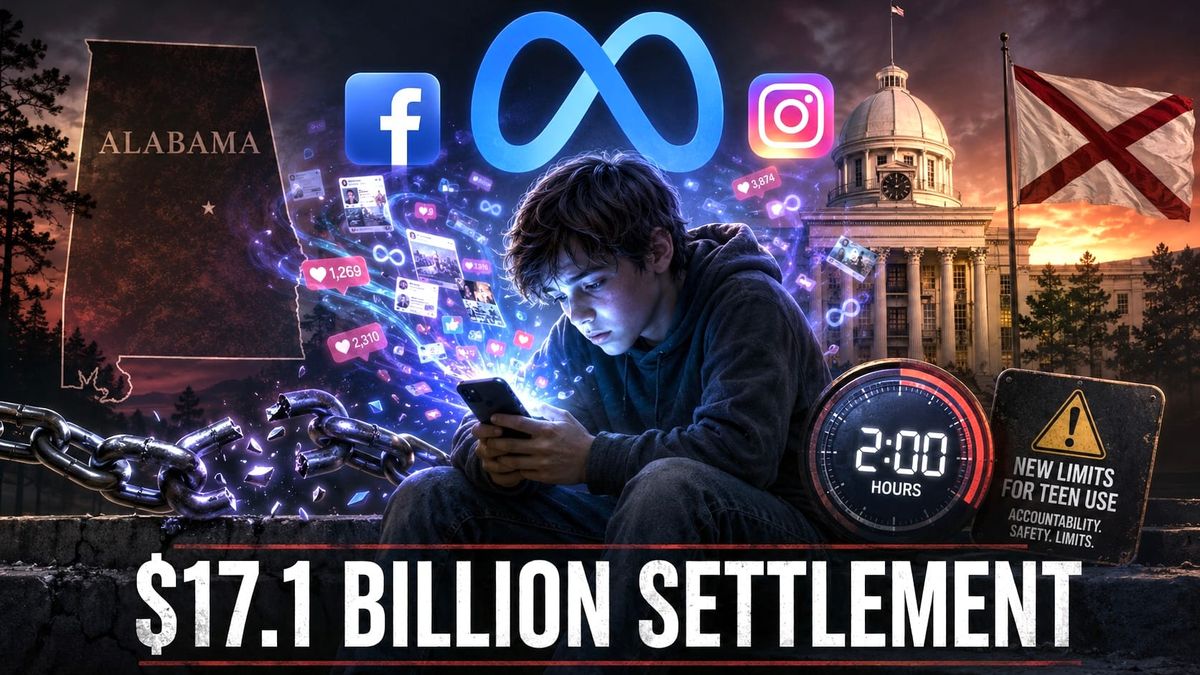
Meta, the parent company of Facebook and Instagram, has agreed to pay up to $17.1 billion and change how children use Facebook and Instagram, ending claims brought by 47 States, Washington, D.C., and three U.S. territories.
Alabama is guaranteed $117,345,409 over the next 10 years, according to Attorney General Steve Marshall’s office. The first payment is due within 30 days.
However, Alabama could ultimately collect much more.
The executed settlement agreement lists Alabama’s guaranteed annual payment as $11,734,540.91. Over 10 years, that comes to $117,345,409.10.
Alabama could also receive annual conditional payments of $5,057,609.31. If all 10 of those payments are made, the State’s share of the youth social media case would reach $167,921,502.24.
The agreement also awards Alabama $10,758,311.87 to settle separate claims tied to the Cambridge Analytica data scandal. Taken together, the State could receive as much as $178,679,814.11.
The conditional funds depend in part on whether other large platforms — including Snapchat, TikTok and YouTube — adopt similar child-safety rules. Nationwide, Meta has guaranteed about $12.7 billion. Another $5 billion is tied to those added conditions.
“This settlement sends a clear message that Alabama will hold big tech accountable when it fails to protect our children online. Meta will pay millions of dollars to Alabama and has taken a critical step toward comprehensive reforms for youth safety. We will continue to monitor Meta to ensure compliance with the terms set forth in the settlement as well as to close off any loopholes predators and other bad actors might try to exploit,” Marshall said in a statement released Wednesday.
The deal resolves claims that Meta built Instagram with features meant to keep children hooked and doom-scrolling. The States also accused the company of knowing about the harm those features could cause while misleading parents and the public about the safety of its platforms.
The litigation grew from a bipartisan probe launched in 2021. States sued Meta on their own and through a combined federal case. The claims included charges that Meta broke the federal Children’s Online Privacy Protection Act by collecting data from children under 13 without parental consent.
Meta did not admit wrongdoing in agreeing to the settlemen.
“Ensuring teens have a safe and productive experience on our platforms is an absolute imperative for Meta,” the company said. “We want to get this right for parents and teens, and that’s why we partnered with State Attorneys General to set a new industry standard.”
The settlement requires Meta to make a broad set of changes to Instagram and Facebook. They include:
- A combined two-hour daily limit for young users on Facebook and Instagram. A parent may allow more time.
- “Productive Pauses” after 15 minutes of nonstop use and again when a child reaches 60 and 90 minutes of use.
- A block on access between midnight and 6 a.m., unless a parent changes the setting.
- An end to most push alerts during school hours, from 8 a.m. until 3 p.m. on weekdays during the school year.
- Stronger checks aimed at finding users who lie about their age and removing children under 13.
- Tighter controls on content tied to bullying, eating disorders, suicide and self-harm.
- Simpler and stronger tools for parents.
- Limits on beauty filters, visible “like” counts and other features that may drive harmful social comparisons.
- Regular reviews by an independent auditor, who will have access to relevant company data, records, staff and internal messages.
The two-hour combined limit will remain in place for five years. If Snapchat, TikTok and YouTube adopt comparable terms, the limit would fall to one hour on each platform and remain in force for 10 years, according to the agreement.
The settlement does not force Meta to end targeted ads or feeds based on a user’s past conduct. Private lawsuits and cases filed by school systems and local governments may also continue.
In his statement, Attorney General Marshall thanked the Civil and Consumer Protection Divisions for their work on achieving the settlement. He emphasized that, as the matter was handled in house, one hundred percent of the settlement amount will go to the State of Alabama.
State lawmakers will now decide how Alabama spends much of the money.
Florida and New Mexico did not join the multistate deal. New Mexico won its own case against Meta earlier this year. Florida Attorney General James Uthmeier rejected the terms as too weak.
The agreement ends a federal trial that began Aug. 18 in Oakland, California. Instagram chief Adam Mosseri had begun to testify, and Meta CEO Mark Zuckerberg was expected to take the stand.
U.S. District Judge Yvonne Gonzalez Rogers approved the main settlement Wednesday. The States had been prepared to seek close to $200 billion in penalties from Meta.
The settlement agreement is attached below: