New Poll Gives Democrats 7-point Midterm Edge
Democrats lead the race for Congress, but doubts about the party’s agenda leave Republicans a path to recover before November
TL;DR: A new Quantus Insights poll gives Democrats a 6.9-point lead over Republicans on the congressional ballot, driven by women, young voters and strong disapproval of President Trump. However, voters remain wary of the Democratic Party’s socialist wing and still support parts of the Republican immigration agenda. The poll suggests Democrats are well-positioned for the midterms, but their lead reflects anger at Republicans more than broad support for the Democratic platform.
Democrats hold a clear national advantage heading into the 2026 midterm elections, according to a new poll that also points to deep voter doubts about President Donald Trump.
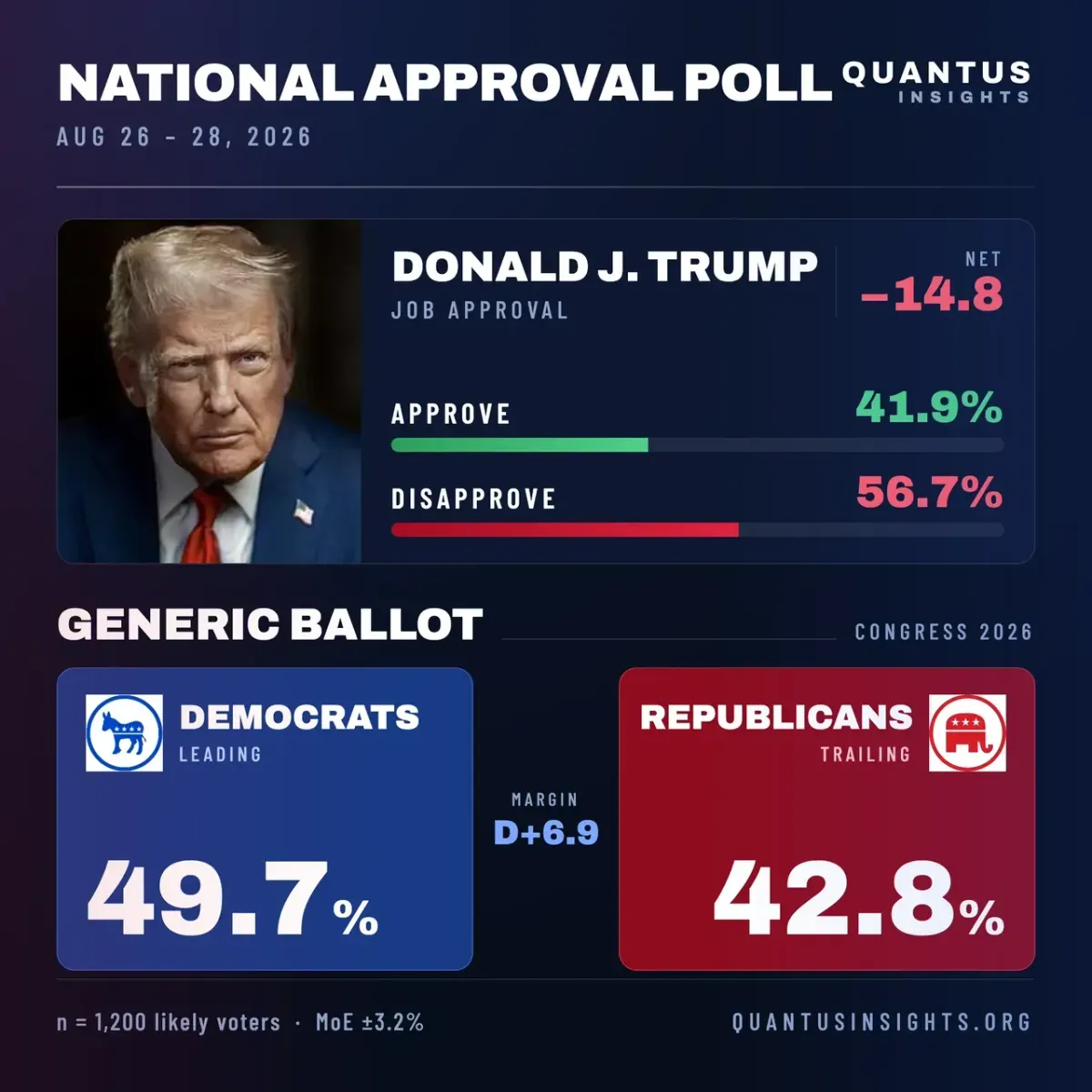
The new Quantus Insights survey found that 49.7 percent of likely voters would support the Democratic candidate for Congress. Republicans drew 42.8 percent.
That gives Democrats a 6.9-point edge with just over two months left before Election Day.
The results are not an outlier, but are consistent with other recent reports. Ballotpedia’s polling index gave Democrats an average six-point lead as of Aug. 28. Recent polls from Reuters/Ipsos, The Economist/YouGov, Emerson College, Morning Consult and other firms have also placed Democrats ahead.
The Quantus poll surveyed 1,200 likely voters nationwide. Its full findings and cross tabs are available in the firm’s technical report.
Democrats also led when voters were asked which party they would rather see control the U.S. Senate. Nearly half, 49.3 percent, chose Democrats. Another 43.4 percent picked Republicans.
The close match between the two questions adds weight to the finding. Voters were not merely reacting to the wording of one generic ballot question. They gave Democrats about the same advantage in two tests of congressional control.
The entire U.S. House and 35 Senate seats will be decided in November. Republicans now control both chambers. Losing either one would make it much harder —if not practically impossible — for Trump to pass his agenda during the final two years of his term.
Notably, the poll does not show a broad shift toward the political left.
Democrats built much of their lead among women, younger adults and urban voters. Women favored the Democratic candidate by 18.2 points. Voters under age 45 backed Democrats by more than 20 points.
Republicans remained stronger among men, older voters and rural residents. The suburbs were far more closely split.
That divide matters because congressional races are not decided by the nationwide vote. House seats are won one district at a time. Large Democratic margins in major cities can boost the national vote without changing many competitive districts.
Alabama offers a clear example of this. Despite the Democratic lead nationwide, the current Cook Political Report ratings list five Alabama districts as “Solid Republican,” the 2nd Congressional District as “Likely Republican” and the 7th District as “Solid Democratic.” This, despite a return to the previous congressional map and “do-over“ special primaries just concluded.
Party identification also shows that Democrats may be gaining support from voters who do not call themselves Democrats.
About 42.9 percent of those surveyed identified with the Democratic Party, compared with 39.5 percent who identified as Republicans. That is a 3.4-point gap — only half the Democrats’ 6.9-point lead on the congressional ballot.
In short, some voters are willing to vote Democratic this fall without adopting the party label.
Trump’s weak approval numbers appear to be a major part of that shift.
Only 41.9 percent approved of his job performance, while 56.7 percent disapproved. The intensity gap was even worse for the President. More than half of voters, 54.2 percent, said they strongly disapproved. Only 29.6 percent strongly approved.
That creates a serious turnout risk for Republicans. Voters who strongly oppose a President are often more eager to vote in a midterm election than those who offer only mild support.
Economic concerns are adding to the GOP’s problems. A separate Reuters/Ipsos poll found that voters trusted Democrats over Republicans on the cost of living, 36 percent to 28 percent. It was the largest Democratic lead on that issue since the pollster began asking the question in October 2025.
Still, the Quantus findings contain several warnings for Democrats.
When asked which party they trusted to govern well, voters gave Democrats a much smaller lead. Democrats drew 40 percent, compared with 36.6 percent for Republicans. More than one in five voters, 20.6 percent, trusted neither party.
That suggests much of the Democratic lead is driven by rejection of Republicans rather than broad faith in Democratic leaders.
Immigration offers another warning.
After the rise in Immigration and Customs Enforcement arrests in July, 43.3 percent said the increase made them feel more secure. Just 39.6 percent said it made them feel less secure. Swing voters were also more likely to view the added enforcement as a source of safety.
The finding shows that a voter can oppose Trump, favor Democratic control of Congress and still support a central part of the Republican immigration agenda.
Voters also showed concern about the rise of democratic socialist candidates within the Democratic Party. Forty-four percent said those candidates’ recent wins in Democratic primaries showed that the party was moving in the wrong direction. Only 32 percent viewed the trend as a move in the right direction.
The poll’s early questions about the 2028 presidential race told much the same story.
Former Transportation Secretary Pete Buttigieg led the Democratic field with 25.7 percent. Georgia Sen. Jon Ossoff followed at 21.3 percent, while Rep. Alexandria Ocasio-Cortez drew 15.3 percent. Nearly one in five Democratic voters remained undecided.
Republicans were more settled. Vice President J.D. Vance led with 41 percent, followed by Secretary of State Marco Rubio at 29.1 percent. Florida Gov. Ron DeSantis and Donald Trump Jr. remained in single digits.
In a hypothetical general election contest, Vance led Ocasio-Cortez 45.1 percent to 41.8 percent. That result should not be treated as a forecast more than two years before the election. It does show, however, that the Democrats’ current congressional lead may not extend to every Democratic candidate.
The survey also found rare areas of common ground, mainly involving artificial intelligence.
Eighty-eight percent said music charts and awards should be limited to works created by humans. Nearly half would bar students from using AI to complete school assignments, while 25.9 percent would allow its use only if students disclose it.
Another 72.3 percent supported a ban on American companies selling AI training data to Chinese firms.
For now, the main political finding is hard to miss. Democrats enter the final stretch of the midterm campaign with a strong national lead, fueled in large part by opposition to Trump.
But that lead is not the same as a mandate for the full Democratic agenda. Voters remain wary of the party’s socialist wing, divided over immigration and unsure that either party can govern well.
The electorate appears ready to punish Republicans, harshly. Democrats still have to prove that voters are moving toward them — and not merely away from Trump.